
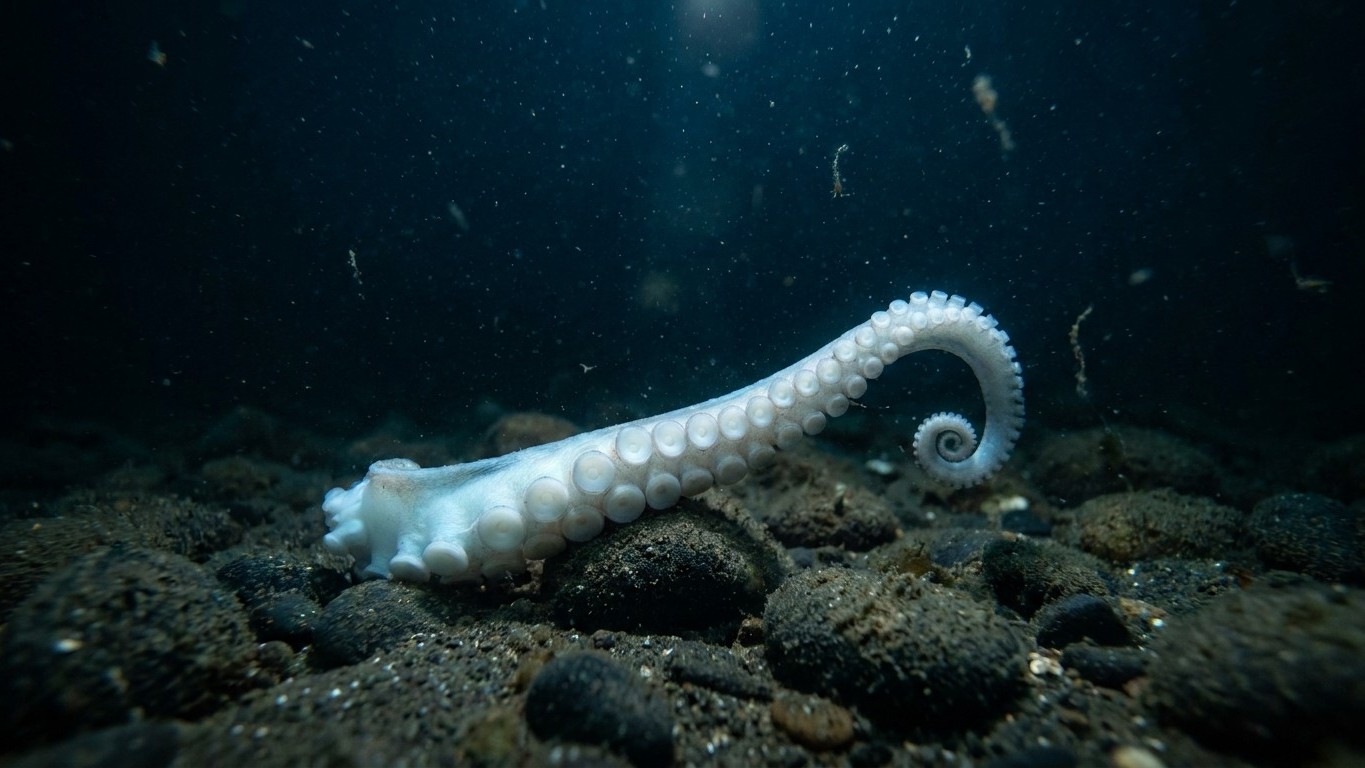
A detached octopus arm does not die immediately. It keeps moving, groping, occasionally even grasping a piece of food that happens to come within reach, even though it is no longer connected to anything. When the tentacle of an octopus is severed, this detached arm continues to function on its own for almost an hour, actively exploring its surroundings, detecting prey, and attempting to seize it. This challenges a long-held preconception: that a single brain, housed in the head, dictates every movement of the body.
Takeaways
- A detached octopus arm continues to explore its surroundings and grasp food for more than an hour
- Two-thirds of the octopus’s roughly 500 million neurons reside in its arms, not in its head
- Each suction cup functions as a mini-brain capable of processing information without consulting the central brain
A nervous system unlike anything in the animal kingdom
In humans, the hierarchy is clear: the brain decides, the limbs execute. In the octopus, that logic collapses. The octopus possesses about 500 million neurons, and only about a third of these neurons reside in the central brain, the remaining two-thirds distributed across its eight arms, roughly 40 million neurons per tentacle. This distribution is far from incidental: it turns each arm into a nearly autonomous computing unit.
Researchers at the University of Chicago have taken a closer look at the question. Their work confirms that a substantial portion of the animal’s computational power lies in its arms rather than in its head, with a segmented nervous system within each tentacle acting as a network of mini control centers. The study, published in Nature Communications under the leadership of neurobiologist Cassady Olsen, describes a nerve cord running the full length of the arm, with a node at the level of each suction cup. The octopus’s neurons are concentrated along an axial nerve cord that undulates the length of each arm, with nodes centered around each suction cup. Dozens of small relays capable of processing information without ever climbing up to the brain.
This organization changes the game for hunting and manipulating objects. About two-thirds of the neurons are concentrated in the eight arms and their suction cups, allowing each arm to explore and manipulate almost on its own while the central brain handles more global decisions, such as fleeing or attacking. An octopus can therefore, in theory, have one arm hunt while another pushes back an intruder, without ever mobilizing its head to arbitrate the two tasks.
What really happens when an arm is severed?
That is where the experiment becomes puzzling. American researchers severed tentacles to study how the suction cups function, isolated from any central control. After severing one arm, the amputated limb and its suction cups remain active for more than an hour. Other older protocols push the observation even further: touching the suction cups triggered a grasp reflex up to three hours after arm amputation, proving that the control of the suction cups was localized within the suction cups themselves and their respective ganglia.
The most striking aspect is that this post-mortem behavior is not merely a mechanical spasm. In one experiment, researchers severed the tentacles of euthanized octopuses, cooled them in water for an hour, and still obtained a response in a fraction of a second when probing the severed limbs. Even more: other studies have shown that, when presented with a piece of food, a severed limb grasps it and attempts to move it toward a phantom mouth. The arm “believes” it still belongs to a whole animal.
This reaction would be tied to very particular cells. These post-mortem responses could be triggered by nociceptors, neurons dedicated to detecting physical danger, which constitutes one of the first proofs that octopuses possess such neurons. In humans, a similar reflex exists (pulling your hand away from a hot surface), but it dies out permanently at death. In the octopus, it persists, isolated, nearly autonomous, for tens of minutes.
Each suction cup, far from being a mere adhesion organ, functions as a fully independent sensor. Each octopus tentacle hosts about 40 million chemical receptors, making it a true sensory organ capable of tasting and sensing the environment, essential for hunting and exploration. Work conducted at Harvard has even identified a family of sensors previously unknown in the outermost layer of cells of the suction cups, specialized to detect molecules that dissolve poorly in water. So the arm does not simply move: it literally keeps tasting the world, even without a head to enjoy it.
Three hearts, blue blood: a tailor-made anatomy
This decentralized nervous system is only one piece of the puzzle. The octopus accumulates anatomical peculiarities that set it among the ocean’s most singular animals. It has three hearts: two propel blood to the gills, a third irrigates the rest of the body. Its blood, moreover, is not red but blue, a hue due to hemocyanin, a copper-based protein that carries oxygen instead of hemoglobin (more efficient in cold, oxygen-poor waters). Add to that the fact that most of its neurons are housed in the arms rather than in the head, and you obtain an animal whose entire physiology seems designed in reverse to our own.
This distributed neural architecture intrigues both biologists and engineers. This discovery by researchers from the University of Chicago helps explain the unusual way cephalopods move through their environment, and could even inspire the design of future soft robots—systems that may have evolved specifically in soft-bodied cephalopods equipped with suction cups to perform undulating movements. Robotics teams are already drawing on this to design mechanical arms capable of processing information locally, without relying on a central processor that becomes overloaded.
One question still divides researchers: is this autonomous behavior simply a reflex mechanism, or a form of more elaborate processing, almost decision-making? The idea is not that the arm “thinks” like a separate animal, but that it contains enough local circuits to turn a sensation into action without the central brain micro-managing every movement. A significant nuance, which does not stop scientists from acknowledging that they are looking at one of the most perplexing nervous systems ever observed in the animal kingdom, with this eight-armed mollusk and nine “brains.”
Source: lemondededemain.fr
