
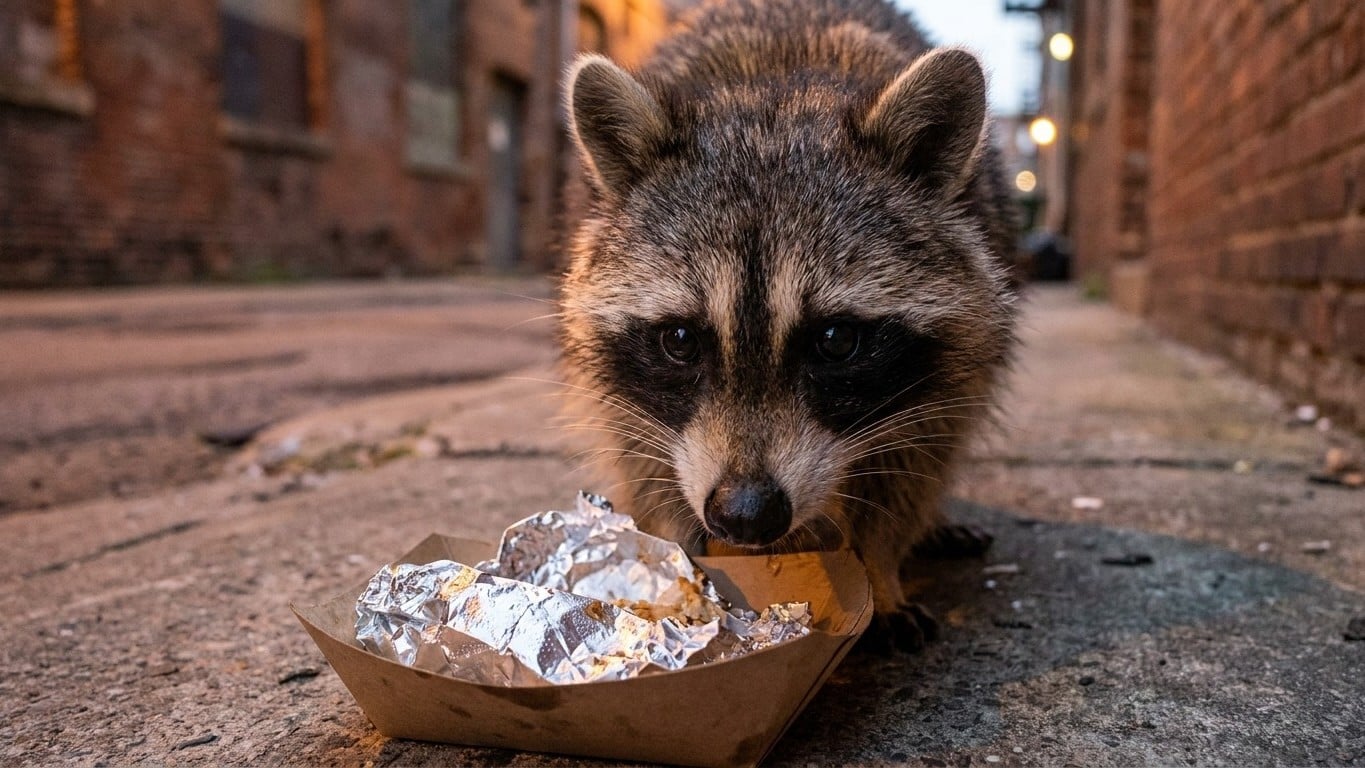
3.56 percent. That is the gap measured between the length of urban raccoons’ snouts and that of their rural American kin. A seemingly tiny figure, yet enough for biologists to suggest that these dumpster-dwelling creatures may well be undergoing the first steps of domestication right before our eyes, without anyone having plotted it.
The study originates from the University of Arkansas in Little Rock, where researcher Raffaela Lesch led a project published in late 2025 in Frontiers in Zoology. It stands out for the unusual fact that sixteen students are listed as co-authors, a notable achievement for researchers at such an early stage. To conduct the inquiry, the team did not capture a single animal. Instead, they mined the archives of iNaturalist, the citizen science platform where any passerby can post a photo of a raccoon or other wildlife spotted at a street corner. Lesch and sixteen undergraduate and graduate students aggregated nearly 20,000 raccoon photographs from across the contiguous United States. It was a monumental, collectively shared effort, with each student analyzing between 1,000 and 1,200 images before the findings were shared and discussed together.
Key takeaways
- Urban raccoons exhibit physical traits associated with domesticated species
- No human selects them deliberately: urban environments drive natural selection
- The process may have begun just a few generations ago, prompting questions about their future
A muzzle that tightens, signature of a well-known mechanism
The final finding can be summarized in one sentence: urban raccoons showed a roughly 3.56% reduction in snout length compared with their rural counterparts. This anatomical detail is not incidental in the eyes of the researchers. It bears a name, the “domestication syndrome,” a collection of traits that consistently reappear in species tamed by humans: a shortened face, drooping ears, depigmentation, and a suite of features that recur in nearly all domesticated species. Charles Darwin himself had already noticed this pattern more than two centuries ago when comparing dogs and wild cats to their domesticated versions, noting that domesticated animals tended to have smaller snouts, smaller heads, and ears that hang down.
The most robust current biological explanation points toward a relatively hidden player in embryogenesis: the neural crest. This group of cells appears very early in development and migrates throughout the body to shape, among other things, the cartilage of the snout and pigmentation. Biologists hypothesize that mutations that slow the proliferation of these cells could result in a shorter muzzle, diminished cartilage in the ears, loss of pigmentation, and a dampened fear response, thereby offering higher chances of survival near humans. It is not the snout itself that is selected, but the docility, with the short muzzle being merely a genetic side effect of the same mutation.
A selection that plays out at the garbage bin
The concrete mechanism is almost elementary. In cities, no human deliberately chooses which raccoon will reproduce. It is the dumpsters that do the sorting. Individuals that are bolder and less aggressive toward people gain easier access to food scraps, survive more readily, reproduce more, and pass these traits of docility on to their offspring. Pasquale Nardone, who followed the case for RTBF, sums up the logic captured by the authors: raccoons living closer to humans have seen their muzzles become about 4% shorter than those inhabiting rural environments. One generation after another, without training, cages, or intent.
The phenomenon is not a gentle urban fable. Nobody fondles these animals, and no one selects them for docility as has been done with wolves that became dogs. The process unfolds in free rein, driven solely by the pressures of the urban environment. In the city, the habitat is radically different for wildlife: nearly there are no large predators, and food is abundant and easily accessible, which radically alters the rules of natural selection compared with the forest.
Domestication in progress or simple local adaptation?
Not all scientific voices share unquestioning optimism. Some critics point out a structural bias in the dataset: iNaturalist users photograph animals that are easy to spot, near houses, parking lots, or campsites, which artificially inflates the urban sample relative to rural populations. The authors themselves anticipated this objection. A fact-check published by Snopes notes that muzzle length is not exclusively tied to geography; climate temperature also correlates with it, meaning that some of the observed differences could be exaggerated by climate or other variables. Raffaela Lesch herself remains cautious about the magnitude of the phenomenon, telling CNN that it isn’t enormous, but if one assumes that these animals are only at the very dawn of a domestication process, the signal remains fairly clear.
The researcher does not plan to stop there. Her team intends to 3D-scan the university’s collection of raccoon skulls to verify whether genetic and hormonal data corroborate what the photographs suggest. Their next field of study will involve other discreet urban residents, with opossums and armadillos leading the way, to check whether a similar pattern repeats. In the meantime, Lesch has not hidden a touch of humor about the hypothesis she defends: it would be both ironic and amusing if our next domesticated species were the raccoon. A reminder that, once upon a time, the dog was nothing more than a somewhat less wary wolf lingering a bit too close to human campsites.
Sources: presse-citron.net | lanature.ca
