
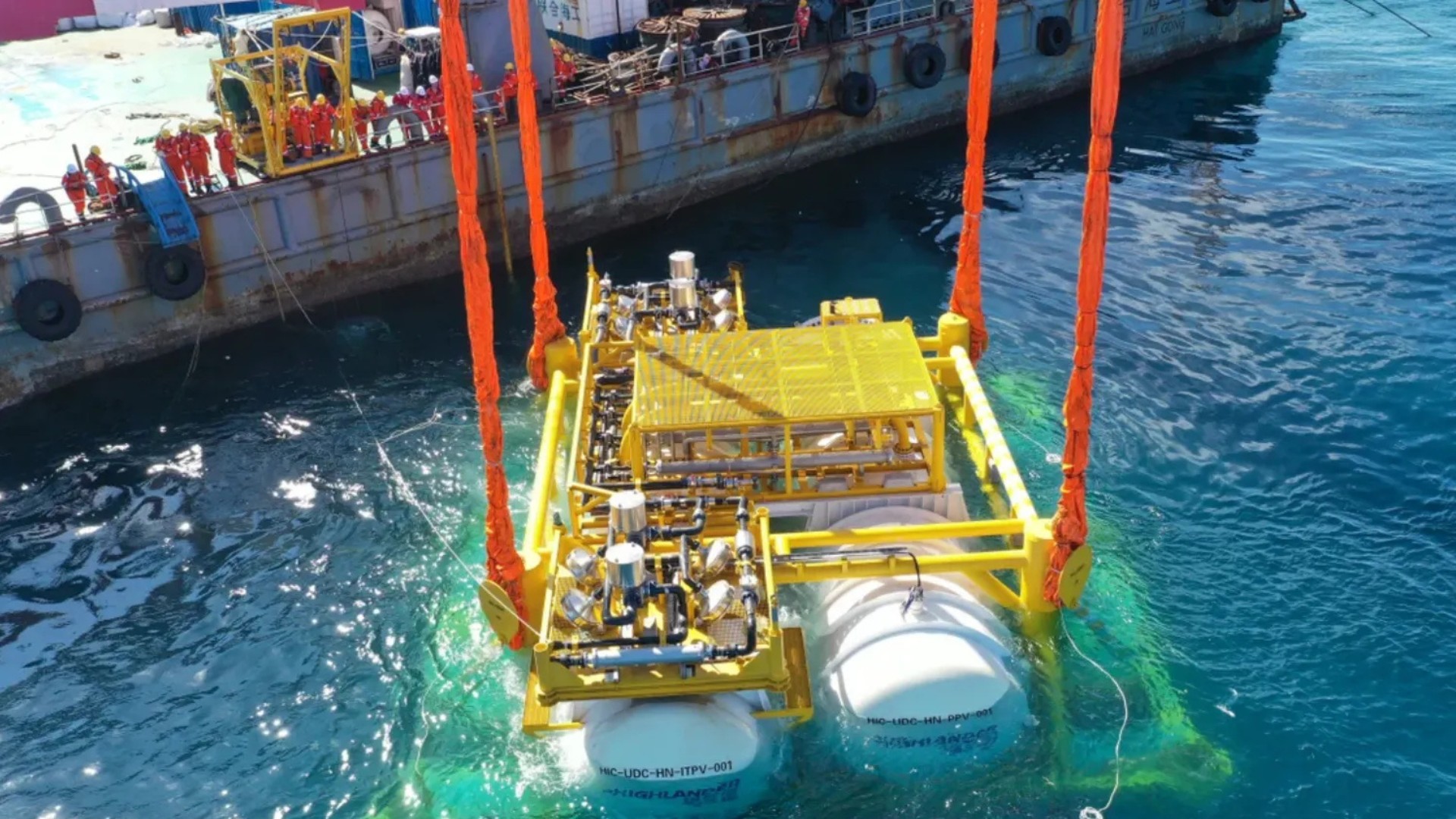
Two thousand servers laid on the sea floor, powered by turbines turning just above them: no longer a laboratory prototype, this is a fully operational commercial installation since mid-May 2026 off the coast of Shanghai. In May 2026, near Shanghai, China officially unveiled the world’s first commercial underwater data center directly powered by an offshore wind farm. The energy dilemma that weighs on every new terrestrial data center is solved here: seawater does the cooling, for free and continuously.
Key takeaways
- Why did Microsoft abandon its groundbreaking underwater data center project after spectacular results?
- How could seawater save 50 billion kilowatt-hours of electricity per year in France if this technology becomes widespread?
- What ecological mysteries lie beneath the immersed modules, and what will be the long-term cost to marine ecosystems?
A data center submerged in the Lingang Free Trade Zone
The facility sits a few kilometers offshore, in Shanghai’s Lingang Special Economic Zone. Developed by HiCloud Technology in partnership with China Communications Construction, the site houses nearly 2,000 servers for a capacity of 24 megawatts. The project moved quickly: a June 2025 agreement with zone authorities, completion of construction in October, testing in February, and full commercial operation by the end of May 2026. The total bill for the operation came to 1.6 billion yuan, roughly 200 million euros.
Below the surface, the modules resemble stacked watertight containers. This 24-megawatt complex hosts 192 racks containing about 2,000 servers, including graphics chips supplied by China Telecom to train AI models. The cooling principle is simple: seawater acts as a giant radiator. In contrast to conventional land-based facilities that rely heavily on industrial chillers and HVAC systems, the Shanghai underwater data center uses seawater from the surrounding area as a passive cooling mechanism. A HiCloud engineer described a closed loop where “the back-end air handlers absorb the hot air generated by the servers,” causing the fluid to “boil into a liquid upon contact with seawater,” and then “gravity returns it to the server room, forming a heat-exchange system that requires no electricity.”
The wind doing all the work, or almost
The real stroke of genius is the direct connection to a wind farm. Directly wiring to a large offshore wind array—more than fifty turbines encircling the site—provides a substantial share of its power. Practically, the project relies on more than 95% green electricity, achieving a 22.8% efficiency gain compared with comparable traditional infrastructures. The offshore power feeds the submerged servers directly nearby, without traversing long cable runs or competing with the electricity needs of a metropolis housing tens of millions of people.
The metric that every data-center operator watches like a hawk is the PUE, or Power Usage Effectiveness, which measures how much electricity goes to computing versus cooling and supporting systems. The underwater installation reports a PUE below 1.15, versus an industry average around 1.5; a lower PUE means a greater share of electricity is dedicated to computation rather than auxiliary systems such as cooling. A scholar from Tsinghua University even projects nationally: “If data centers of this scale were placed underwater across the country, even allowing for margins, cooling-related electricity use could drop to around 30 billion kilowatt-hours, enabling savings of about 50 billion kWh per year.” To put it in perspective, cooling can account for up to half of a traditional data center’s total electricity use. Underwater, HiCloud claims to bring that share down to under 10% of total consumption.
Microsoft had opened the path, China industrializes
The idea did not originate in Shanghai. In the summer of 2018, Microsoft submerged a white cylinder containing 855 servers off the Orkney Islands, Scotland. The Natick experiment ran for two years without any human intervention before surfacing, encrusted with algae and barnacles but still operational, with an almost remarkable performance: eight times fewer failures than a comparable land-based installation. The logic was simple: underwater, there is no free oxygen to corrode components, no dust, and no humidity fluctuations that fatigue electronics. Yet Microsoft shut the program in 2024, without a clear explanation. China, by contrast, did not hesitate: HiCloud had already submerged modules off Hainan in 2021, then opened a first commercial underwater data center in 2023, allowing them to refine their techniques before expanding to scale in Shanghai.
What Microsoft tested, Beijing turned into an industrial sector. The ambition does not stop at Lingang: the goal has grown to 500 megawatts. Looking further ahead, by 2030 Beijing plans to deploy around a hundred modules off Hainan. The context underscores the stakes: a United Nations University report published in early June 2026 noted that global data centers consumed 448 terawatt-hours of electricity in 2025; if they formed a country, they would be the eleventh-largest consumer, just behind France.
Questions that remain at the bottom of the water
However, sinking servers does not erase all problems; it merely shifts some to new locations. The heat discharged by the modules does not vanish; it diffuses into the surrounding marine ecosystem. When seawater cools the servers, it carries residual heat into nearby waters, and studies on the thermal discharges of power plants show that such releases can alter oxygen levels and pH as well as sediment composition, potentially reducing local biodiversity. On the Hainan pilot site, HiCloud asserts that water temperature around the installation has risen by less than one degree Celsius, and schools of fish even gather around the modules to shield themselves from currents. Maintenance remains another question: replacing a faulty circuit board at depths of 10 to 35 meters is not the same as an intervention in a standard server room, and operators must contend with saline corrosion and constant pressure on seals for perhaps 25 years of operation. A technical and ecological gamble about which no one truly knows the long-term cost, both on the seabed and on the electricity bill.
Sources: tomshardware.com | media24.fr
