
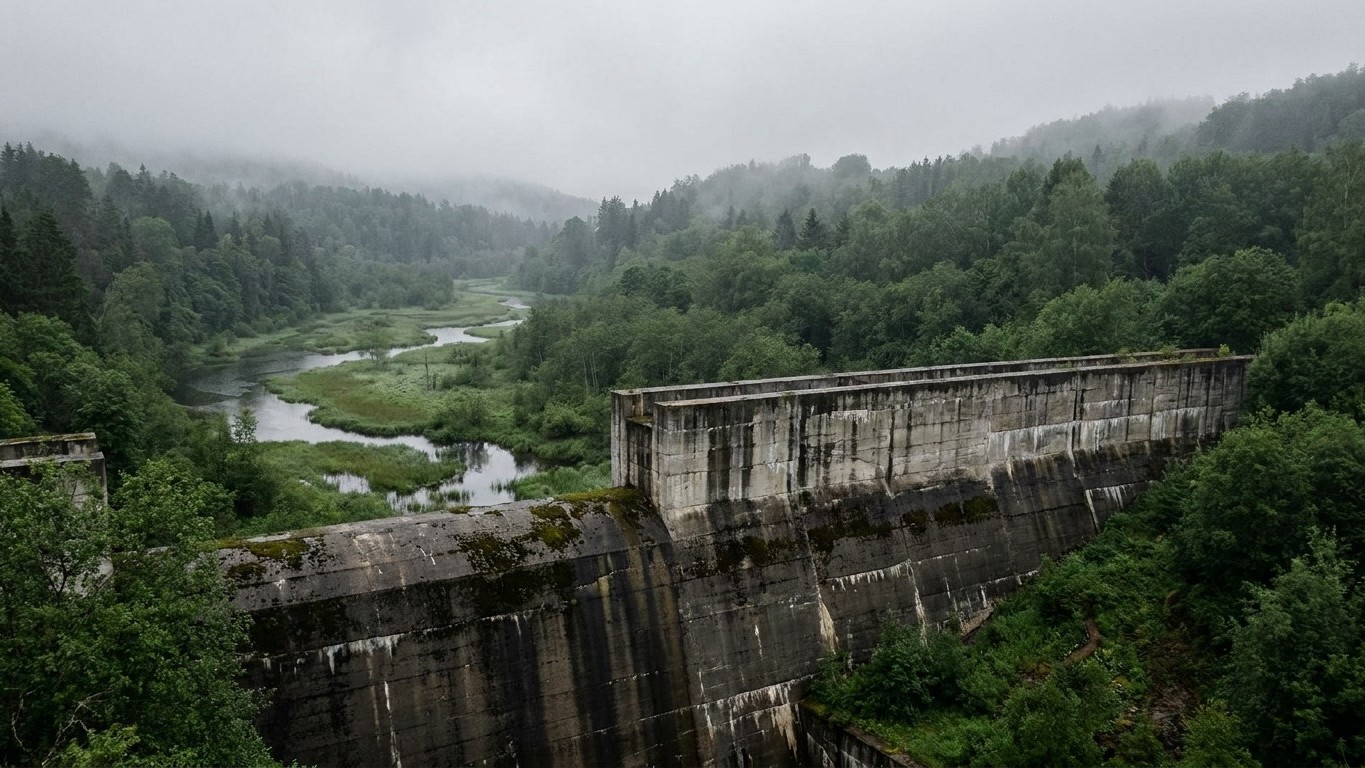
Three hectares of forest laid waste, a dam wall half finished, a drained wetland: this is what remained of the Sivens dam project when the judiciary finally spoke. The Toulouse Administrative Court annulled the authorisations that allowed the construction to proceed, effectively forcing the Tarn department to demolish what had been built and to restore the site at the community’s expense. A project meant to secure irrigation for about twenty farms ended up a financial sinkhole and a national symbol of failed regional planning.
Key takeaways
- An administrative court retroactively cancels the legal basis for the dam project
- The experts themselves deemed the project oversized and disproportionate to actual needs
- Demolition and restoration will cost more than if the project had been abandoned at the outset
A project launched despite all warning signs
The plan concerned building a dam-reservoir on the Tescou, a small tributary of the Tarn, near the hamlet known as Testet. This project would have created a dammed lake, forming a water reserve of 1.5 million cubic meters usable primarily for irrigation of farmland and for regulating the Tescou’s low-water period. On paper, the installation was to benefit around thirty farmers who grew maize. In practice, the state-appointed experts themselves doubted the project’s relevance.
The expert report commissioned after construction began did not mince words. The experts judged the project to be oversized, stated that the environmental impact assessment was of “very average quality,” and deplored that the choice of a dam across the valley had been chosen “without a real analysis of potential alternative solutions.” And the financial calculations already raised questions: “This is all the more regrettable since the investment cost (8.4 million euros excluding tax, editor’s note) related to the volume stored is high,” the two engineers noted, who also estimated that 40 operators would benefit from the dam, while the General Council announced the figure would be double that number.
The ecological consequences did not take long to appear. From the outset, deforestation on a site spanning 34 hectares triggered actions by opponents attempting to prevent the destruction of a 13-hectare wetland. A losing battle: the soil stripping already doomed the wetland, which sheltered several dozen protected species. A member of the anti-dam group summed up the situation with a striking line: “It is destroyed by 90% … It will never revert to its original state.”
The court decides: everything was illegal
It took until July 2016 for the axe to fall. The Toulouse Administrative Court annulled three foundational ordinances of Sivens’ initial dam project—a significant legal victory that challenged the project’s core utility. Three decisions, three blows to the same file: the court voided the declaration of public utility (DUP), the clearance for deforestation, and the exemption under the species protection law, while Sivens’ wetland harbored hundreds of protected species.
The public rapporteur did not mince words on the operation’s assessment. He had deemed there to be “a negative balance given the excessiveness of the dam relative to needs, the environmental damage, and the cost.” On the protection of species, the sanction was equally clear: “the project does not meet imperative reasons of major public interest given its dimensions and inadequate compensation measures.” A detail that mattered for what followed: the judges chose outright annulment of the three ordinances, not mere revocation, a legal nuance that retroactively erases any legal basis for the project, both for the existing structure and for any attempt to resurrect it at the same site.
The big loser of this ruling: the Tarn department, the project’s prime contractor. The department found itself without any legal basis to plan a project at Sivens, while a redesigned and relocated dam would require a new declaration of public utility and a new public inquiry. In short, it would have to start from scratch after already pouring millions into works that, overnight, had become illegal in perpetuity.
Demolish, compensate, restore: the department’s double punishment
Such an annulment is never just a legal formality. It carries a concrete obligation: return the site to its original state, i.e., demolish what was built without rights and restore the destroyed wetland. A later judgment of the Toulouse Administrative Court reminded the State to “prescribe the measures for the remaking of the Sivens site” and to apply the policing measures related to deforestation operations.
Financing-wise, the tally was painful for the departmental budget. Beyond the 8.4 million euros already invested in a structure that was never filled with water, a settlement protocol arranged the resolution of the dispute: a transactional agreement provided for a 3.4 million euro compensation from the State to the Department for abandoning the project, i.e., 2.1 million for pure loss and 1.3 million to rehabilitate the wetland. Demolition and restoration work eventually began, more than a year and a half late: on August 21, 2017, the site’s rehabilitation work started with the objective of restoring the site to its pre-construction state, notably by replacing the displaced soil.
Strangely, this delay was not deemed culpable by the courts, unlike other breaches by the State in this file. One judgment noted that while the State, even within a transactional settlement with the Tarn department, had taken time to address compensatory measures following the wetland destruction, such a delay was not blameworthy in the eyes of the administrative judge. In contrast, for the deforestation undertaken before any lawful authorization, the judicial bill was higher: the State was ordered to pay 10,000 euros to each of the two applicant associations.
The case also claimed a human life: Rémi Fraisse, a 21-year-old naturalist, died during protests in the autumn of 2014, a tragedy that hastened the abandonment of the initial project and intensified political awareness about the true scale of local agricultural needs. Even today, the Tescou valley is cited in debates about water retention and mega-dams, proof that a poorly planned project can cost far more to demolish than never having been built.
Sources: fne.asso.fr | cpepesc.org
