
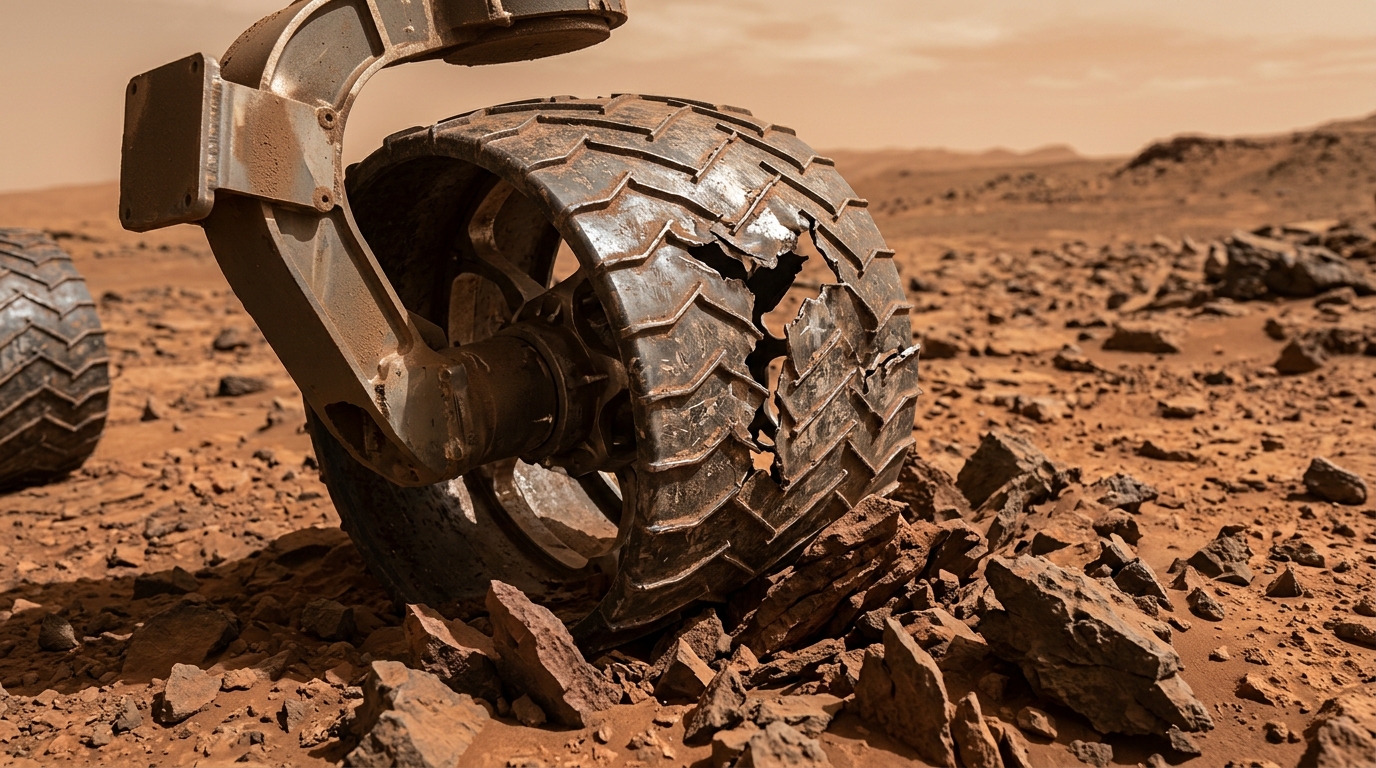
Imagine a pair of boots meant to endure years of rugged hiking, only to be found with holes after just a few months of use. That’s somewhat akin to what happened with Curiosity, NASA’s rover that has been on the Martian surface for more than a decade. Its six wheels, engineered by seasoned hands to tackle the harshest landscapes of the red planet, proved far more fragile than anticipated. In the first year of the mission, perforations appeared, forcing the team to scramble and rethink the plan. How could a device so sophisticated, capable of spanning millions of kilometers through the vacuum of space, get snagged by mere rocks? A look back at a technical mishap that nearly jeopardized one of the most iconic Mars exploration missions.
- Curiosity’s wheels, crafted from aluminum only 0.75 mm thick to balance lightness with strength, perforated in the first year due to Martian rocks that had been underestimated during Earth-based tests.
- NASA had to rethink its driving strategy by slowing the rover down and recalculating routes to avoid dangerous rock formations flagged by satellite imagery.
- This experience informed the wheel design of Perseverance, while Curiosity continued its mission despite the damage to its wheels.
- Aluminium too thin for terrain too hard
- When engineers realize the magnitude of the damage
- Driving differently to survive longer
- What this setback changed for Martian exploration
Aluminium too thin for terrain too hard
On paper, every detail seemed calculated to the millimeter. The wheels of Curiosity were built from a special aluminum, a mere 0.75 millimeters thick, intended to fuse lightness with durability. A sensible choice given that every gram counts for a space launch, and the rover needed to carry a full scientific laboratory on its back. Engineers opted for a lattice design, a kind of open pattern meant to provide solid traction while keeping the overall weight down.
The problem, however, is that Mars does not offer the courtesy of a well-marked trail. The Martian ground, especially in regions Curiosity traversed, is speckled with sharp rocks and highly abrasive formations. These obstacles, far from being harmless grains of sand, act like true blades under the weight of a vehicle nearing a ton. Earth-based tests conducted before launch hadn’t fully anticipated the hardness of some Martian terrains, particularly those riddled with pointed rocks capable of literally slicing the metal with every pass.
When engineers realize the magnitude of the damage
It was by analyzing the images sent back by the onboard cameras that NASA teams began to gauge the full extent of the problem. The first cracks and perforations appeared much earlier than expected, even though the rover had covered only a fraction of its planned travel. Photos showed gaping holes, tears in the metal, and a lattice pattern that was starting to unravel in places.
An air of worry settled over the technical teams. If the wheels deteriorated too quickly, the entire mission could be at risk. Curiosity isn’t a gadget you can repair in the field: once on Mars, there’s no human intervention possible. Every decision had to be made remotely, with an almost zero margin for error. Analyses soon confirmed that the damage originated directly from the sharp rocks encountered along the route, rather than a manufacturing defect. A finding that was at once reassuring and troubling: reassuring because it validated the initial design, troubling because it revealed an environmental factor that could not be fully anticipated from Earth.
Driving differently to survive longer
In response to this situation, NASA had no choice but to rethink the rover’s operation from the ground up. The goal was no longer to rush to scientifically interesting locations, but to preserve the mechanical integrity of the craft over the long term. Engineers therefore slowed the rover’s pace considerably, avoiding as much as possible the zones where the most dangerous rocks had been identified in advance through satellite imagery.
The routes were recalculated with surgical precision, favoring sandier terrains or open spaces, even if that meant taking much longer to reach certain destinations. This heightened caution demanded far more meticulous planning for each leg of the journey, with teams now tasked not only with the scientific value of a site but also with the potential risk to the wheels. A true transformation in the rover’s operating philosophy, which had to learn to move forward with much more restraint than originally anticipated.
What this setback changed for Martian exploration
This misadventure, as stressful as it was for NASA’s teams, ultimately became a valuable lesson for the entire space exploration program. The data gathered about Curiosity’s wheel wear directly influenced the design of subsequent rovers, notably Perseverance, whose wheels benefited from a revised design and reinforced material to better withstand rugged terrains.
Beyond the purely technical aspects, this episode perfectly illustrates the enormous challenges of exploring a world as unfamiliar as Mars. Despite years of preparation, simulations, and rigorous testing, the reality of the Martian landscape surprised even NASA’s top experts. This real-time adaptation, millions of kilometers from home, demonstrates the innovative spirit and responsiveness of the scientific teams when faced with the unexpected. Even with damaged wheels, Curiosity continues its journey on Mars, proof that a major mechanical setback does not prevent the pursuit of an exceptional scientific mission.
Ultimately, the tale of punctured wheels reminds us of a fundamental truth: conquering another planet is not merely about sending a sophisticated machine into space, but about learning—sometimes through hardship—from realities that even the brightest minds could not fully foresee. As new Martian missions are in the works, one question remains: what other surprises might the Red Planet hold in store for us?
