
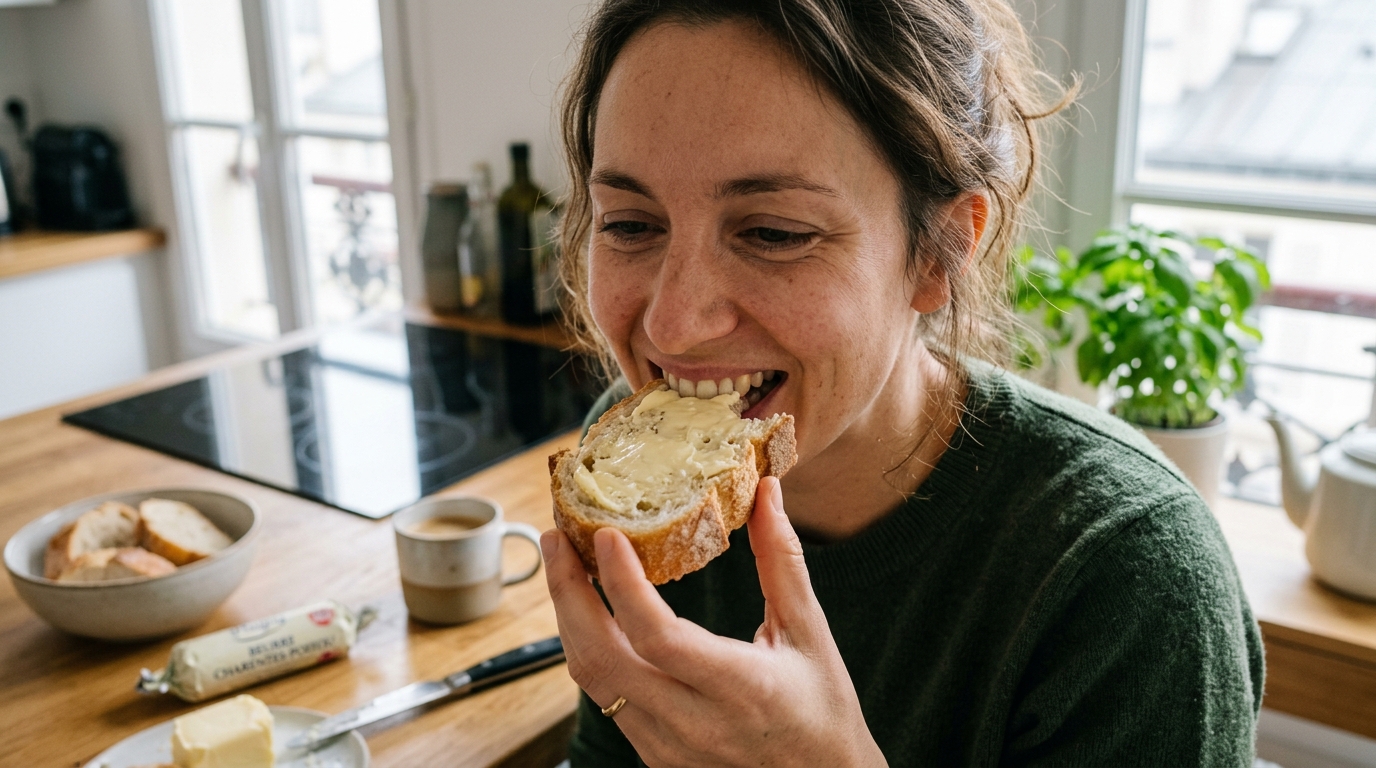
For a long time, two concepts that are actually quite distinct have been treated as one: the quantity of fat consumed and its nature. As long as you didn’t drown your toast in a slab of butter, you believed you were safe. A few grams here, a scoop for the pan there, nothing particularly alarming. Yet after tracking tens of thousands of people across decades, researchers noticed a detail that completely alters the picture. It’s not so much the act of spreading that matters, but what you choose to spread. And when some of these people replaced, without changing their habits, a simple spoonful of butter with olive oil, something began to shift in the health statistics. A small change that could give a new meaning to breakfast.
- Replacing about 10 g of butter per day with olive oil is associated with a 15 to 19 % lower risk of death from cardiovascular disease and cancer, according to a study of 90,000 people followed for 28 years.
- A second study from 2025, conducted on more than 221,000 adults for up to 33 years, confirms a mortality reduction of roughly 17 % by substituting butter with vegetable oils.
- This difference stems from the nature of fats: butter contains saturated fats harmful to the arteries, while olive oil provides unsaturated fats beneficial to the cardiovascular system.
- Thirty years of data that don’t lie
- The figure that changes everything: 15–19 % lower risk
- Why olive oil does better than butter for our arteries
Thirty years of data that don’t lie
Tracking 90,000 people for three decades isn’t the result of a casual poll conducted in a hurry at the doorway. It’s the kind of meticulous work that reveals enduring trends far from dietary fads. The two large American cohorts, made up of adults free of cardiovascular disease or cancer at the start, were observed for about twenty-eight years. That duration allowed time to see who, among heavy butter users and olive-oil enthusiasts, fared better in the long run. And the results did not stay isolated: another cohort study published in 2025 followed more than 221,000 adults for up to thirty-three years, with conclusions that align with the previous findings. In other words, this is not a random statistical fluke.
The figure that changes everything: 15–19 % lower risk
Here is the heart of the matter. Replacing about 10 grams per day of butter, margarine, mayonnaise, or dairy fats with an equivalent amount of olive oil is associated with a lower mortality risk. Concretely, higher olive-oil intake was linked to a mortality risk from cardiovascular disease reduced by 19 %, and by 17 % for cancer mortality. The same applies to the 2025 study: the simple daily, modest substitution of butter with vegetable oils was associated with a mortality reduction of around 17 %. And good news for those who aren’t heavy users of olive oil: you don’t need to go through liters of it—consuming at least a half a tablespoon per day would already show a drop in cardiovascular risk. A small gesture, a big shift in the statistics.
Why olive oil does better than butter for our arteries
The answer lies in one word: the nature of fats. Butter is rich in saturated fats, those that tend to raise the bad cholesterol and gradually clog the arteries. Olive oil, by contrast, is mainly composed of unsaturated fats, gentler on the cardiovascular system. It’s not the quantity of fat consumed that makes the difference, but its chemical composition. A reminder echoing the famed Mediterranean diet, of which olive oil is a cornerstone, which had already shown, in a widely cited trial, roughly 30 % fewer major cardiovascular events among those who adopted it. That study has undergone some editorial twists over the years, but the overall trend favoring unsaturated fats remains broadly supported by newer work.
So, concretely, what does this change look like in the kitchen? There’s no need to ban butter outright, nor to feel guilty with every Sunday croissant. The idea, subtler, is to make targeted, durable substitutions rather than a total diet overhaul:
- Replace part of the cooking butter with olive oil, especially for sautéed dishes and stews
- Favor olive oil for dressings and morning spreads
- Keep butter for uses where it is indispensable, in measured amounts, such as certain pastries
In plain terms, this isn’t about reinventing your everyday cooking overnight, but about gradually adjusting the proportions. A splash of olive oil in place of a knob of butter here and there is already a first step toward arteries that may thank you later. The question remains whether butter, so deeply rooted in French habits, will concede a bit of ground without much resistance.
