
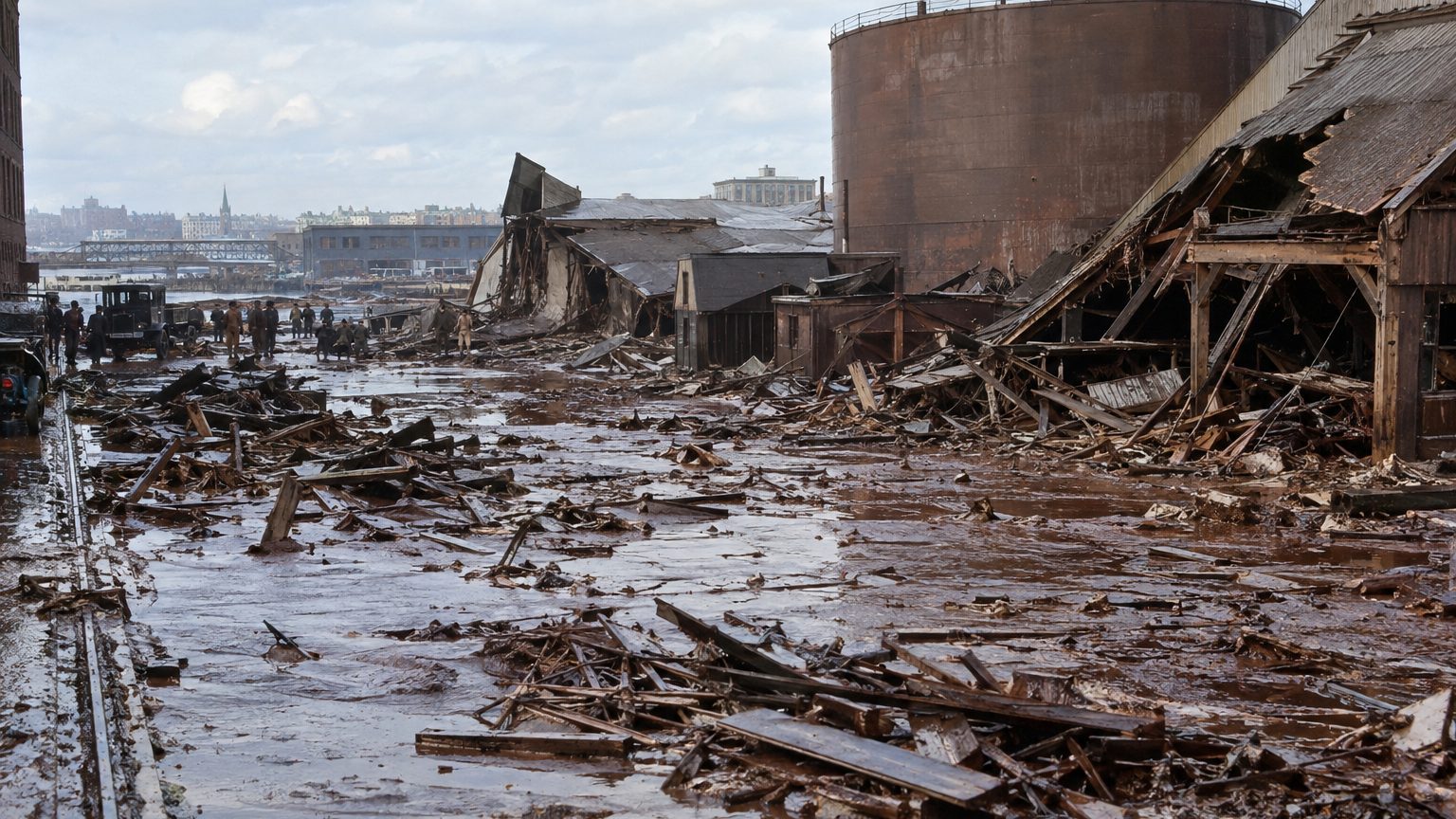
On January 15, 1919, shortly after noon, a 15-meter-tall tank ruptured on Commercial Street in Boston’s North End. It held up to 2.3 million US gallons, about 8,700 cubic meters of molasses, enough to fill more than three Olympic pools. The toll: 21 dead and 150 injured.
A tank that workers had warned about for months.
- A seven-meter-high wave of molasses surged down Commercial Street at about 55 km/h after the tank ruptured.
- The tank’s steel was 50% too thin, and the absence of manganese made it excessively brittle.
- Molasses thickened by the cold trapped and suffocated victims, making rescue efforts extremely difficult.
A Botched Tank, Repainted Brown
The Purity Distilling Company had erected it in 1915, near the port, where molasses arrived from Puerto Rico, and rails carried it to the Cambridge plant. The construction was rushed: the tank was never pressure-tested in water, and the sheets were too thin. A 2015 study found that the steel was about 50% too thin and too brittle due to a lack of manganese. The investigation also revealed that the job-site supervisor had no technical training and could not read a blueprint.
Leaks appeared almost immediately. Long dark drips ran down the walls, and neighborhood kids scraped them with sticks to fashion makeshift lollipops. Management did not have the tank inspected: it had it painted brown to camouflage the stains.
Nevertheless, workers had warned that this reservoir was dangerous, and passersby said they heard the structure groaning long before the accident. On that day, the weather added to the conditions. After a sharp cold spell, temperatures rose again, and a warm molasses delivery that had arrived shortly before further increased the pressure on walls already near rupture.
Seven Meters of Syrup at 55 km/h
The wall tore into two large panels of sheet metal drawn in opposite directions. The molasses wave, about seven meters high, swept through the neighborhood at roughly 55 km/h, contradicting the adage that molasses is slow.
In the street, no one had time to react. Houses were torn from their foundations, and many victims were injured or killed by the debris. Then the molasses cooled. As it thickened in January’s cold, it trapped and suffocated those caught in it, and its density made rescue efforts extremely difficult. Some victims even ended up in Boston Harbor, where their bodies were found months later.
The danger looked unlike anything known, and the rescuers discovered it on the spot.
The Anarchist Bombing Theory, Dismissed in 1925
In response to complaints, the parent company, United States Industrial Alcohol (USIA), advanced an explanation: sabotage by anarchists. The theory wasn’t unfounded at the time, since the Boston area had experienced 40 explosive attacks in the year preceding the disaster. The debris on Commercial Street resembled the aftermath of a bombing, and the argument could be persuasive.
More than 100 lawsuits were filed against USIA.
It took until 1925 for the Massachusetts court-appointed auditor to rule. He rejected the sabotage theory and found the company responsible, prompting USIA to compensate the victims.
The choice of location speaks volumes: the neighborhood was populated by poor Italian immigrants, poorly positioned to oppose the installation of such a facility. As for the industry, it had to rethink how it stores its supplies, a century before tanks would be monitored by sensors.
Sources: petroleumservicecompany.com | boston.gov
