
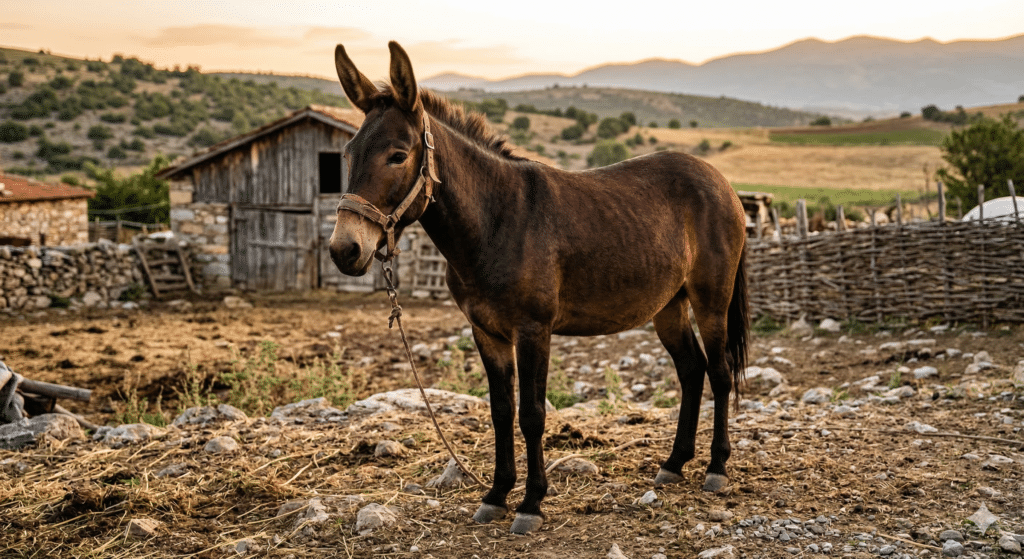
Since antiquity, humanity has tapped into an extraordinary creature, born from the meeting of two distinct species. By crossing a donkey and a mare, we obtain an animal that combines the horse’s strength with the donkey’s robustness: the mule. This perfect hybrid has built civilizations, tilled our fields, and fought at our side. Yet it carries within it a fundamental biological flaw, a genetic dead end that makes the reproduction of these animals almost impossible.
The puzzle of odd chromosomes
The very existence of the mule is an anomaly tolerated by biology. Although both belong to the equid family, horses and donkeys diverged from a common ancestor about 10 million years ago. Result: they no longer share the same genetic material. A horse has 64 chromosomes, while a donkey has only 62.
When they mate, the calculation becomes wonky. The mule inherits 32 maternal chromosomes and 31 paternal chromosomes, totaling an odd number of 63. Strangely, this imbalance doesn’t affect its everyday life. Its cells divide normally, even giving it a form of “hybrid vigor” that makes it more robust and cautious than its parents. The real trouble arises at the moment of reproduction.
The impossible puzzle of meiosis
For a living being to reproduce, it must create gametes (sperm or eggs) through a process called meiosis. In this crucial stage, chromosomes must pair up two by two, each finding its exact counterpart to fuse and exchange information.
That is where the mule’s system collapses. Try assembling two puzzles whose pieces have neither the same size, nor the same shape, nor even the same number. The horse’s and the donkey’s chromosomes refuse to interlock. In the face of this chaos, the process halts. Gametes do not form. The scientific conclusion is theoretically unequivocal: mules are sterile.
The anomaly that defies the laws of evolution
Yet, in exceedingly rare cases, nature forces the passage. Over the last five centuries, about sixty births arising from female mules have been documented, and some have been subjected to rigorous analysis by modern genetics. In 1984, the case of the mule “Blue Moon” literally astonished the researchers at the San Diego Zoo.
DNA tests revealed a statistically aberrant scenario: the foal had inherited absolutely no genetic marker from its supposed father. The mother had transmitted a complete set of maternal chromosomes with no recombination. This kind of reproduction forced geneticists to acknowledge that Mendel’s laws of inheritance were not infallible. The mule may not be a mistake of nature, but living proof that life finds a way to bend the rules, even once in ten billion.
