
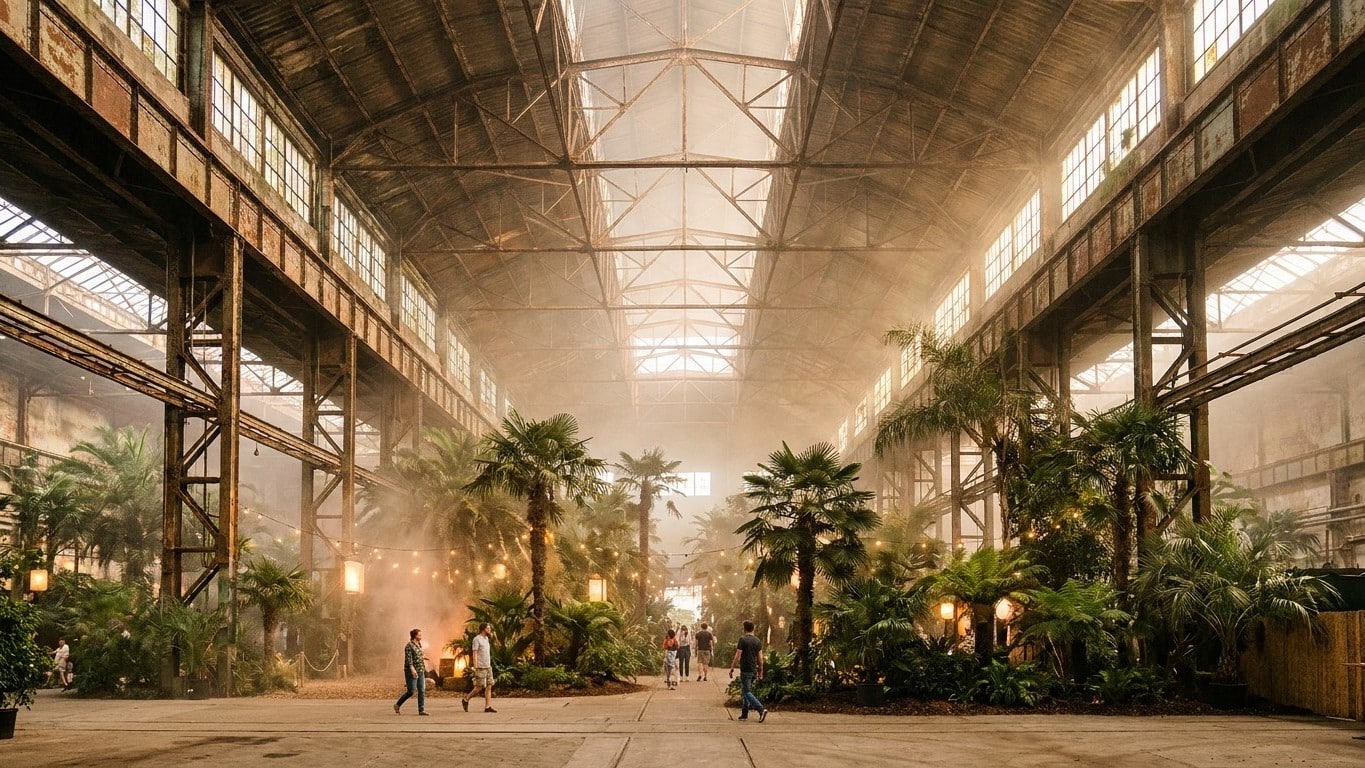
A hangar large enough to swallow the Eiffel Tower lying on its side, without it touching a single wall. That is what remains, south of Berlin, of the wildest dream of German aviation in the 2000s: a cargo airship able to lift 160 tons without a runway or a crane. The project collapsed. The building, however, still stands, and today houses palm trees, an artificial beach and plastic flamingos.
Takeaways
- A flying behemoth intended to revolutionize heavy-load transport: what happened to the project?
- €300 million invested for a one-of-a-kind hall: how everything collapsed in a few years
- From a utopian tech project to an artificial tropical paradise: a radical conversion that today yields thirteen times the investment
The bold bet of a dirigible capable of lifting 160 tonnes
Everything begins in 1996 with the creation of CargoLifter AG, a company aiming to reinvent heavy-load transport through a giant airship, the CL160. The idea wins over investors: a public offering takes place in May 2000, and the resulting ownership structure is marked by a large share of small investors drawn by extensive media coverage of the promised new technologies. The euphoria of the dot-com bubble completes the picture.
To build this flying mastodon, you first need a mastodon on the ground. On a former military airfield in Brandenburg (used by the Luftwaffe, then by the Soviet army, and which reportedly hosted Gagarin’s landing in 1963 according to the site’s archives), CargoLifter erects between 1998 and 2000 a hangar without equal: 360 m long by 210 m wide and 107 m high, with 5.5 million cubic meters, one of the largest buildings in the world by volume, and the largest single-span hall without internal supporting pillars. Named the Aerium, it alone costs 78 million euros.
The rest of the money goes up in smoke in the engineering phase. According to a Forbes article published in 2002, CargoLifter, claiming to manufacture heavy-lift airships, had raised 263 million dollars from investors while not a single aircraft had been completed. A team of more than 260 engineers worked on the project, but costs rose faster than the helium could rise. The state of Brandenburg chipped in with subsidies, hoping to transform the region into a technology hub. None of it did.
A spectacular bankruptcy and a fire-sale hangar
The post-9/11 stock market crash finishes off the company. CargoLifter falls victim to the aviation slowdown following the 9/11 attacks and to the 2002 financial crisis, declaring bankruptcy in June 2002. The CL160 airship itself never leaves its drawing board: the craft was never built and the company went bust in July 2002.
The hangar becomes an unwieldy asset to liquidate. In 2003, the liquidators organize the sale. The result is a fire-sale: in June 2003, the court-appointed administrators sell the hall and 500 hectares of land to the Malaysian company Tanjong, which converts the hall into a leisure park named Tropical Islands Resort. The transaction amount? 17.5 million euros for the entire hangar and land, barely more than 20% of the cost of constructing the building alone. An American niche site puts it plainly: the company ran dry in 2002, and in 2003 it was forced to sell the hangar, which had cost 78 million euros to build, at a drastic 80% write-down.
From hangar to airships to an artificial tropical paradise
Translating a cathedral of steel designed for aerostatic testing into a tropical water park was no easy feat. Yet Tanjong set to work, and the park opened its doors on December 19, 2004, offering visitors an exotic tropical rainforest environment with a beach, artificial sun, palm trees, orchids and a soundtrack of birdsong. The scene is complete: imported sand, year-round temperatures around 26 degrees Celsius, and a capacity that leaves one marveling for an enclosed site.
Today it stands as the largest indoor water park in the world, larger than World Waterpark at the West Edmonton Mall in Canada, and it can welcome up to 8,200 visitors a day. About 600 people work there on a permanent basis, a figure far surpassing the staff CargoLifter employed at the time of its collapse.
The site changed hands again in 2018. The Spanish group Parques Reunidos acquired Tropical Islands in December 2018 for €226 million, nearly thirteen times the price paid by the Malaysians a decade and a half earlier. Irony of ironies: this figure is almost equal to the total bill of CargoLifter’s failure. The hangar designed to help Germany take off is now worth its weight in gold, yet its feet stay firmly planted in the artificial sand of Brandenburg.
Sources: en.wikipedia.org | wikimemoires.net
