
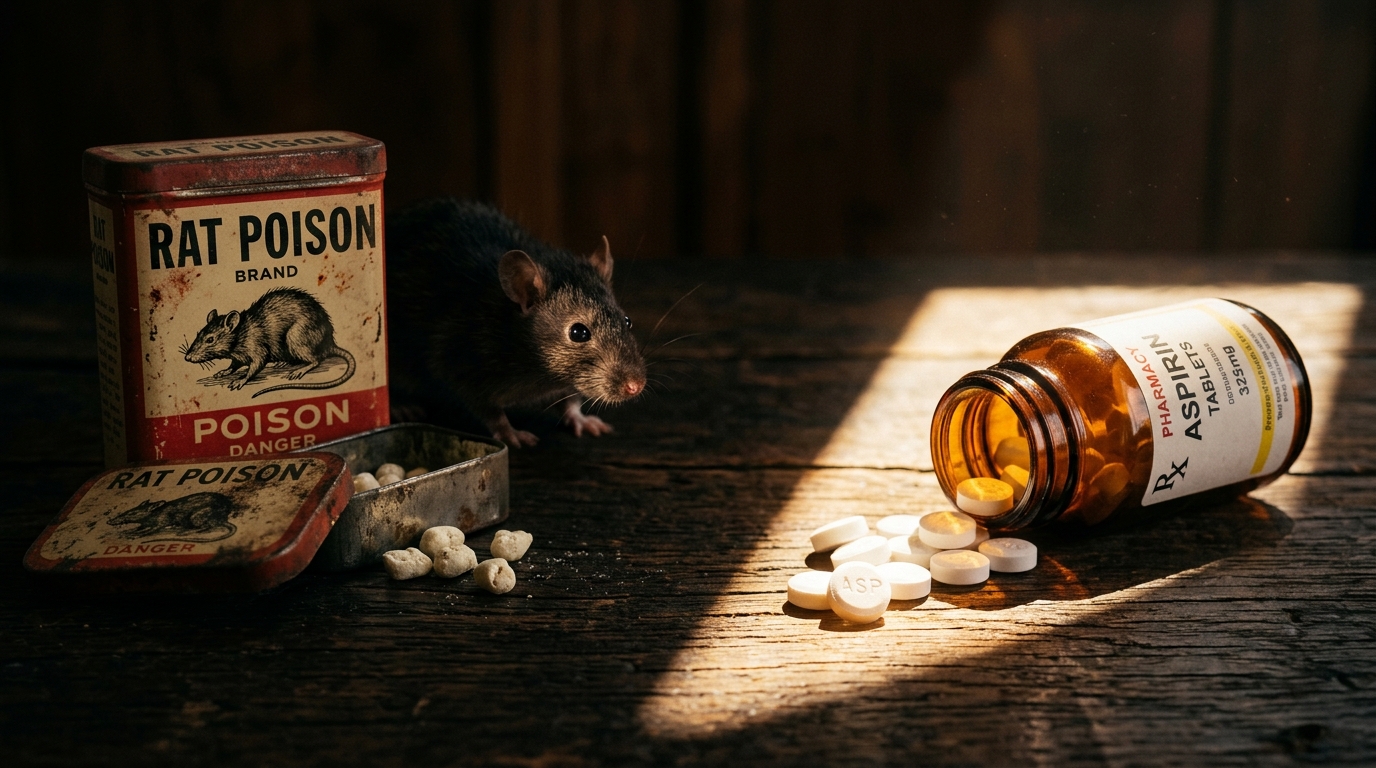
En cherchant en 1940 ce qui faisait saigner à mort les vaches du Wisconsin, un chimiste a littéralement créé une mort-aux-rats que des millions de patients avalent aujourd’hui
The answer comes down to a single word: mold. More precisely, the mold that grew on badly dried sweet clover, a forage plant once fed to cattle in Wisconsin. As it decayed, it transformed a harmless compound, coumarin, into a poison capable of draining an animal’s blood from the inside, leaving no visible wound. This veterinary mystery, born on American farms in the 1930s, would lead a chemist to one of the world’s most widely prescribed medicines, crossing through drugstore aisles where death-for-rats poison was sold. A story that blends chance, scientific stubbornness, and a hint of irony, since the same compound would eventually treat those it could have killed.
- In 1940, chemist Karl Paul Link isolated dicoumarol, the cause of fatal hemorrhages in cows that had eaten moldy sweet clover in Wisconsin.
- Testing 150 derivatives, his team created warfarin, marketed from 1948 as a rat poison before being approved for human use in 1954.
- Warfarin became a major anticoagulant, famously used by President Eisenhower in 1955, and today remains one of the world’s most prescribed medicines.
- Cows bleeding for no apparent reason in 1933 Wisconsin
- Karl Link isolates the culprit molecule and files a patent for a poison
- From the farmers’ attic to the pharmacy shelves in under ten years
- Eisenhower, reluctant patient, turns rat poison into a mass-market drug
Cows Bleeding for No Apparent Reason in Wisconsin, 1933
It all begins with a scene worthy of a rural crime novel. A Wisconsin farmer walks into a university laboratory one day, cradling a dead cow and a tub of milk and blood that stubbornly refuses to coagulate. The animal bore no visible wounds or external injuries. It had simply vented its blood from within after consuming moldy sweet clover, a forage plant that was then grown in large quantities to feed cattle through the winter.
The phenomenon wasn’t isolated. Across the region, breeders reported similar cases of deadly internal bleeding with no identifiable trauma. This particular case, documented by veterinarians, made its way to the desk of Karl Paul Link, a biochemist at the University of Wisconsin. He realized he had a mystery worth pursuing, though no one yet imagined it would take six long years of work to crack its chemical secret.
Karl Link Isolates the Culprit Molecule and Files a Patent for a Poison
After six years of relentless work in his laboratory, Link’s team finally isolated the true culprit behind the bovine hemorrhages. The compound was named dicoumarol, and its mechanism was as elegant as it was formidable: it prevents blood from clotting by blocking the regeneration of vitamin K in the body. The moment of laboratory synthesis is recorded in the annals, as Link himself noted that the target was reached on April Fool’s Day—a playful wink for a discovery that would turn out far from a joke.
That same year, the Wisconsin Alumni Research Foundation, the organization funding the lab’s research, sensed the compound’s potential and made it available for early human testing. Teams from Wisconsin General Hospital, the Mayo Clinic, and Montreal General Hospital set out to study this bovine toxin as a treatment for blood clots. A major problem, however: the doses needed for humans were high, the therapeutic window was narrow between a useful effect and dangerous bleeding, and the product’s slow absorption made it impractical in emergency situations.
From the Farmers’ Attic to the Pharmacy Shelves in Under Ten Years
Rather than stopping there, Link and his colleagues decided to systematically explore all possible derivatives of coumarin. They tested no fewer than 150 distinct chemical variations, a painstaking effort that underlines how pharmaceutical research often hinges more on patience than sudden genius. Among this long list, compound number 42 stood out for its remarkable potency. It was named warfarin, a direct homage to the funder of the entire project, the famous WARF.
The patent for this new molecule, clearly distinct from the original dicoumarol, was filed in 1945 for the benefit of the university foundation. Three years later, in 1948, warfarin hit the market with immediate success, but in a completely different domain: it became a highly effective rodenticide, sold in stores to rid farms and homes of rodents. At this stage, no one could imagine that it would one day reside in the medicine cabinets of millions of households.
Eisenhower, Reluctant Patient, Turns Rat Poison into a Mass-Market Drug
The real turning point came in 1951, in the most unexpected way. A young recruit in the U.S. Army attempted to take her own life by swallowing several doses of this warfarin rat poison. Against all odds, she recovered completely after receiving vitamin K treatment in hospital, the compound’s natural antidote. This episode, as dramatic as it was revealing, proved that warfarin could be administered and controlled in humans, provided the dosage could be mastered and a reliable antidote existed.
Studies soon multiplied on its use as a therapeutic anticoagulant, and the product received approval for human use in 1954. The following year, the story took a nearly symbolic turn: President Dwight Eisenhower, suffering a heart attack, was treated with warfarin. Wisconsin’s rat poison had literally cured the President of the United States. Karl Paul Link, for his part, was honored for the entirety of his work with the prestigious Albert Lasker Award in 1955, a fitting accolade for a discovery born from a can of unclotted blood.
Today, warfarin remains among the world’s most prescribed oral anticoagulants, used daily by millions to prevent strokes and thromboses. It sits on pharmacy shelves alongside newer molecules, but its history remains a fascinating case study: a farm poison that, through the force of scientific curiosity and a nearly cinematic sequence of events, became one of the most commonplace—and yet most valuable—drugs in modern pharmacopoeia.
