
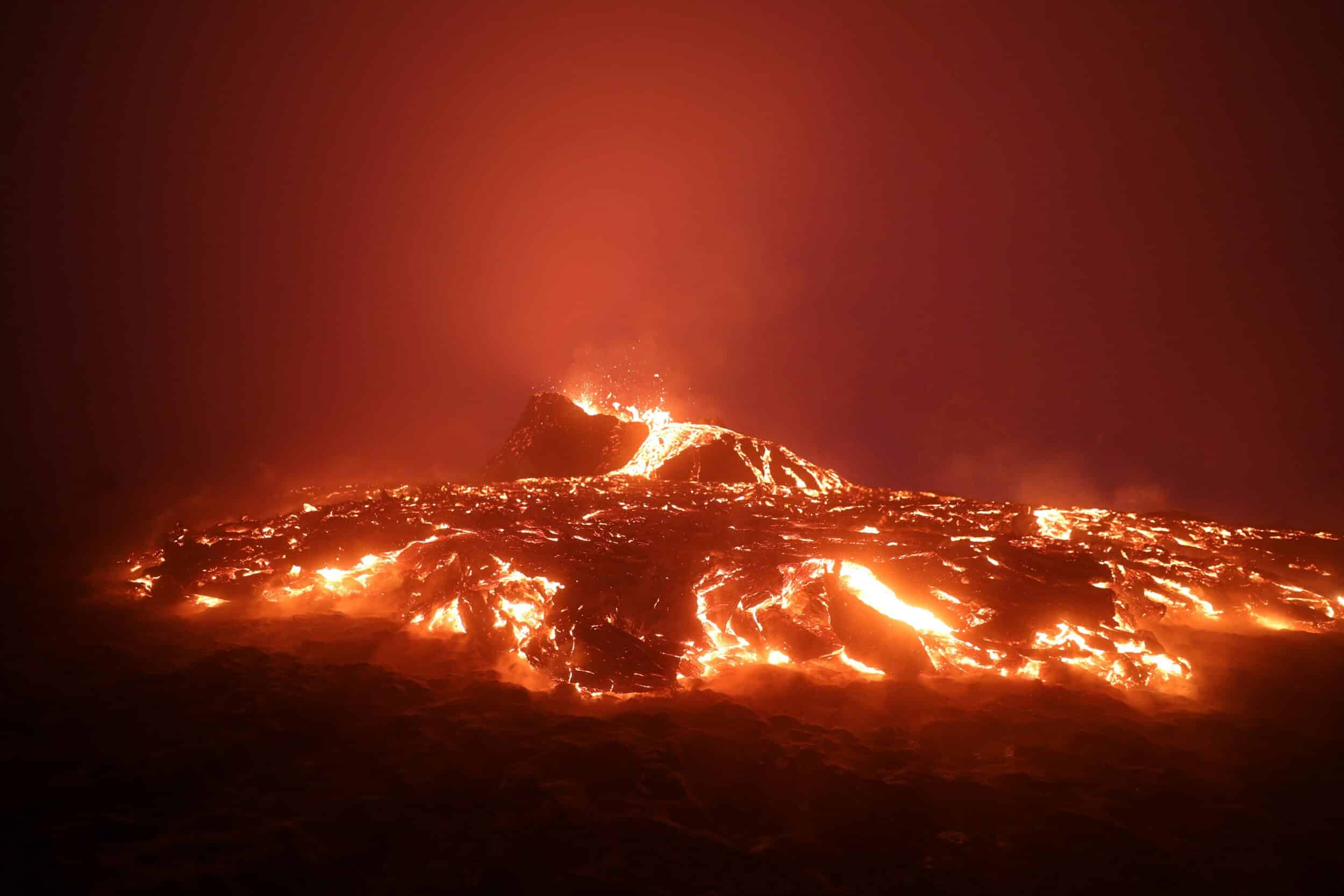
Why can’t we simply seal volcanoes with concrete to prevent an eruption? This question, oddly flourishing on social media, seems appealing in its simplicity. Yet, far from being a miracle solution, this method would turn a potentially manageable eruption into a cataclysmic disaster. By attempting to gag the Earth, we’d only transform peaceful volcanoes into high-pressure time bombs. Here’s why this idea is geological nonsense.
What you will learn
Why sealing a volcano amounts to turning a safety valve into a bomb.
How magma viscosity dictates the danger level of an eruption.
The only real use of concrete against lava that doesn’t worsen the situation.
The Volcano: a pressure-relief valve
Magma does not always rise to the surface to explode. When it is fluid, the gases it contains can escape gradually, allowing a relatively slow and predictable lava flow. In this scenario, the volcano acts as a natural safety valve, releasing the Earth’s interior energy in a controlled fashion.
Pouring concrete into an vent does not stop the geological process; it blocks it mechanically. Concrete, with its high melting point, would form a temporary plug. However, the pressure would continue to build beneath. By denying the volcano its outlet, you force the gases to seek another escape route or, worse, push internal pressure up to a critical breaking point. You thereby convert a peaceful flow into a violent eruption.
Toward a guaranteed explosive catastrophe
The deadliest eruptions, such as Mount St. Helens, occur when magma is so viscous that it traps the gases. The pressure rises until the rock explodes, ejecting incandescent tephra clouds that race down the slopes at destructive speeds. Adding concrete is literally adding an explosive charge to a mine already primed to blow.
Beyond the blast, the environmental impact would be disastrous. Concrete would be pulverized by the eruption’s immense force, turning into a cloud of fine dust. Inhaled, these cement particles are extremely harmful to the lungs, potentially causing serious respiratory diseases and long-term cancers. Rather than saving lives, this human intervention would become the engine of a health and geological catastrophe.
A smarter use: divert instead of block
Is there any legitimate use for concrete in an eruption? Yes, but not for acting on the crater itself. In historical eruptions—most notably Etna—blocks of concrete were used not to seal the volcano but to build temporary barriers to divert lava flows away from inhabited areas.
While the effectiveness of this method for large-scale eruptions remains debated, it has the merit of not interfering with the volcano’s internal pressure. It helps manage the consequences without turning a difficult situation into an explosive nightmare. In short, in the face of Earth’s power, the best strategy is not to build a barrier, but to accompany the inevitable with caution.
