
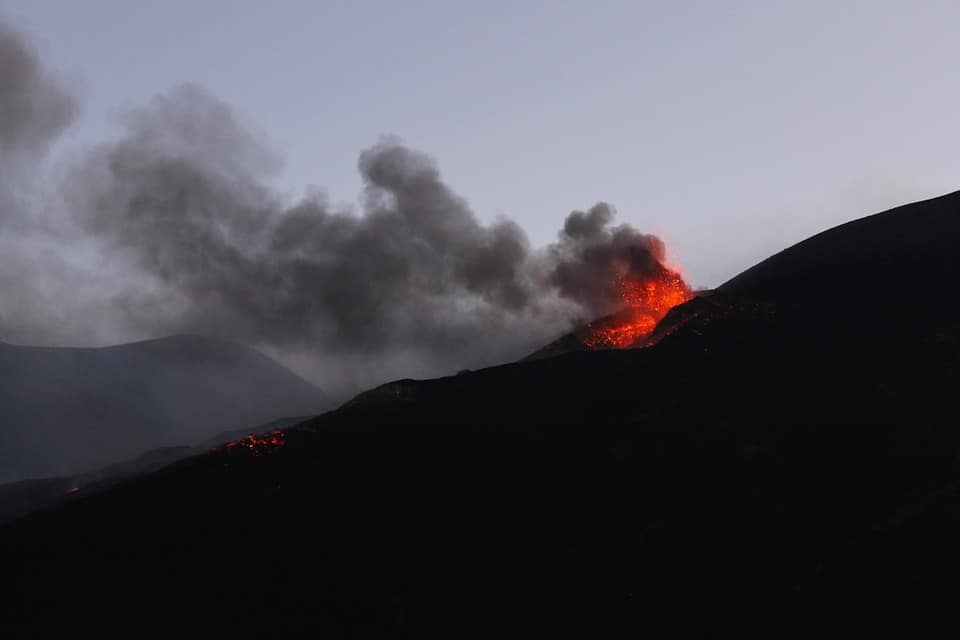
When discussing volcanism in southern Italy, two names consistently come to mind: Etna and Vesuvius, both of which have already caused damage in the past. Yet another behemoth, this time underwater, could cause trouble in the future: Marsili.
An imposing underwater volcano
Etna (3,323 m) and Vesuvius (1,281 m) are two volcanoes located respectively in Sicily and near Naples. The first has been erupting since 2013 and the second is famous for having destroyed the city of Pompeii in the year 79. As explained in a BBC Future article on August 2, 2021, a third volcano could well shake up this monopoly of danger in southern Italy. The Marsili volcano lies 175 km to the south of Naples and stands at about 3,000 meters in height. Its base is very impressive: 70 km long and 30 km wide.
Marsili is undoubtedly the largest active volcano on the European continent but remains rather discreet for an obvious reason. Indeed, it lies in the Tyrrhenian Sea at a depth of 500 meters. This mastodon is part of a volcanic arc (the Aeolian Arc), a sequence of volcanoes that has also given rise to several landmasses such as the Aeolian Islands.
The volcanologist Guido Ventura and his team at the National Institute of Geophysics and Volcanology (INGV) in Italy published a study in the journal Scientific Reports in April 2020. Marsili would have formed about a million years ago. It would have accumulated no fewer than 80 eruptive cones over the millennia, along numerous fractures and fissures capable of venting lava.
Significant risks
Due to its depth, Marsili has only been known since the early 20th century, when seabed mapping emerged. It should be noted that the development of certain technologies has driven this discovery, including the more frequent use of submarines. Also mentioned is the appearance of new communication systems such as telegraph cables that had to be laid on the seabed. In the 1920s, Marsili was named in honor of the polymath Luigi Ferdinando Marsili, author of the first treatise on oceanography.
Initial research into Marsili began quite late, in the 2000s. Various studies estimate that the last eruption of this volcano occurred a few thousand years ago. Today, its activity is minimal: a few gas emissions, rumblings and weak tremors. Researchers also explain that in the event of a massive eruption, the lava and ash produced would be smothered by the mass of water. There is therefore very little risk that such an eruption would reach dry land, and thus the local population.
Nevertheless, the danger is real. The various works suggest that risks involve possible submarine landslides. In the event of a seismic jolt causing the collapse of one of Marsili’s flanks, the displaced water volume could generate a major tsunami. However, today it is impossible to predict the potential imminence of a catastrophe. Thus, scientists are currently calling for new technologies to monitor the region’s activity.
