
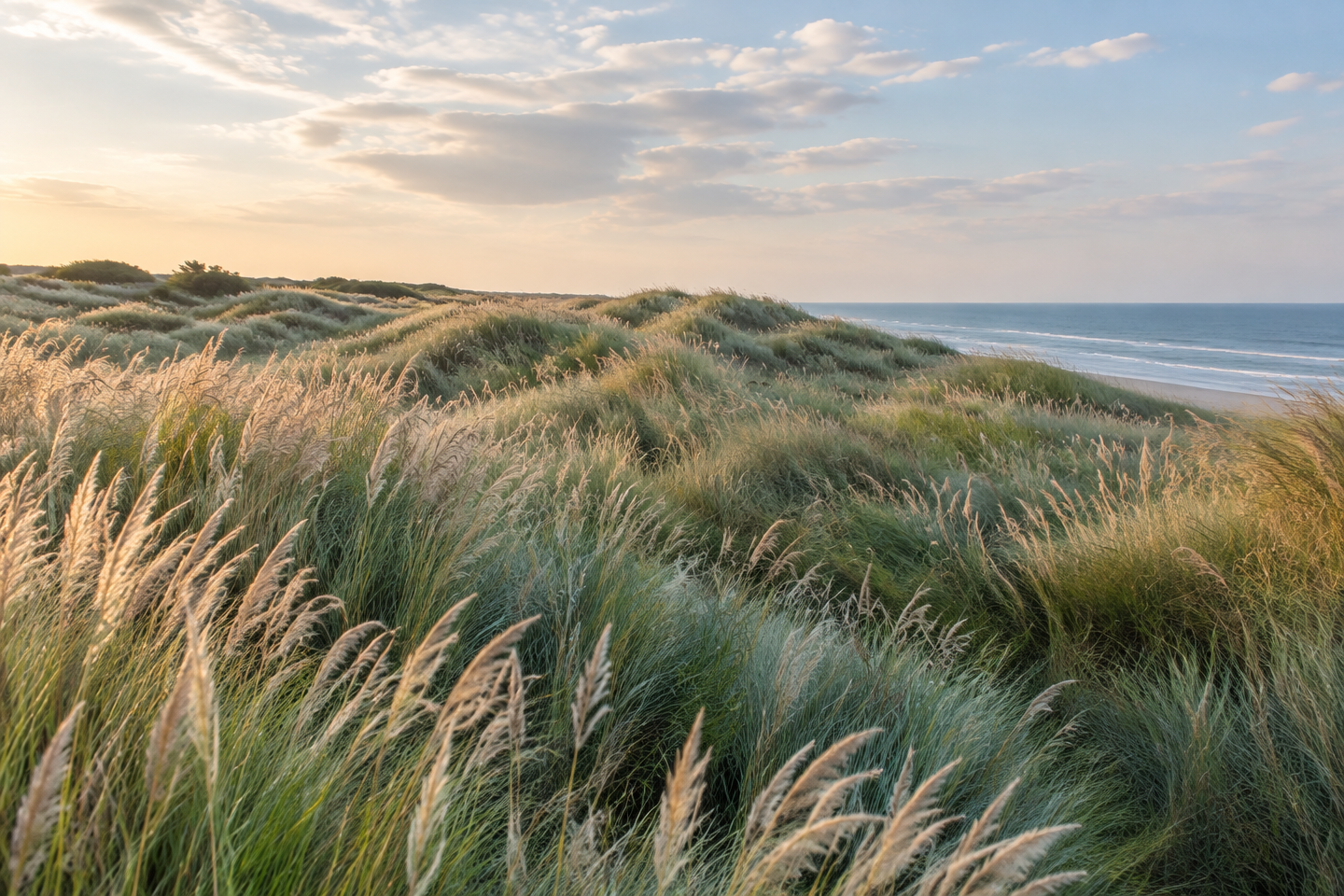
Along the dune ridges of Vendée, between La Tranche-sur-Mer and Noirmoutier Island, tall silvery tufts have billowed in the wind for more than forty years now. Their silky plumes, so photogenic in late summer along the coastal trails, conceal a reality far less poetic. This grass, known as pampas grass, long sat in French garden-center catalogs before, overnight, becoming a prohibited plant. How could such a banal ornamental plant end up threatening entire ecosystems and be banned from sale across the country? The story deserves a closer look.
- Pampas grass can produce up to one million seeds per plant, dispersed by the wind over more than one kilometer
- A ministerial decree of March 2, 2023 bans its sale, possession and transport across the entire French territory, under penalty of up to three years in prison and a fine of €150,000
- In response to persistent cross-border purchases, associations and communities focus on uprooting, public awareness, and training of maintenance workers
- A Seed That Travels a Kilometer Away
- How a Garden Plant Colonized the Protected Dunes
- The Day Brussels Signed Its Ban
- What This Ban Really Changes for French Gardens
A Seed That Travels a Kilometer Away
The secret of Cortaderia selloana‘s success hinges on one word: the proliferation. A single adult plant can produce up to one million seeds per year, with some estimates reaching ten million for the largest specimens. These tiny seeds, light as snowflakes, are designed to travel far, very far, carried by the wind over distances that can exceed a kilometer. A pair of plumes planted in a seaside garden can thus seed an entire neighboring dune within just a few seasons.
This dispersal mode explains why the plant could escape from ornamental beds so easily to colonize natural environments. Native to South America, it had, upon its arrival in Europe, no known specialized predator or sufficiently effective competitor to slow its spread. The result: what was thought to be a simple decorative element of landscape design became, without anyone paying real attention, a formidable colonizer.
How a Garden Plant Colonized the Protected Dunes
It was around the turn of the 1980s that pampas grass began to settle durably along the Vendée coastline, taking advantage of the sandy soils and the oceanic climate that suit it perfectly. In Brittany, a similar pattern was observed a little later, at the beginning of the 1990s: the plant first colonizes former industrial wastelands before gradually seizing the coastline, the dunes, the backshore marshes, and the roadside margins. Everywhere it takes hold, the scenario repeats itself identically.
Its large dense clumps, which can reach several meters in height, form true vegetation walls. They smother the local flora, monopolize water and nutrients, and drastically reduce the resources available for littoral fauna. On the dunes, habitats essential to fragile species disappear, simply replaced by an invasive monoculture that impoverishes the surrounding biodiversity. Another less-known consequence: once dried, the plant’s mass becomes highly flammable, making it a factor that increases fire risk in areas where it proliferates, a concern far from insignificant on a coast frequented all year round.
The Day Brussels Signed Its Ban
Facing the scale of the phenomenon, observed well beyond the French coastlines, the European Union eventually acted. In 2022, Cortaderia selloana was listed among the Invasive Alien Species of Union Concern, a designation reserved for organisms deemed sufficiently harmful to justify coordinated action across the continent. France subsequently transposed this decision into national law via a ministerial decree dated March 2, 2023, which came into effect on April 7, 2023.
Concretely, this text now bans, across the entirety of metropolitan territory, the introduction, possession, transport, use, exchange, making available for sale, sale or purchase of living specimens of this plant. The penalties are not symbolic: the Environmental Code provides up to three years in prison and a fine of 150,000 euros, penalties that can be doubled if the offense occurs in a national park or nature reserve. A plant once sold in pallets in garden centers has thus, within a few months, been officially classified alongside the species deemed most problematic for the environment.
What This Ban Really Changes for French Gardens
In practice, this regulation has upended the habits of an entire sector. French garden centers are no longer allowed to offer the plant for sale, and individuals who already own it in their gardens can legally neither exchange nor transport it. Yet, the law does not solve everything: some professionals and individuals continue to obtain it through cross-border purchases, notably in Italy, Germany, Belgium, or the Netherlands, where sale remains permitted. This permeability of European borders obviously complicates the work of French authorities.
On the ground, environmental groups and coastal communities now rely on three complementary levers: uprooting campaigns conducted before seed maturation, public information campaigns to educate owners and tourists, and training for green-space workers responsible for maintaining roadside verges and natural areas. The objective is clear: to prevent every silvery plume from becoming, the following year, a new colony on protected dunes.
The damage is nonetheless already widespread in some sections of the Vendée coastline, where decades of dissemination have deeply altered dune landscapes. The question is therefore no longer merely about preventing new plantings, but about restoring fragile habitats—a long-term project that more broadly questions our relationship with exotic plants that we often plant, without thinking, in the backyards of our homes.
