
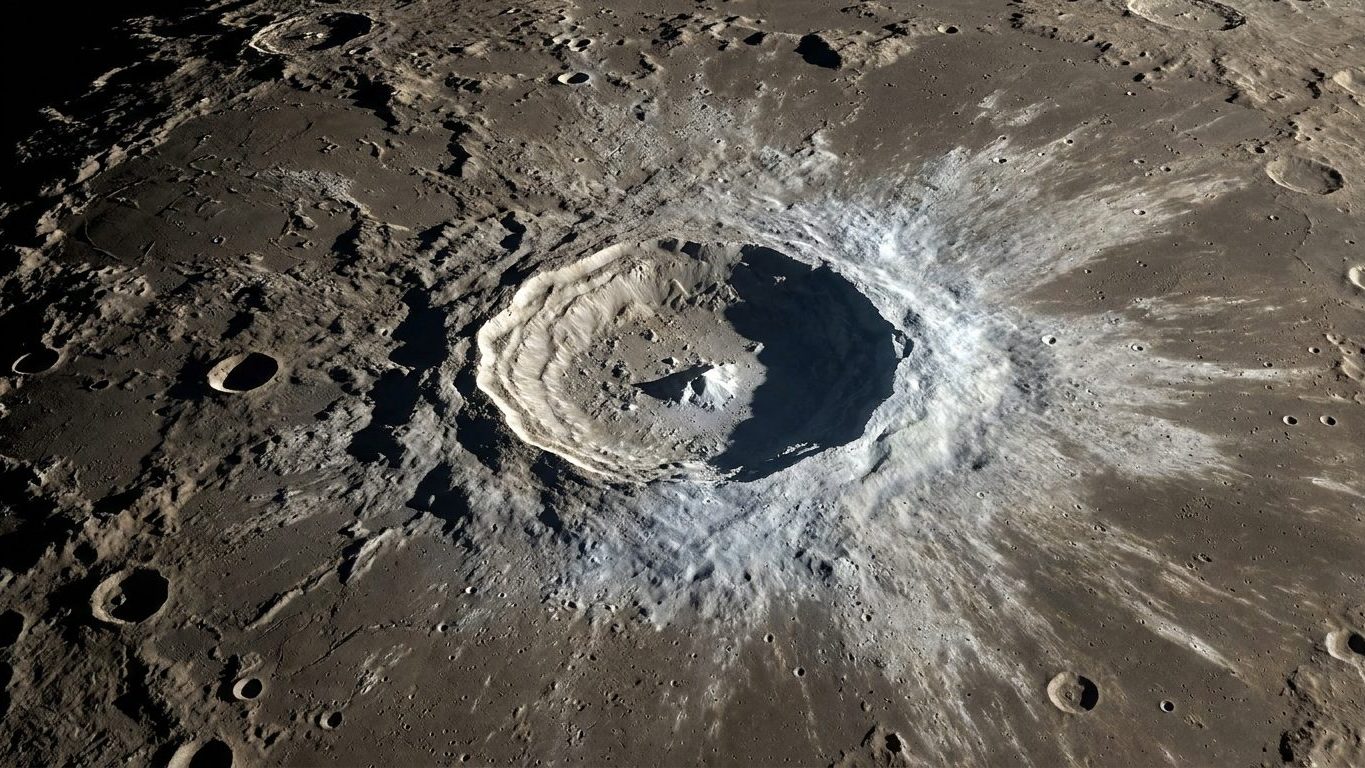
A crater of 222 meters in diameter opened on the visible face of the Moon between April 11 and May 22, 2024. It is the largest impact crater ever identified as actively forming anywhere in the Solar System, according to a study published on September 16, 2026 in Science Advances. Yet the observatory that should have been the first to be informed missed it: an amateur detected it before NASA disclosed its location.
Named McGetchin, this new crater sits near the Moon’s eastern limb at roughly 1.35° N and 67.18° E. It measures an average diameter of 222 meters, with measurements ranging from 213 to 231 meters depending on the axis considered, and it reaches about 43 meters in depth, with wall slopes averaging around 24°, climbing to nearly 40° in places. McGetchin crater lies near the Moon’s eastern limb at roughly 1.35 degrees north and 67.18 degrees east, précise the researchers, who give an average diameter of 222 meters, the measurement varying from 213 to 231 meters depending on the axis considered.
- A 222-meter-wide crater formed on the Moon between April 11 and May 22, 2024, the largest ever observed yet in the act of formation.
- The impact was caused by a fragment of a comet or asteroid the size of a 3- to 6-story building.
- Yann Pinard, a French amateur astronomer, pinpointed the crater on September 7, 2026, ahead of NASA’s official announcement on September 16.
A Building-Sized Projectile, Invisible for a Year and a Half
The engine behind this lunar upheaval? A fragment of a comet or asteroid, estimated to be the size of a building of three to six stories. The energy released by the impact was substantial: according to the researchers’ models, an impact of this scale on the Moon occurs only about once every 132 years on average.
No one observed the event at the moment it happened. NASA’s Lunar Reconnaissance Orbiter (LRO) has been photographing the entire lunar surface each month since 2010 with its wide-angle camera. By comparing two images taken months apart under similar lighting, imaging specialist Robert Wagner of Intuitive Machines detected an unusually bright spot circled by a dark halo. This discovery dates from October 24, 2025, roughly a year and a half after the crater’s actual formation.
The researcher described his reaction at the time: “I just stopped, dropped everything, and started looking into what that spot was.” A close-up photograph taken on December 5, 2025 by LRO’s narrow-angle camera later confirmed the magnitude of the phenomenon.
The Lunar Ground Disrupted Over 6.4 Kilometers
A second article, published on the same day in the same journal, explored the impact’s consequences well beyond the hole itself. Thermal measurements by the Diviner instrument reveal a roughly 7-kilometer-wide region where nighttime temperatures remain 8 to 9 kelvin cooler than the surrounding terrain. The cold spot aligns with decompaction of the upper centimeters to decimeters of regolith—the Moon’s dusty surface.
This kind of “cold spot” is not unique to McGetchin. Researchers examined all recently formed craters larger than 20 meters and found that every crater bigger than about 30 meters produces detectable cold spots, indicating that this phenomenon is a common outcome of recent lunar impacts. The larger the crater, the deeper the thermal anomaly extends into the regolith, the dusty layer covering the Moon.
These thermal scars do not last forever. They typically fade away over a timescale ranging from 100,000 to a million years, making them valuable markers for dating the most recent impacts.
A Frenchman Beat NASA by Several Days
That’s the science side. But the story takes an unexpected turn on the French front. As early as April 30, 2026, the magazine Ciel & Espace announced the crater’s existence following a scientific presentation at the Lunar and Planetary Science Conference in Texas in March 2026. The problem: the authors had provided no coordinates, not even the lunar region involved.
The magazine then issued a challenge to its readers. The editorial team judged the search to be a tough one, likening it to finding a needle in a haystack. The crater, with an apparent diameter of about 225 meters at the time, would correspond to roughly 0.12 arcseconds as seen from Earth—an angular size considered beyond the reach of ordinary amateur instruments.
Five months later, a reader accepted the challenge. On September 7, 2026, Yann Pinard, a 46-year-old amateur astronomer, emailed the editors claiming to have identified the impact. Ciel & Espace summarizes the moment: “The editors of Ciel & Espace had received on September 7 an email from Yann Pinard, a 46-year-old amateur astronomer, asserting he had identified the impact.” His case rested on a careful comparison of LRO imagery with photographs taken by other amateurs, a method that clearly convinced the editors.
The magazine deemed the demonstration solid. Its evidence was persuasive enough to award him the prize—a one-year subscription to Ciel & Espace. Nine days later, on September 16, 2026, NASA publicly released the crater’s exact location in an official statement, confirming what the French amateur had already found.
What This Improbable Race Reveals
This gap between a scientific announcement and a precise localization highlights a little-known aspect of planetary science. A discovery can be published, debated, and discussed for months, while the general public or even seasoned amateurs may not have access to the raw data needed to verify it themselves.
In seventeen years of the mission, LRO has cataloged at least 1,000 new craters and about 100,000 other surface changes on the Moon, roughly 140 new craters of at least 9 meters each year. McGetchin remains, for now, the most spectacular among those caught in the act of formation. And the next bright spot to appear on the probe’s monthly images might, once again, be spotted by an amateur’s eye before the scientists’.
Sources: cieletespace.fr | lpi.usra.edu
