
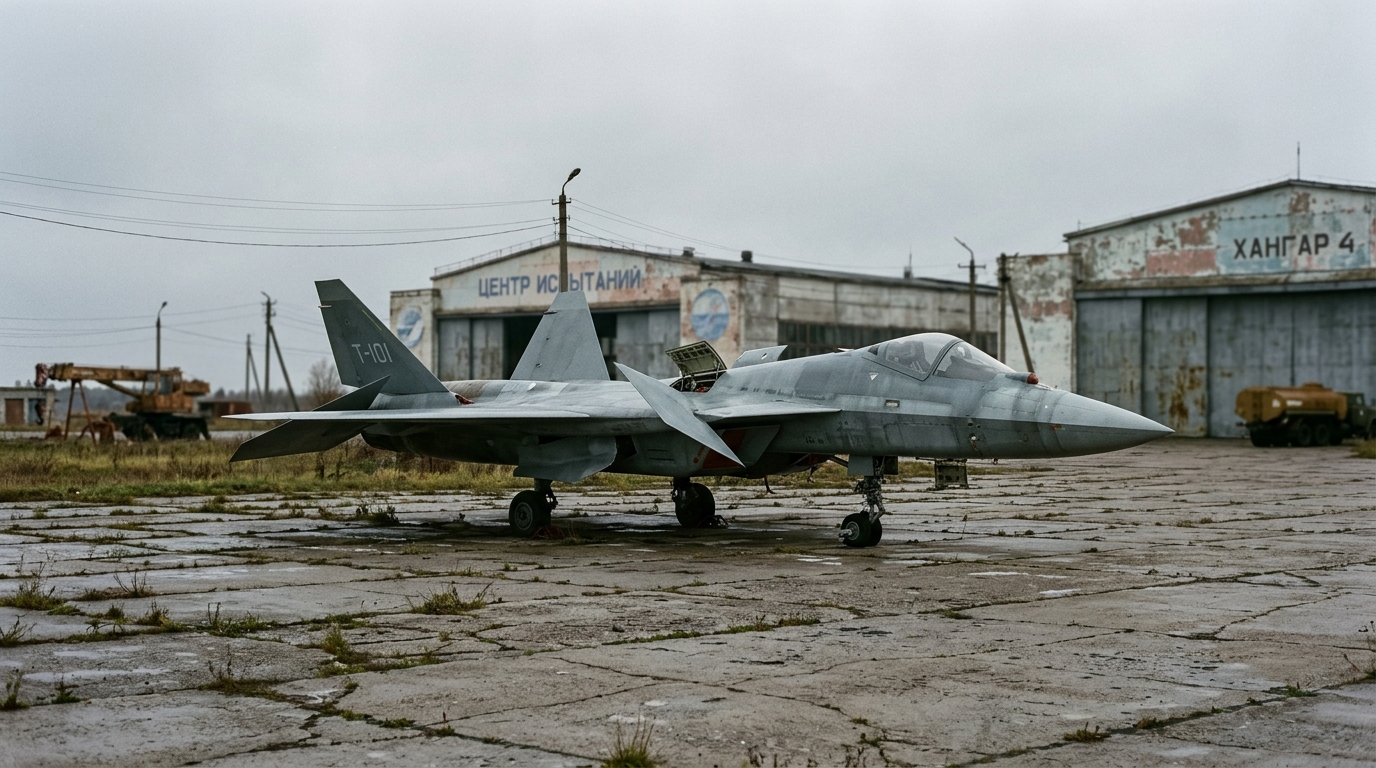
Imagine a jet fighter conceived to rival the best Western aircraft, drawn up at the dawn of the 1980s, and which would ultimately take off only in 2000, for two flights before vanishing forever from radar. This isn’t fiction, but the very real history of the Mikoyan Project 1.44, the Soviet—and later Russian—stealth fighter whose fate reveals more about the collapse of an empire than about any inherent flaw in military aviation. For unlike what one might suppose, it was neither an accident nor an engineering error that doomed this aircraft. The truth is far more dizzying, and it deserves closer scrutiny.
- The MFI program, launched in 1983 by Mikoyan and TsAGI, was only validated in 1991, the year the USSR collapsed
- Due to budget constraints, the program was halted in 1997 while the sole demonstrator neared completion at Zhukovsky
- Unveiled in 1999, the MiG 1.44 conducted only two test flights in 2000 before being abandoned in favor of the PAK FA, the future Su-57
- A program born in the midst of the Cold War, under the cloak of total secrecy
- What truly grounded the 1.44 had nothing to do with technology
- Two flights in 2000, then silence: the brutal end of a stealth dream
- From the 1.44 to the Su-57: the strange legacy of a plane never put into service
A program born in the middle of the Cold War, under the shadow of absolute secrecy
It all begins in 1979, when the Soviet government officially launches the MFI program (Mnogofunktsionalny Frontovoi Istrebitel, i.e., Multirole Frontline Fighter). The objective is clear: to design the natural successor to the MiG-29 and Su-27, the crown jewels of Soviet air combat that are just starting to equip frontline units. But in Moscow, the horizon extends even further, toward a new generation of aircraft capable of competing with the anticipated American fighters.
It is in 1983 that Mikoyan’s design bureau partners with the TsAGI institute, the Soviet benchmark in aerodynamics, to lay out the lines of this fighter of a novel kind. Engineers work on an unprecedented silhouette, engineered to reduce radar signature while preserving outstanding flight performance. Yet it would take 1991 for the concept to be officially endorsed by the Soviet Air Force, finally opening the path to building a demonstrator. A delay that, in itself, betrays the project’s sheer complexity and enormous ambition.
What really grounded the 1.44 had nothing to do with the technology
Here is the moment when the story truly shifts. In 1991, just as the concept has just been validated, the USSR collapses. The prototype, still only half built at the moment of the fall of the Berlin Wall, would not emerge from the factory until the early 1994, in a country that was already no longer the same. Post-Soviet Russia endures an economic crisis of unparalleled scale, and defense budgets melt away like snow in the sun.
The program limps along, until the Russian government formally halts it in 1997. Ironically, the single demonstrator was then nearly finished, stranded on the tarmac at Zhukovsky, the legendary aviation test center on Moscow’s outskirts. It wasn’t a design defect or a dramatic crash that ended the venture, but chronic underfunding, symptomatic of a country struggling to finance the ambitions inherited from the Soviet era, much like that ship, as long as two football fields, built to track American missiles, doomed by lack of resources. It’s a bit like a fossil trapped in a geological layer frozen at the wrong moment; the 1.44 ends up literally stuck between two worlds, two regimes, two entirely opposed economic realities.
Two flights in 2000, then silence: the brutal end of a stealth dream
It isn’t until January 1999 that the aircraft is finally shown to the public, without any active military program backing it in earnest. A kind of last-stand display, for a plane born for a Cold War that no longer exists. Then, against all odds, on February 29, 2000, the MiG 1.44 lifts off for the first time, piloted by Vladimir Gorbounov, roughly nine years late against the original schedule.
That inaugural flight lasts 18 minutes, reaching a maximum altitude of about 1,000 meters and a speed of 600 km/h, fairly modest figures for a fighter expected to embody the future of Russian aviation. A second test flight follows on April 27, 2000, lasting 22 minutes. And then, nothing more. The aircraft would never take to the air again. Two flights, barely forty minutes aloft in total, to close nearly two decades of effort, research, and technological hope.
From the 1.44 to the Su-57: the strange legacy of a plane never put into service
The program is definitively buried in favor of a new project, the PAK FA, launched in April 2001. This would give rise to the Su-57, the stealth fighter currently in service, the direct heir to all the lessons drawn from the 1.44’s failure. For although it never fought, never patrolled, never even joined an operational unit, the Project 1.44 did not vanish without a trace. Its work on aerodynamics, stealth, and materials quietly fed the research that would years later yield a genuinely operational aircraft.
Perhaps the most striking takeaway of this story is this: a plane can fail without ever having truly failed to fly. The 1.44 wasn’t abandoned because it flew poorly, but because it was born at the wrong moment, trapped between two geopolitical eras, between the waning days of the Cold War and the chaotic first years of post-Soviet Russia.
Ultimately, the Mikoyan Project 1.44 isn’t so much the tale of a thwarted stealth fighter as it is the story of a country compelled, by lack of resources, to relinquish a technological ambition it had the capability to realize. An aircraft nearly finished, left a captive relic of History rather than a victim of its own flaws. So next time you see a Su-57 in a report or documentary, remember that it carries, somewhere within it, the shadow of this forgotten ancestor—grounded not by technique, but by the weight of an era collapsing under its wings.
