
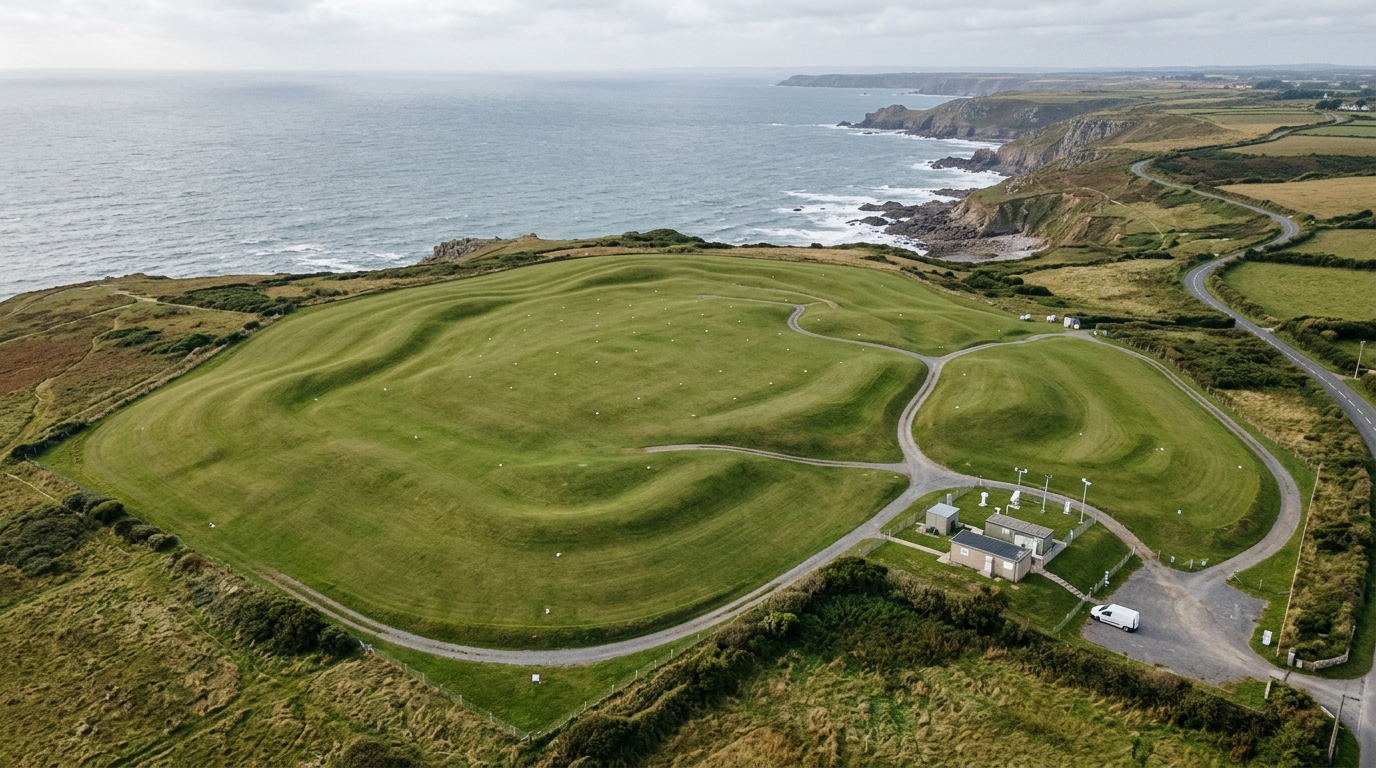
At the start of autumn, hikers wandering the Cotentin’s trails, between granite hamlets and the sea spray along the cap de la Hague, often encounter a verdant hill, covered in short grass and sometimes grazed by a few sheep. At first glance, nothing distinguishes this mound from the other reliefs of the region. Yet, beneath this peaceful meadow lie about 527,000 m³ of radioactive waste, the legacy of a quarter-century of French nuclear activity. And France has not finished watching over this site: authorities estimate that it will need to be monitored for three centuries, a duration that far exceeds the lifespans of several future generations.
- The Manche Storage Center, in Digulleville, received between 1969 and 1994 about 1,469,265 packages of radioactive waste, i.e., roughly 527,225 m³.
- A permanent cover, installed between 1991 and 1997, now covers the site and forms the hill seen today.
- Put under active surveillance since 2003, the site must be monitored for about three centuries, potentially until 2269.
- A meadow that hides the country’s oldest nuclear cemetery
- 1969-1994: a quarter-century burying France’s atomic waste
- Three centuries of surveillance, the hidden price of nuclear energy
- What this hill reveals about our radioactive heritage
A Meadow that Conceals the Country’s Oldest Nuclear Cemetery
The site is named the Manche Storage Center, installed in the commune of Digulleville, just a few steps from the La Hague reprocessing plant. It is simply the first French center for radioactive waste storage, put into service in 1969. Before the choice was made to use this site, engineers had briefly considered the dunes of Biville, a neighboring military property. It was ultimately a wetland area called the “Haut Marais” that was selected to host this installation of a special kind.
The center covers about 15 hectares, but the core of the storage concentrates on a very precise strip of land: 600 meters long, 300 meters wide and 10 meters high. It is this structure, today covered with earth and grass, that forms the famous hill seen by hikers. Under this vegetative cover lie approximately 1,469,265 packages of waste, representing a total volume of 527,225 m³, according to data from the Nuclear Safety Authority.
1969-1994: a Quarter-Century Burying France’s Nuclear Waste
Created by decree in June 1969 as Nuclear Base Facility No. 66, the Manche Storage Center had a very precise mission: to receive low- and medium-activity short-lived waste, i.e., waste whose radioactivity declines significantly within 30 years. For twenty-five years, trucks arrived at Digulleville, depositing packages largely from French nuclear electricity production, then booming.
This logistical ballet lasted until July 1994, date on which the last packages were taken in charge by the center. The site had then reached its maximum capacity. It took almost six more years, between 1991 and 1997, to install a permanent cover designed to isolate the waste from the external environment on a durable basis. It is this protective layer, made of impermeable materials and then covered with topsoil, that gave birth to the hill we know today.
Three Centuries of Surveillance, the Hidden Price of Nuclear Energy
Once the cover was completed, the site entered an active surveillance phase in January 2003. Practically, this means teams regularly check the hill’s tightness, the quality of nearby groundwater, and the overall evolution of the installation. A bit like a doctor monitoring a patient over the very long term, without heavy interventions, but with constant vigilance.
Regulatory-wise, the Manche Storage Center officially remains in a dismantling phase until the permanent cover is fully installed. A decision by the Nuclear Safety Authority still must specify the exact date of final closure of the storage, as well as the minimum duration of the surveillance phase. According to current estimates, this vigilance period should extend for about three centuries, i.e., surveillance that could theoretically continue until 2269. A dizzying figure, which reminds us that nuclear energy, however efficient, carries responsibilities spanning generations far beyond electricity production itself.
What This Hill Says About Our Radioactive Heritage
This discreet Cotentin hill is far more than a mere relief feature. It embodies the challenges posed by managing radioactive waste: how to isolate a dangerous material durably while preserving, over time scales that surpass human comprehension, the memory of what lies buried beneath our feet? Future generations will inherit not only the site itself but also the precise knowledge of its contents and the precautions to take.
As France’s debate about the future of energy remains lively, this discreet nuclear cemetery, covered in grass and grazed by a few sheep, provides a striking counterpoint. It reminds us that every kilowatt-hour produced by nuclear energy leaves a physical, tangible trace that will traverse dozens of generations before it can be considered fully neutralized.
So the next time you encounter, on a detour during a hike in the Manche, a hill a bit too regular to be natural, you may perhaps know what it hides. This story ultimately raises a simple yet essential question: are we collectively ready to shoulder a heritage whose surveillance will far outlast our own existence?
