
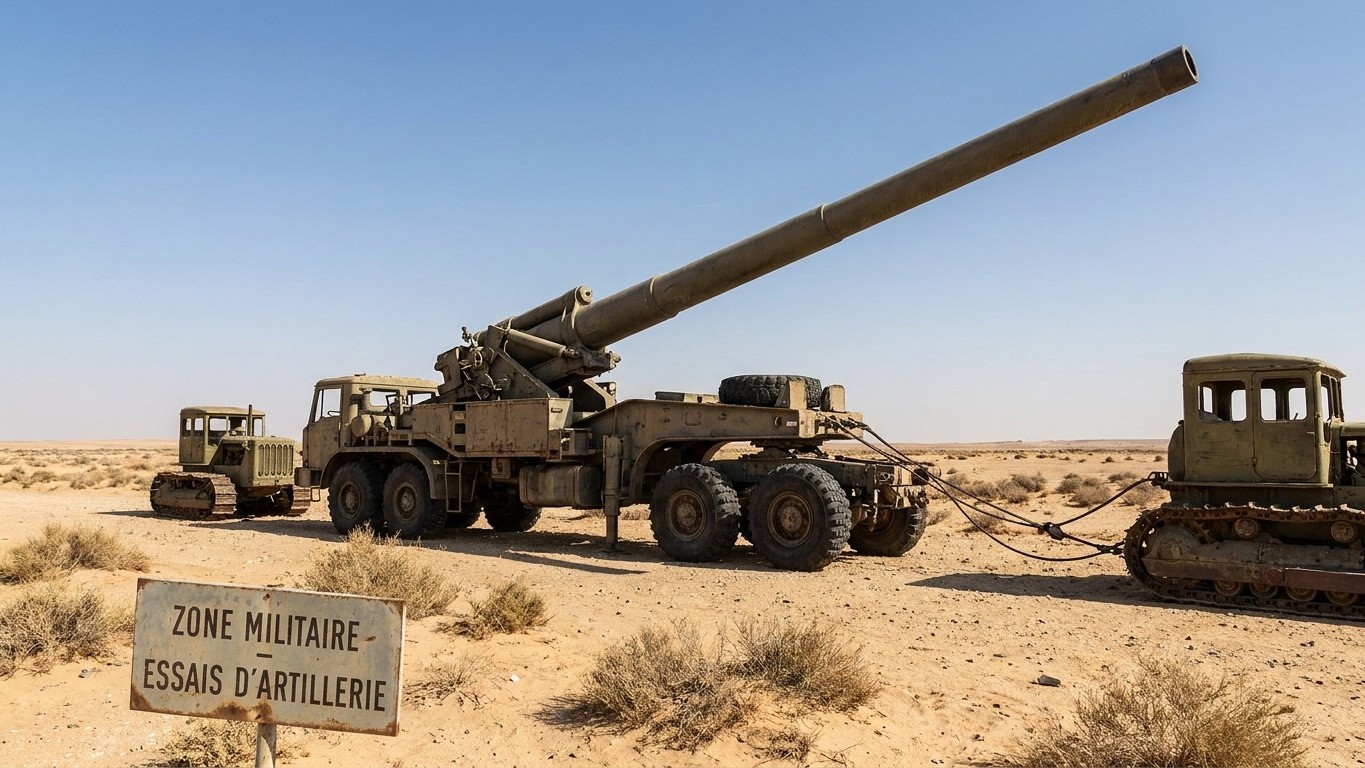
Eight-thirty in the morning. On May 25, 1953, the atomic cannon was tested at the Nevada Test Site, on Frenchman Flat, as part of the Upshot-Knothole nuclear-experiment series. The test carried a seemingly ordinary code name: Grable. The test was observed by the chairman of the Joint Chiefs of Staff, Admiral Arthur W. Radford, and by Secretary of Defense Charles Erwin Wilson; it culminated in the successful detonation of a 15-kiloton shell (W9 warhead) at a distance of seven miles—an explosive power comparable to the Hiroshima bomb, but fired from a field cannon.
The scene was breathtaking. The 280 mm gun hurled its nuclear charge 10,000 yards downstream, before the eyes of 3,200 soldiers and civilians who had come to witness the United States’ only artillery-based nuclear test. The shell exploded in the air, several hundred meters above the ground, obliterating everything beneath. That day would remain unique in military history: it was the only nuclear shell ever fired from an artillery piece. Nineteen other examples of the same cannon would subsequently patrol for a decade without ever reenacting the moment.
Twenty Cannons, Two Continents, Zero Real Shots Fired
The machine itself stands as a triumph of engineering and a logistical puzzle. The M65 weighed 85 tons and stretched 85 feet in length, requiring two heavy tractors to haul it and a crew of five to seven to operate it. Two Kenworth semi-trailers, one in front and one in back, framed the piece like a pair of oxen pulling an enormous plow. Each tractor delivered 375 horsepower, and the whole assembly, despite its improbable appearance, could reach 35 miles per hour and negotiate right-angle turns on 28-foot-wide roads.
After the Grable success, the Army placed orders. At least twenty cannons were manufactured at the Watervliet and Watertown arsenals, at a cost of $800,000 each. A fortune for the era, the equivalent today of tens of millions of dollars for the entire program. These pieces were then sent to hot spots: deployed from April 1955 to December 1962 in West Germany with the 7th Army, in South Korea with the 8th Army, and on the island of Okinawa, Japan. There, there was no option to leave them idle. They were constantly moved to avoid detection and avoid being targeted by opposing forces. They were hidden in German forests, regularly changing positions to confuse Soviet observers.
A telling detail, and revealing of the era’s deterrence logic: even the rumor of its deployment could weigh on events. While the Korean War raged, the rumor that a 15 kt W9 nuclear shell could be deployed on the Korean Peninsula may have helped push the conflict toward its end. A cannon never used in combat, but whose very existence served as a diplomatic argument. This is the absurdity, and the paradoxical effectiveness, of 1950s nuclear deterrence.
Why Washington Ultimately Put Away Its Atomic Toy
The M65 had a fatal flaw: its size. Despite the publicity surrounding this grand public relations effort, the 280 mm cannon quickly proved nearly unusable in any conceivable combat scenario. Too heavy, too slow to bring into battery against missiles that advanced at a rapid pace, too easy to spot once immobilized. The gun’s size, its limited range, the development of nuclear shells compatible with existing artillery pieces, and the rise of rocket- and missile-based nuclear artillery rendered the M65 practically obsolete shortly after its deployment.
The American armed forces had, in fact, found a more practical approach: to miniaturize the atom rather than enlarge the cannon. Nuclear shells tailored for standard 155 mm and 203 mm guns, far more mobile, took over. The tactical Honest John and Lance missiles, capable of striking farther without needing a convoy of two tractors to move, sealed the fate of Atomic Annie. The cannon remained a prestige weapon, but it was not withdrawn from service until 1963. Ten years of service, a single real shot, and a reputation that far outlived its military usefulness.
Today, a handful of witnesses remain from an era when dragging the atomic weapon at the end of a road trailer seemed plausible. Of the twenty M65s produced, at least seven survive and are on public display. One can be seen at Fort Sill in Oklahoma, another at Aberdeen Proving Ground in Maryland, or at the National Museum of Nuclear Science & History. One unit even enjoyed an unexpected second life: after restoration, one piece recently joined the Army’s new artillery training center at Fort Lee, as the centerpiece of a building spanning more than 11,000 square meters. The cannon that was meant to intimidate the Red Army now serves to educate new recruits about the history of a weapon that, in the end, no one ever had to fire for real.
Sources: warhistoryonline.com | kangnamtimes.com
