
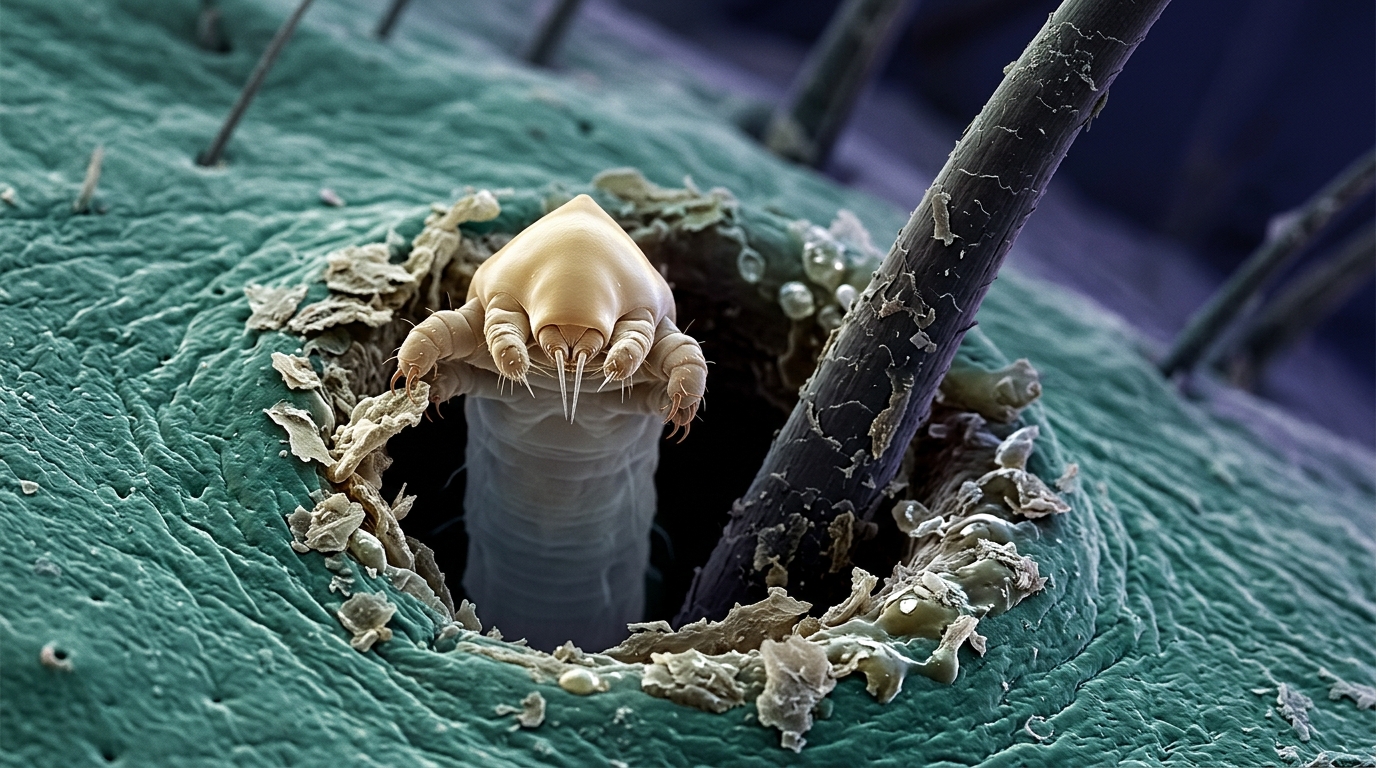
Washing your face morning and night is not enough to stay alone under your own skin. Like a house that remains inhabited despite a thorough cleaning, your face is constantly home to tiny roommates. In 2014, a team from North Carolina sought to verify their real presence using DNA, with a result that surprised even the researchers themselves.
- In 2014, Megan Thoemmes’s study detected Demodex DNA in 100% of tested adults, compared with 70% among younger participants.
- Researchers now estimate that Demodex folliculorum is present in more than 90% of humans, well beyond the rates observed by microscope in the 1980s.
- These mites are generally harmless, but an imbalance can cause blepharitis, for which the FDA approved its first treatment in 2023.
- The myth of the perfectly clean face collapses completely
- 100% success: a rate no one expected
- What the universal presence of these mites reveals
The Myth of the Clean Face Has Collapsed Completely
For a long time, people believed they could escape Demodex mites with soap and hot water. These microscopic creatures, distant relatives of spiders, nestle in pores at the base of hair follicles. Only two species colonize humans: Demodex folliculorum, which particularly favors the nose, forehead, and ear canal, and D. brevis, more drawn to the sebaceous glands.
Old detection methods relied on direct microscopic observation. A 1986 study of 370 volunteers, recruited from two hospitals and a university, already offered a glimpse of their ubiquity: about one-third of children and young adults carried them, half of adults, and up to two-thirds of older people.
But this technique had an obvious limitation. Detecting a mite with the naked eye inside a pore is a bit like looking for a needle in a haystack with a magnifying glass. Many carriers probably slipped through the cracks, biasing the statistics downward.
100% Success: a Rate No One Expected
This is where the 2014 study in the journal PLoS ONE by Megan Thoemmes and her team at North Carolina State University comes in. Rather than searching for the mites themselves, the researchers tracked their DNA, a method far more sensitive than traditional microscopic observation.
The sample was small—29 people in total—but the result was striking. Among the 19 adults over 18 tested, Demodex DNA was detected in 100% of cases. No exceptions, no faces spared. Among the younger participants, the rate still reached 70%.
The authors themselves remained cautious. The small sample size and its geographic concentration in North Carolina prevented a blunt generalization of this figure to all of humanity. But the signal was clear: earlier studies had substantially underestimated the true prevalence of these mites.
Since then, other studies have reinforced this idea. Researchers now estimate that Demodex folliculorum is present in more than 90% of humans, a figure that makes this mite one of the most faithful companions of our species, far more discreet than a cat or dog, yet just as constant.
What the Universal Presence of These Mites Reveals
This ubiquity has intrigued geneticists. In June 2022, a team from Bangor and Reading universities published in Molecular Biology and Evolution the first complete genome sequencing of Demodex folliculorum. The result is striking: it is the second smallest genome ever cataloged among a panarthropod.
This genetic reduction is explained by a very particular lifestyle. Isolated in each pore, these mites reproduce among individuals that are very closely related genetically, an extreme inbreeding that drives them to lose genes and even cells that have become unnecessary. They slowly drift toward a status akin to an internal symbiont, almost an integral part of our body rather than a mere resident passing through.
The lingering question remains: are these mites dangerous? Alejandra Perotti of the University of Reading provides an important nuance. The increased presence of Demodex in people with rosacea may be a consequence of the disease rather than its direct cause.
In some cases, imbalance does exist. In the United States, Demodex-related blepharitis accounts for more than two-thirds of eyelid inflammation cases. The situation is taken seriously: in 2023, the FDA approved its first treatment specifically designed for this condition.
Ultimately, these studies sketch a reassuring portrait of our tiny cohabitants. Far from being invaders to be fought at all costs, Demodex have been an intrinsic part of our skin ecosystem for millennia. Their near-universal presence highlights a simple truth: our skin has never been an empty territory but a true miniature world, discreet and broadly harmless, living in quiet existence just a few micrometers beneath the surface.
