
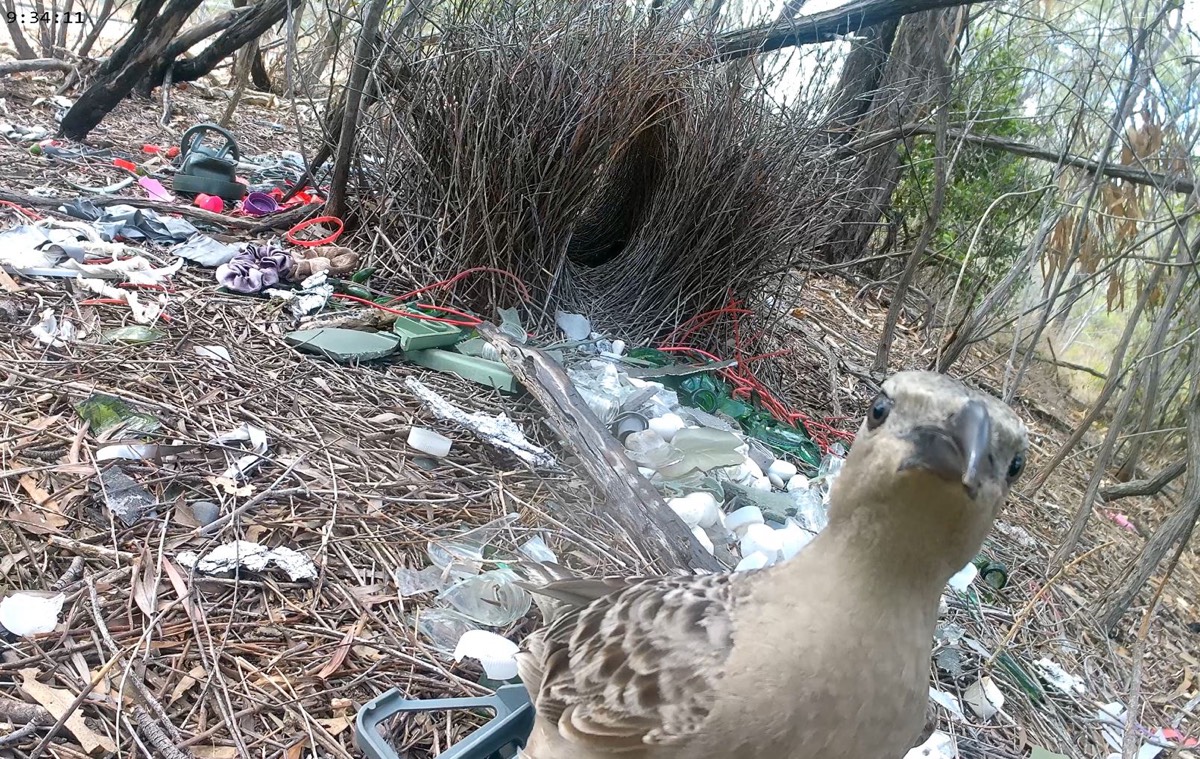
Australian gardeners are among the few animals that decorate their surroundings to attract mates. But a study published in Royal Society Open Science reveals that urbanization has profoundly transformed this art of courtship: where rural males collect leaves and seeds, their urban counterparts fill their bower with plastic, glass, and barbed wire — and accumulate up to five times more.
What you will learn
- How researchers measured the impact of urbanization on the male courtship rituals
- Why urban and rural birds both prefer human-made objects when given a choice
- What this transformation of mating displays implies for the species’ sexual selection
The Bower, the Architectural Masterpiece of Avian Seduction
The great Australian bowerbird is a standout case in the animal kingdom. The male builds a structure made from twigs — the bower — which he methodically decorates with colorful objects to attract females. When a prospective mate approaches, he projects his finest ornaments toward her while fanning his plumage.
This behavior is not innate in the strict sense: it evolves according to the resources available. That is precisely what a team from the University of Exeter aimed to measure by comparing bowers of 61 males spread across a rural site in Queensland and the city of Townsville.
An Inventory of 61 Bowers Between Urban and Rural Settings
During the 2023 breeding season, researchers photographed the decorations on each bower under visible and ultraviolet light — the realm in which gardeners perceive — focusing on the ten ornaments closest to the entrance, the ones used during displays.
To test the actual preferences of the males, the team then removed all decorations and assembled a mix of objects drawn from ten urban bowers and ten rural bowers. Three days later, they observed what each bird had chosen to retrieve.
The contrast was striking. Urban bowers contained an average of 90 items — versus 20 for the rural ones. One particularly motivated male had amassed 300. Among the more unusual finds: a pair of handcuffs, medicine containers near a hospital, fluorescent mouthguards near a football field.
Plastic vs Leaves: Two Aesthetics, One Instinct
In rural settings, green glass and natural elements — leaves, seeds, fruits — dominate bowers. In urban environments, green glass gives way to red wire and colored plastic. The urban reds are more vivid, the greens duller than their rural counterparts.
Yet the substitution experiment reveals a common preference: when given a choice between natural and artificial objects, males from both environments gravitate toward human-made productions. The difference between city and countryside thus does not lie in taste, but in availability.
A Courtship that Evolves with Its Environment
This behavioral plasticity raises a central question: is it a beneficial adaptation or a disruption of the sexual selection process?
Past studies indicate higher rates of display and mating among urban males. Yet researchers emphasize that it remains unknown whether urban females have developed preferences different from their rural counterparts — and whether a male well-supplied with red plastic truly gains a reproductive edge over one who patiently gathers berries in the forest.
What the study establishes with certainty is that human activity reconfigures animal behaviors that have evolved over millions of years — often in unexpected ways, and not always in the direction one might imagine.
