
Imagine a whole day wasted winding the seventeen locks one by one to gain only a few hundred meters of elevation. This was the daily reality for boatmen on the Marne–Rhine Canal, until a handful of engineers decided to completely reinvent how a barge could be navigated vertically.
- The Saint-Louis-Arzviller inclined plane replaces 17 locks and allows crossing 44.55 meters of elevation in just 4 minutes thanks to a mobile steel caisson on a 41% slope.
- In service on January 27, 1969 after an international architecture competition launched in 1962 by Robert Vadot, the structure can theoretically accommodate up to 39 barges per day.
- Today, primarily devoted to leisure boating, the site attracts over 75,000 visitors and more than 8,500 boats each year.
- Seventeen locks, a single water movement
- The steel caisson that defies gravity
- A day of navigation won forever
- What Saint-Louis-Arzviller has changed for the Marne–Rhine Canal
Seventeen locks, a single water movement
Before the late 1960s, crossing the Teigelbach valley was almost an endurance test for boatmen. Indeed, one had to pass no fewer than seventeen locks, tightly packed along about 4 kilometers, to make up a rise of 44.55 meters. Each lock imposed its own set of maneuvers, waiting and patience, turning this short stretch of the Marne–Rhine Canal into a true bottleneck for river traffic.
Facing this logistical puzzle, the General Engineer of Bridges and Roads Robert Vadot launched in 1962 an international architecture competition. The goal was clear: find a solution capable of replacing this succession of locks with a single, faster and more efficient structure. It was from this collective reflection that the idea of an inclined plane emerged—a kind of boat elevator able to swallow the entire elevation in one operation.
The steel caisson that defies gravity
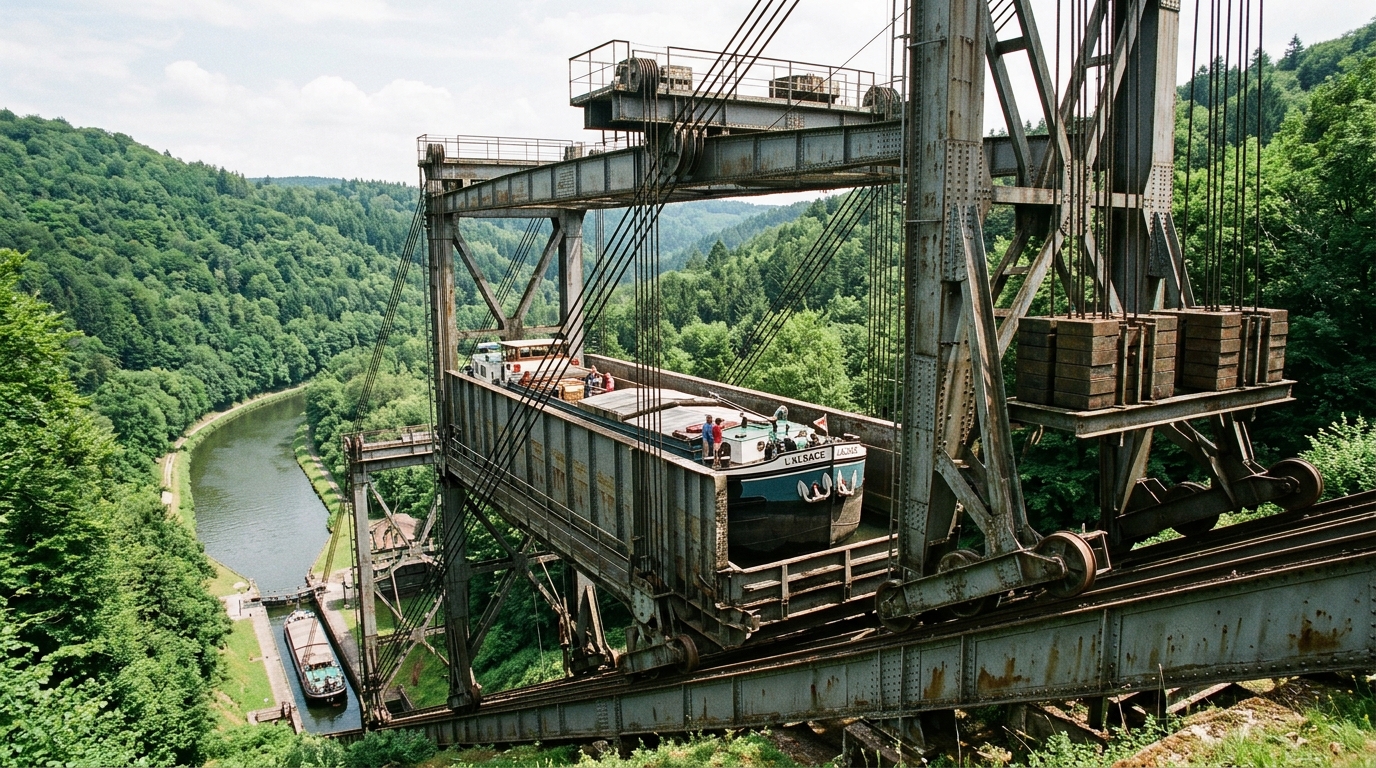
The chosen principle is almost a mechanical feat. A huge steel caisson carriage, filled with water and large enough to hold an entire barge, travels along a slope of 41% incline, guided by a longitudinal beam according to the EIN Review, specialized in water engineering. This caisson does not merely slide: it must stay perfectly horizontal throughout its descent or ascent, so that the water and the boat it carries never topple.
After tests conducted as early as 1968, the structure officially entered service on January 27, 1969. The result is spectacular: where one previously had to chain the locks for hours, the full crossing of the elevation can now be completed in just four minutes, a time finally comparable to passing a single conventional canal lock. Originally, engineers had even planned to build two identical caissons to absorb what was judged to be growing traffic. But the gradual decline of freight transport on waterways made that second structure unnecessary, and today a single steel caisson carriage suffices to provide the service.
A day of navigation won forever
This is perhaps the most telling aspect of this engineering feat: by replacing the seventeen locks with a single incline, the designers literally erased an entire day of navigation for commercial barges connecting Strasbourg to Paris. This substantial time saving is not merely a technical curiosity; it had a real economic impact on river traffic at the time, smoothing a strategic axis for the transport of goods between eastern France and the capital.
Technically, the structure could theoretically handle traffic of 39 barges per day, a figure that reflects the project’s initial ambition. While this maximum capacity is not called upon in the same way today, it serves as a reminder that the Saint-Louis-Arzviller inclined plane was designed to absorb a much denser commercial flow than what is observed today on this stretch of the canal.
What Saint-Louis-Arzviller has changed for the Marne–Rhine Canal
More than fifty years after its commissioning, the structure remains a unique case in Europe for its transversal operation across a canal. For its fiftieth anniversary in 2019, the Moselle prefecture recalled how essential this incline plane remains, with more than 75,000 visitors and over 8,500 pleasure boats using it each year. As freight transport gradually yielded to leisure boating, the structure reinvented itself without ever losing its appeal.
In autumn, a season favorable to quieter getaways along the Alsatian and Lorraine canals, the site attracts both boating enthusiasts and curious visitors who come simply to watch this impressive mechanical ballet. Watching a barge enter the steel caisson and then glide along the slope remains a rare experience, blending the rigor of engineering with a nearly hypnotic spectacle.
What is striking in the history of the Saint-Louis-Arzviller inclined plane is how a geographic constraint was turned into an opportunity for innovation. Where seventeen locks dictated a slow, repetitive rhythm, a single mechanical device sufficed to reshape the uses of an entire canal. One might wonder how many other pieces of French river heritage deserve to be rediscovered today through the same perspective—the engineering serving time saved and travel reimagined.
