
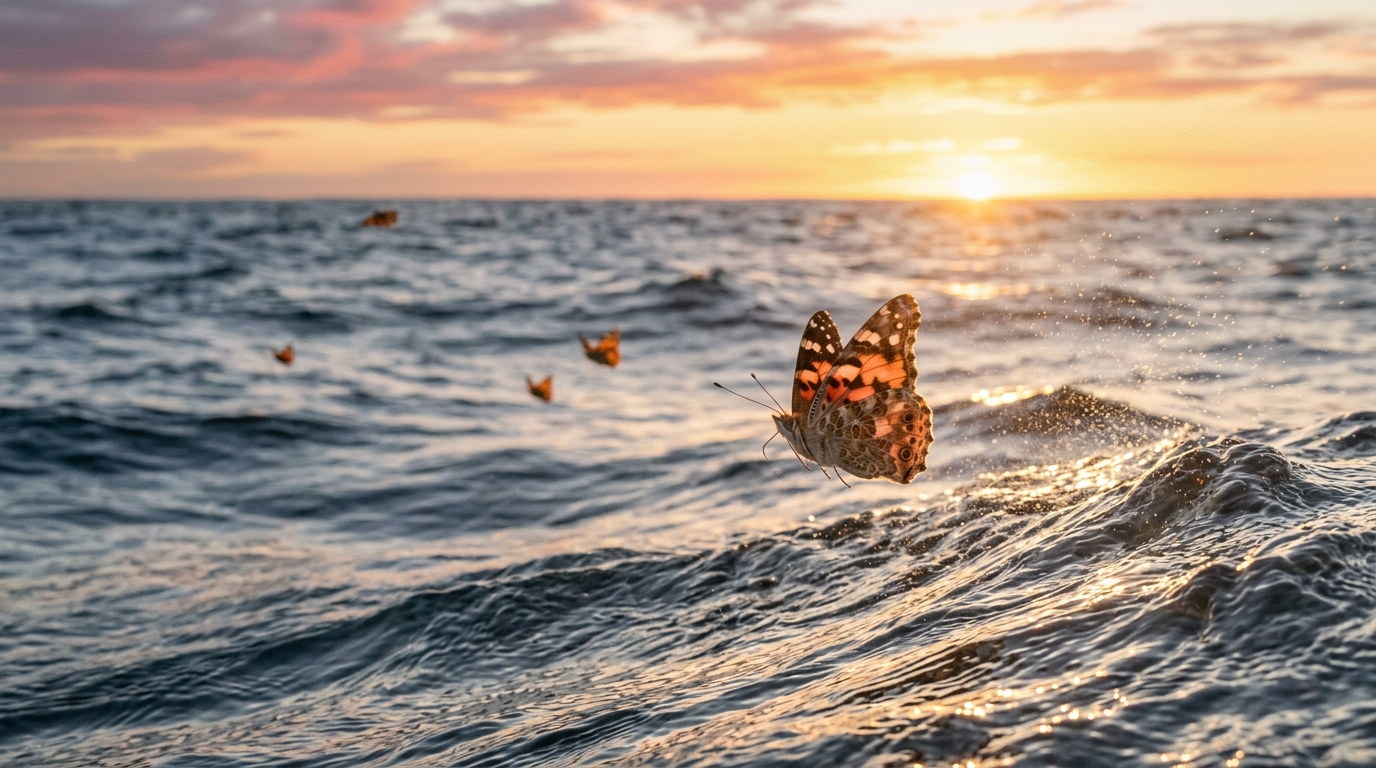
4,200 kilometers across the Atlantic without a stop: the painted ladies stranded in 2013 on a Guyanese beach had originated from Africa
Butterflies with torn wings wash up on a beach in French Guiana, thousands of kilometers from any known population of their species. The explanation for this anomaly lies in one word: an aerial crossing of the Atlantic, previously deemed impossible for such a light insect. This scene, observed in 2013 by biologist Gerard Talavera, remained a mystery for more than a decade. It would take the use of highly advanced analytical tools, blending genetics, pollen analysis, and wind modeling, to finally understand where these improbable travelers came from and what biological feat they had accomplished. The result, published in a leading scientific journal, reshapes what we thought we knew about the migratory abilities of the animal world.
- In 2013, painted ladies (Vanessa cardui) were found exhausted on a Guyanese beach, with no link to a population known in the Americas.
- The pollen analysis attached to their bodies revealed an origin in West Africa, proving a transatlantic crossing of at least 4,200 km without a stopover.
- This feat could only have been possible with the help of Saharan winds and trade winds, in 5 to 8 days, upending our understanding of insects’ migratory capabilities.
- Exhausted butterflies on a Guyanese beach
- The pollen that revealed it all
- A 4,200-kilometer flight with no layover
- What this exploit reveals about insect capabilities
Exhausted butterflies on a Guyanese beach
In 2013, entomologists discovered several Vanessa cardui, the painted ladies, stranded along the Guyanese coastline in an extreme state of exhaustion. Their wings were damaged and worn, as if they had just completed an effort far beyond what the species normally achieves. The problem: these butterflies did not belong to any known population in South America, and their presence did not correspond to any documented migration on that continent.
Yet the species is by no means unknown to science. It already undertakes impressive migrations in Europe and Africa, across multiple generations, a biological relay that allows them to cover thousands of kilometers over the seasons. But crossing an entire ocean in one go remained, at that time, an hypothesis judged frankly unlikely by the scientific community.
Lacking a satisfying explanation, researchers simply collected the specimens. It would take more than ten years and the advent of cutting-edge analysis techniques to hope to crack this entomological mystery that never left Gerard Talavera’s mind.
The pollen that revealed everything
It was by examining the butterflies from an unexpected angle that the Barcelona Institute of Botany team would tilt the investigation. Their fur still bore tiny grains of pollen, invisible to the naked eye but carrying a true genetic fingerprint. This method, pollen metabarcoding—which is rarely used in entomology—proved decisive in retracing the insects’ real journey.
Genetic analysis of these grains identified plants native to West Africa, a region thousands of kilometers from Guyana. This detail immediately ruled out any South American or North American origin for these butterflies. The West African pollen carried by the butterflies thus demonstrated a transatlantic crossing of at least 4,200 kilometers, aided by the winds, as shown in the study published in Nature Communications in June 2024.
The researchers then cross-referenced these data with isotopic geolocation and the butterflies’ own DNA. All indicators converged on the same conclusion: these painted ladies indeed crossed the Atlantic from the African continent, and isotopic analysis even suggested an origin even farther afield, in Western Europe, bringing the total journey to 7,000 kilometers or more.
A 4,200-kilometer flight with no layover
To reconstruct the most probable trajectory, scientists relied on atmospheric circulation models recorded in 2013. The route would have crossed the Atlantic over a minimum distance of 4,200 kilometers, with no possible rest stop for the insect—the ocean providing obviously no layover for a flying creature.
Yet a butterfly, no matter how resilient, does not possess the energy autonomy to sustain such a distance by wingbeats alone. Researchers thus estimate that an external assist system was indispensable for the crossing to succeed; without it, the feat would simply be physiologically impossible.
The climate models point to the trade winds and the Saharan air layer—the same current known for carrying Sahara dust to the Amazon—as the main allies of this odyssey. Combined with the insect’s powered flight, this air stream would have allowed the journey to be completed in five to eight days, with butterflies alternating active flight phases and wind-assisted gliding segments.
What this feat reveals about insect capabilities
This discovery deeply reshapes our understanding of insects’ migratory abilities. If a butterfly with such fragile wings can cross an entire ocean, other species might accomplish similar feats, previously entirely invisible due to a lack of direct observation.
Researchers now point to the possibility of genetic connections between populations located on different continents. This phenomenon, long dismissed as anecdotal or fanciful, deserves global reevaluation, as it questions how certain species disperse and adapt over the long term.
David Lohman, a researcher at the City College of New York who did not participate in the study, described this method that combines pollen, wind, genetics, and isotopes as a remarkable piece of biological inquiry. Such recognition highlights how a multidisciplinary approach used here could become a model for uncovering other extraordinary journeys that remain invisible for lack of suitable tools.
Beyond the scientific feat, Gerard Talavera stresses a crucial point: the need to systematically monitor insect dispersion across the globe. With climate change altering wind patterns and ecosystems, understanding how these tiny creatures move over such distances could prove essential for anticipating future biodiversity upheavals. A humbling lesson, too, for anyone who believed they understood the limits of living beings.
