
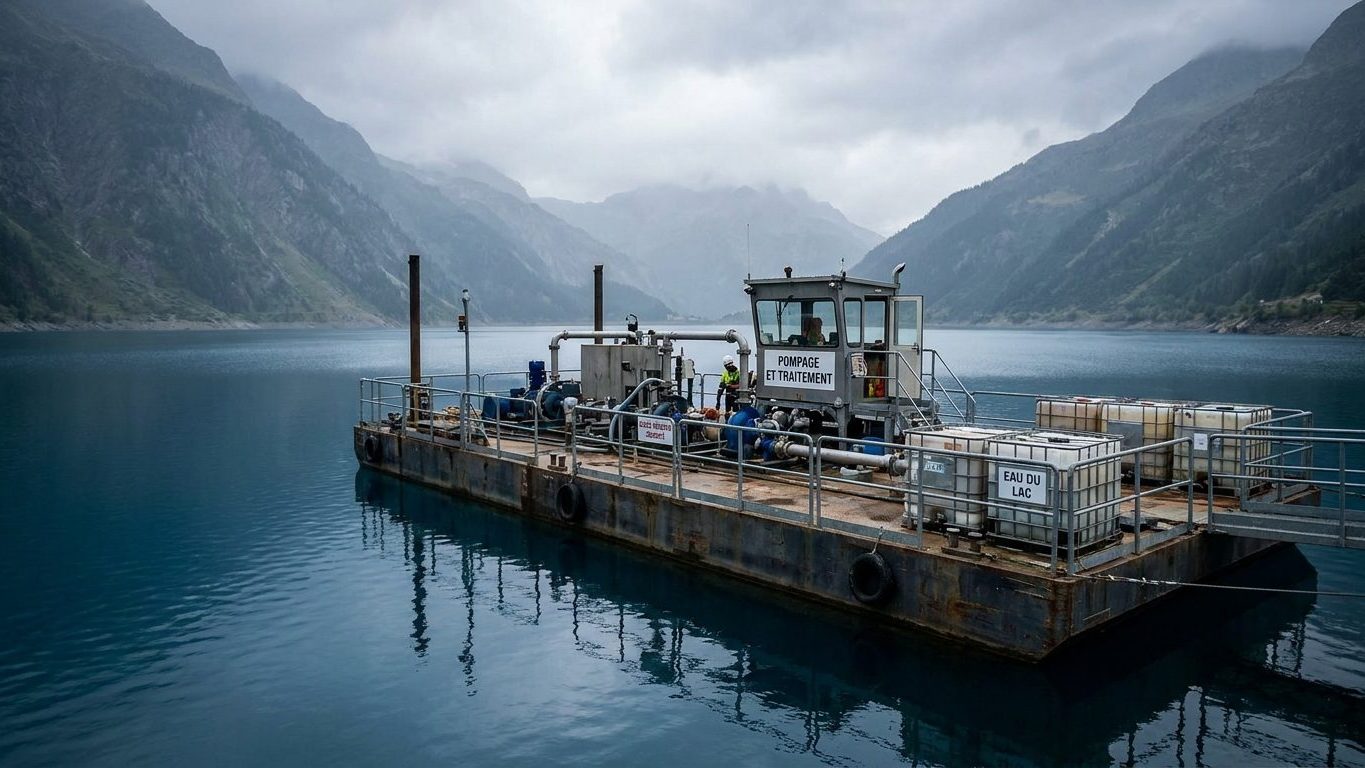
Under the calm waters of Lake Kivu, straddling the border between Rwanda and the Democratic Republic of Congo, gas quantities so immense they are almost dizzying lie asleep. Its deep waters, separated from the surface by a permanent density stratification, contain about 62 km3 of methane and 300 km3 of carbon dioxide. And around two million people live in the lake’s immediate surroundings. Since the mid-2010s, this gas has begun to be pumped. Not to get rid of it in a disaster, but to turn it into electricity.
To understand the stakes, one must go back to Cameroon, a neighboring country. On August 21, 1986, an unforeseen phenomenon erased whole villages from the map in a single night.
- Lake Kivu contains about 300 km³ of CO2 and 62 km³ of methane trapped beneath a stable water layer for centuries.
- A limnic eruption comparable to Nyos in 1986 could theoretically claim two million lives.
- Since 2015, the KivuWatt project has been pumping methane to generate 500–700 MW of electricity over 25 years.
Nyos, the night a lake killed in silence
The Nyos disaster is a limnic eruption that occurred on August 21, 1986 in the northwest of Cameroon, which caused the deaths of 1,746 people and nearly 3,000 livestock. No explosion, no fire, no earthquake. Just an invisible gas that spread through the valleys while residents slept.
The eruption triggered the sudden release of roughly 100,000 to 300,000 tonnes of carbon dioxide, a cloud that first rose at nearly 100 km/h before falling back down, being heavier than air, onto neighboring villages, suffocating people and animals within 25 km of the lake. The precise mechanism that triggered this massive degassing remains debated. Its cause has not been established: most geologists suspect a landslide, but some believe a minor volcanic eruption at the bottom of the lake.
It would take until 2001 for a technical response to emerge. Beginning in 2001, a French team led by Professor Michel Halbwachs installed a clever, artisanal system, with degassing pipes to release the gases imprisoned in a controlled manner, a plastic tube descending to a depth of 203 meters. The principle is like opening a soda bottle slowly rather than shaking it: the gas rises continuously, without a jolt, rather than piling up and then releasing all at once. Today, several degassing columns operate continuously, and despite these measures, Lake Nyos remains under close watch.
Kivu, a geological bomb beneath two million inhabitants
Lake Kivu is not Nyos in scale. Located on the border between Rwanda and the Democratic Republic of Congo, it covers a surface of 2,385 km2, contains a volume of 550 km3 and has a maximum depth of 485 meters. Entire towns, Goma on the Congolese side and Gisenyi on the Rwandan side, line its shores.
What makes the lake unique is its stratification. It differs from other large African lakes by its permanent stratification, characterized by a main chemocline extending from 255 to 262 meters. Beneath this layer, the gas has stagnated for centuries, not mixing with surface water. The gases are only transported out of the deep zones by a slow ascent, with a residence time of 800 to 1,000 years. What rests at the bottom today could have been there since the era of the great barbarian invasions in Europe.
The danger is what could break this balance. A rise in warm water, a submarine landslide, or the region’s volcanic activity could in theory destabilize the stratification. In 2002, an eruption of Nyiragongo had raised fears of a disruption to the lake’s stratification, potentially triggering a rise of the gas-bearing layers, a risk kept under close surveillance. More recent observations have identified another source of concern. Satellite imagery showed a section of underground magmatic fault opening southward toward Rwandan territory, beneath the lake’s northern part, raising fears of a rapid and massive CO2 release. Rwandan authorities have since tempered these fears, excluding any immediate risk.
No credible scientist sets a precise deadline for a limnic eruption at Kivu. But the scale of a catastrophic scenario, should it ever occur, is staggering. According to alarmist estimates, a Nyos-type disaster could kill up to two million people around Lake Kivu. This figure remains theoretical, not a forecast.
From threat to resource: the pumping gamble
Faced with this risk, a logic gradually took hold among researchers and local authorities: rather than letting the gas accumulate indefinitely without action, extract it and use it. This is precisely the opposite of what happened at Nyos, where degassing serves only to avert danger.
This is the bet of the KivuWatt plant, installed on the Rwandan side since late 2015: a floating barge pumps water saturated with carbon dioxide and methane from about 350 meters depth. Once raised, the water releases its methane, which drives turbines to generate electricity. The CO2, for its part, is largely reinjected or treated separately. A second project, launched since 2019 in the Rubavu district by Shema Power Lake Kivu, complements this system.
The scale of the energy potential reflects the economic logic behind the operation. The lake’s gas reservoir would contain about 42 km3 of methane and 200 km3 of carbon dioxide in its exploitable zone, an amount that would yield electrical production of 500 to 700 MW over 25 years. Enough to cover a substantial portion of Rwanda’s electricity needs for decades, while gradually reducing the gas burden on the two million inhabitants.
The method is not without its critics. A study by the University of Calgary, published in March 2025 in the ACS Omega journal, points to the effects of reinjecting acidic water into areas of the lake previously devoid of gas, with potentially measurable consequences for the local ecosystem. Lake Kivu thus remains a rare case where the same body of water embodies both a closely monitored geologic hazard and a source of energy being exploited at an industrial scale.
Sources: histoires-inexpliquees.fr | sddnature.com
