
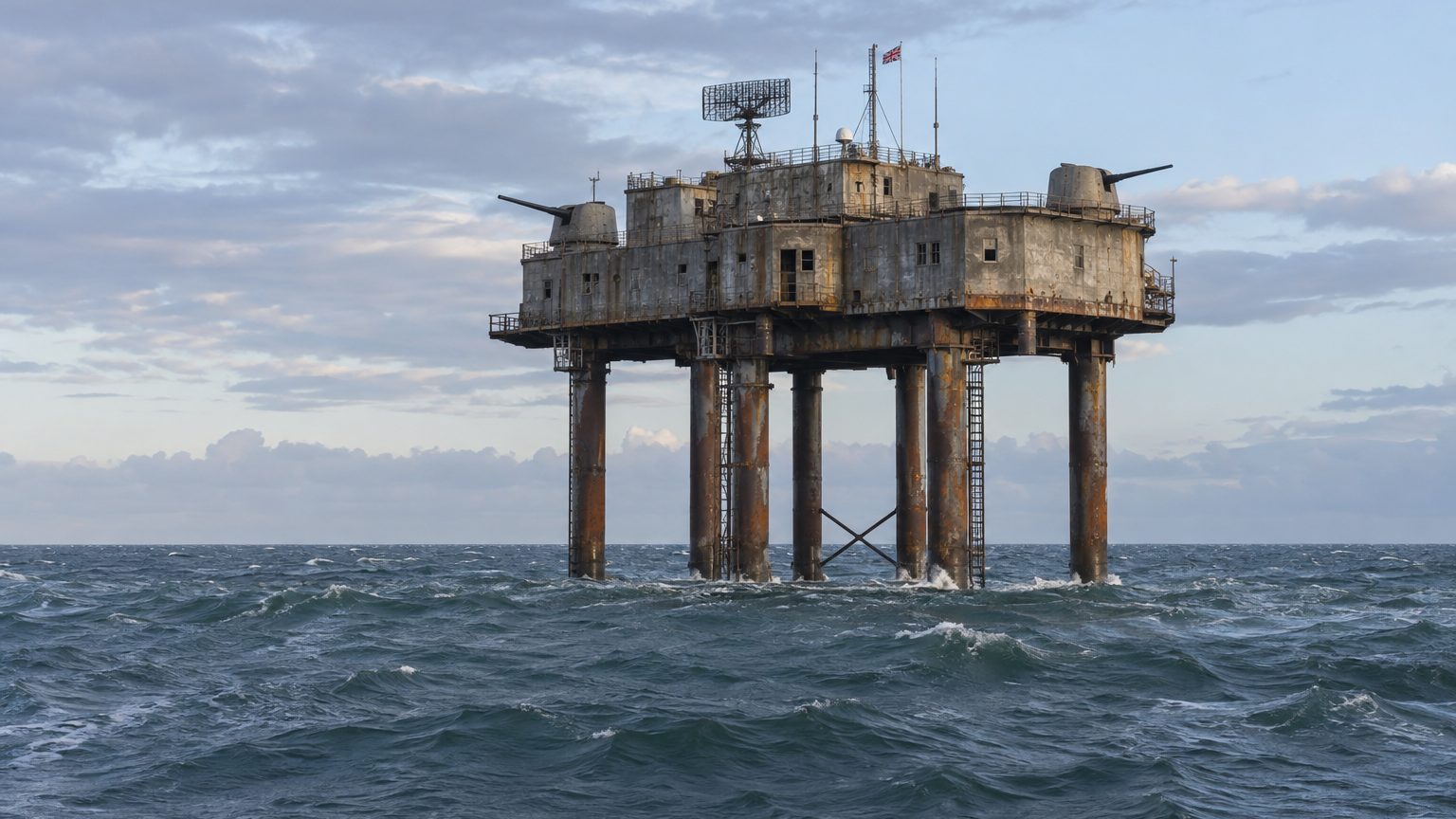
This flag is not British. It flies over Roughs Tower, a steel-and-concrete platform set in the North Sea about 12 km from Felixstowe, in Suffolk, and it represents the Principality of Sealand. This micronation was proclaimed on September 2, 1967 by Paddy Roy Bates, a former British Army major, although its official symbols were not adopted until eight years later.
- Roughs Tower is a Maunsell fort built in 1942 on stilts about 6.5 nautical miles from the coast, i.e., beyond the British territorial waters of the time.
- Paddy Roy Bates occupied the fort in 1966 and proclaimed the Principality of Sealand on September 2, 1967 with a flag and an anthem.
- A 1968 judgment declared British justice incompetent because the fort lies outside the United Kingdom’s waters, creating a legal vacuum Bates exploited.
A War Fort Forgotten by the State
Roughs Tower dates from 1942. It is one of the Maunsell forts, named after civil engineer Guy Maunsell, built on stilts to take down German bombers that mined the estuaries. In the thick of the war, the platform could house up to 300 men, equipped with radars and anti-aircraft guns.
After 1945, most forts were dismantled, but Roughs Tower remained standing.
In the 1960s, these rusting carcasses attracted pirate radio stations, broadcasting from the sea to evade British law. As early as 1965, Jack Moore and his daughter Jane settled there on behalf of Radio Caroline. Paddy Roy Bates, who ran Radio Essex from another fort, Knock John, had been fined £100 before turning to Roughs. The Marine Broadcasting Offences Act of 1966 nonetheless prohibited such broadcasts, and it was in this context that Bates settled on the tower, by the end of 1966 according to the Encyclopædia Britannica, then repelling in 1967 an assault by Radio Caroline with incendiary bombs and firearms.
Warning Shots, a Court, and a Legal Vacuum
In 1968, Michael Bates, Roy’s son, fired warning shots at a Trinity House vessel, the body charged with maritime signaling. According to other accounts, the vessel was bringing workers to service a nearby buoy. The father and son were prosecuted for violating firearm regulations.
The trial opened in Chelmsford, in Essex, before Judge Chapman, and the verdict came on October 25, 1968. The reasoning boiled down to one figure: the limit of British territorial waters was then three nautical miles, just over 5.5 km, while the fort lay about 6.5 nautical miles from the coast. Outside the Kingdom’s waters, the court had no jurisdiction. The two men thus escaped charges.
The British judiciary declared itself incompetent, and the case ended there.
Bates saw this as de facto recognition. In 1975, he endowed Sealand with a constitution, a flag, and an anthem. In 1978, a German businessman, accompanied by Germans and Dutch, stormed the tower during the prince’s absence. Bates retook it, then released his prisoners after a visit by a diplomat from the German embassy in London, a visit he later described as a gesture of recognition.
1987: The Sea Expands, Sealand Remains
Since 1958, international law allowed a limit of 12 miles, or 22 km. London, however, waited until 1987 and the Territorial Sea Act to adopt it. Roughs Tower found itself inside British waters then.
The principality replied by proclaiming its own 12-mile limit, a month before the British law, according to Sealand’s official site. No treaty has ever resolved the overlap between the two claims.
No state recognizes Sealand.
The Bates family continues to occupy the platform. Roy died in 2012, and his son Michael, regent since 1999 and based in Essex, succeeded him. A guard watches over the fortress: as of August 2024, the platform had only one permanent resident. The principality funds its maintenance by selling noble titles and related merchandise, and it claims its own passports, stamps, and currency, under the motto E Mare, Libertas (“from the sea, freedom”).
The 1968 judgment does not recognize any state: it merely notes that the Chelmsford court did not have authority there. In 1978, the Cologne Administrative Court ruled that an artificial island could not constitute a state’s territory, and that Sealand’s inhabitants did not constitute a people in the sense of international law.
Sources: offshoreradiomuseum.co.uk | free-cities.org
