
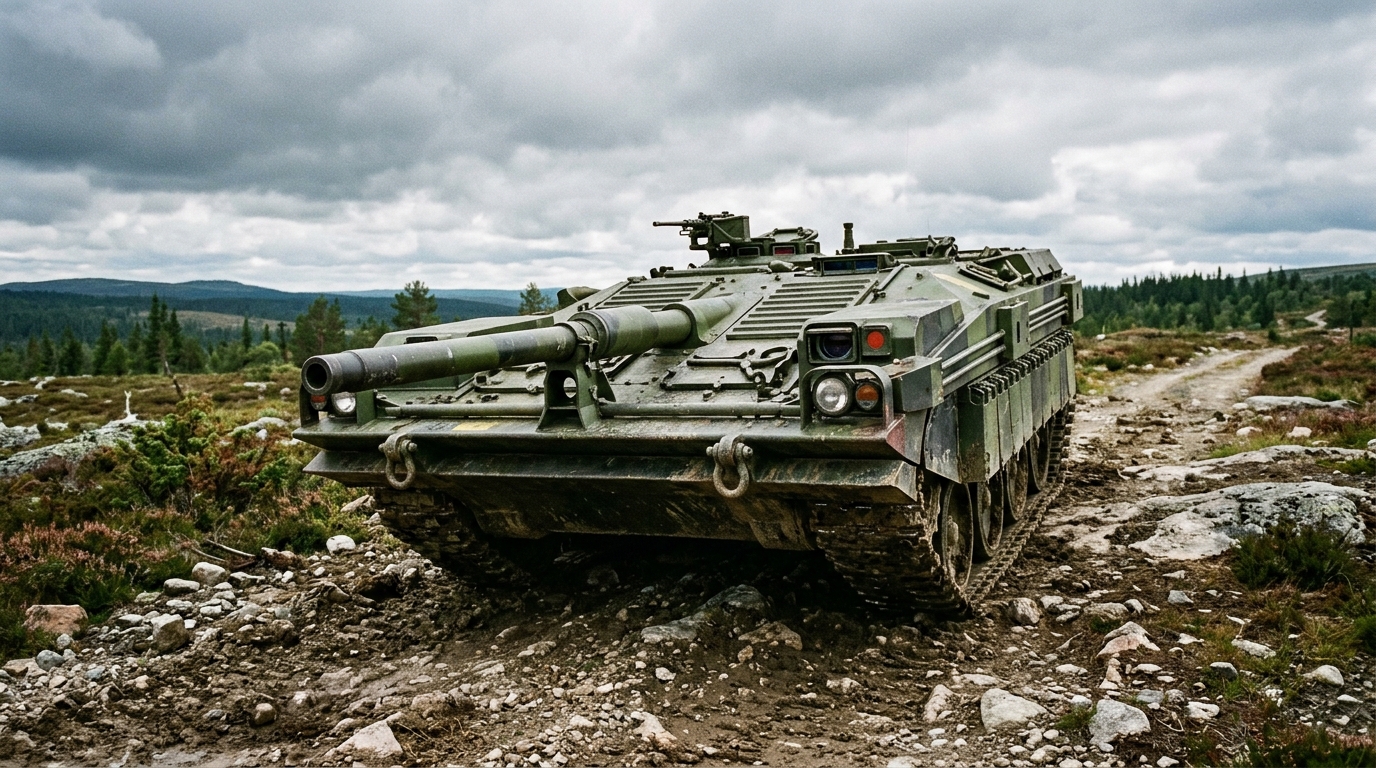
Imagine a turretless assault tank, where the gun is fixed and the entire chassis turns to aim at its target. This technical gamble, Sweden held to for thirty years with its remarkable Strv 103. But what signaled its end lies not in the mechanics, nor in a hidden flaw.
- The Strv 103, turretless, had to rotate the entire vehicle to orient its 105 mm cannon, with vertical aiming adjusted via a hydropneumatic suspension.
- Despite ongoing upgrades (fire-control in 1986, Detroit Diesel engines in 1987-1988), the tank remained fully operable at retirement in 1997.
- Its withdrawal stemmed from a doctrinal shift after the Cold War and its incompatibility with NATO standards, notably its inability to fire on the move, which led to its replacement by the Stridsvagn 121 (Leopard 2A4).
- A turretless tank: Sweden’s bold neutral gamble
- Aiming without moving: the Strv 103’s technical feat
- A formidable armored vehicle, up to the fall of the Iron Curtain
- The true reason for its retirement: not wear, not a design flaw
Un char sans tourelle : le pari fou de la Suède neutre
In the tense context of the Cold War, Sweden pursued a distinctive military doctrine: stay neutral, but arm yourself to deter any aggressor from the East. It is in this spirit that, in the mid-1960s, the Stridsvagn 103, better known by its evocative nickname of S-Tank, was born. Designed and built by the manufacturer Bofors, this armored vehicle broke radically with the established cannon concepts of European tank design. Between 1966 and 1971, no fewer than 290 examples rolled off the production lines, a substantial figure for a country whose population remained modest compared to the major military powers of the era.
What immediately strikes the observer is the complete absence of a rotating turret, that feature long regarded as a hallmark of the battle tank since World War I. Swedish engineers made a radical choice: to integrate the gun directly into the hull of the vehicle. It was not whimsy; it was a deliberate response to the constraints of the Scandinavian terrain, characterized by dense forests, rugged relief, and long snowy winters where concealment and a low profile mattered more than offensive mobility.
Viser sans bouger : la prouesse technique du Strv 103
With no turret, how does such a tank manage to adjust its fire? The answer lies in an ingeniously unconventional system: the entire vehicle must pivot to aim its gun at the target. Horizontal aiming is achieved by rotating the tank on its own axis, while the vertical elevation of the shot rests on a hydropneumatic suspension capable of changing the chassis’ attitude, somewhat like adjusting a vehicle’s suspension to tilt forward or backward.
This atypical architecture still allowed mounting a formidable armament for its time: a 105 mm rifled Bofors L74 cannon, a caliber standardized within NATO. Coupled with an extremely low profile, particularly hard to spot and hit in ambush positions, the Strv 103 became a fearsome defensive weapon, designed to surprise the enemy from forest cover rather than lead frontal offensives. This design philosophy, entirely oriented toward defending the homeland, perfectly illustrates the Swedish military doctrine of that period.
Un blindé redoutable, jusqu’à la chute du rideau de fer
Far from remaining fixed in its original configuration, the Strv 103 benefited from continual upgrades throughout its service. As early as 1986, a broad modernization program enriched the tanks with more capable fire-control systems, dramatically improving accuracy and responsiveness against adversaries. Two years later, between 1987 and 1988, Sweden also replaced the original British Rolls-Royce engines with American Detroit Diesel units delivering 290 horsepower, thus gaining mechanical reliability.
At the very start of the 1990s, Swedish engineers even explored the addition of a reactive armor, a technology capable of exploding external explosive charges upon contact with a projectile to neutralize its penetration effect. This project, technically viable, was ultimately abandoned. Not because it didn’t work, but because a far deeper upheaval was about to reshuffle Sweden’s defense landscape.
Le vrai motif de sa retraite : ni usure, ni défaut de conception
This is where the knot of the story unravels. In 1997, after three decades of loyal service, the Strv 103 was definitively withdrawn from the Swedish Army. One might legitimately think that such an aged armored vehicle suffered inevitable mechanical wear or a design flaw that became intolerable with time. That was not the case. The engines had been renewed, the electronics modernized, and the chassis remained perfectly functional.
The true reason for its retirement lies in a shift of strategic doctrine. With the collapse of the Soviet Union and the end of the Iron Curtain, the threat of a massive invasion from the East receded, and Sweden gradually redirected its defense policy toward greater mobility and participation in international joint exercises. Although it did not officially join NATO until 2024, Sweden aligned its equipment with NATO standards from the 1990s onward to cooperate effectively with partners. Yet the Strv 103’s 105 mm rifled cannon contrasted with the NATO standard 120 mm smoothbore caliber.
More fundamentally still, the very trait that gave the tank its strength spelled the end of its career: its inability to fire while moving. While a conventional tank can advance with its turret oriented toward the enemy, the Strv 103 must come to a complete halt and rotate the entire vehicle to adjust its shot, a tactical constraint poorly suited to the new mobility and force-projection doctrines. Thus the Strv 103 gave way to the Stridsvagn 121, Sweden’s version of the German Leopard 2A4, a more conventional tank but better adapted to the post–Cold War world’s requirements.
Today, Sweden remains the only country to have operationally used this turretless tank concept. The Strv 103 thus stands as a fascinating relic of a bygone era, one in which technical ingenuity served a particular geography and doctrine. Its story reminds us that the value of a weapon is not measured solely by its raw performance, but also by its ability to fit into a geopolitically evolving context. And if other military innovations, now deemed ingenious, may one day meet the same fate, not for lack of quality but simply because the world around them has changed?
