
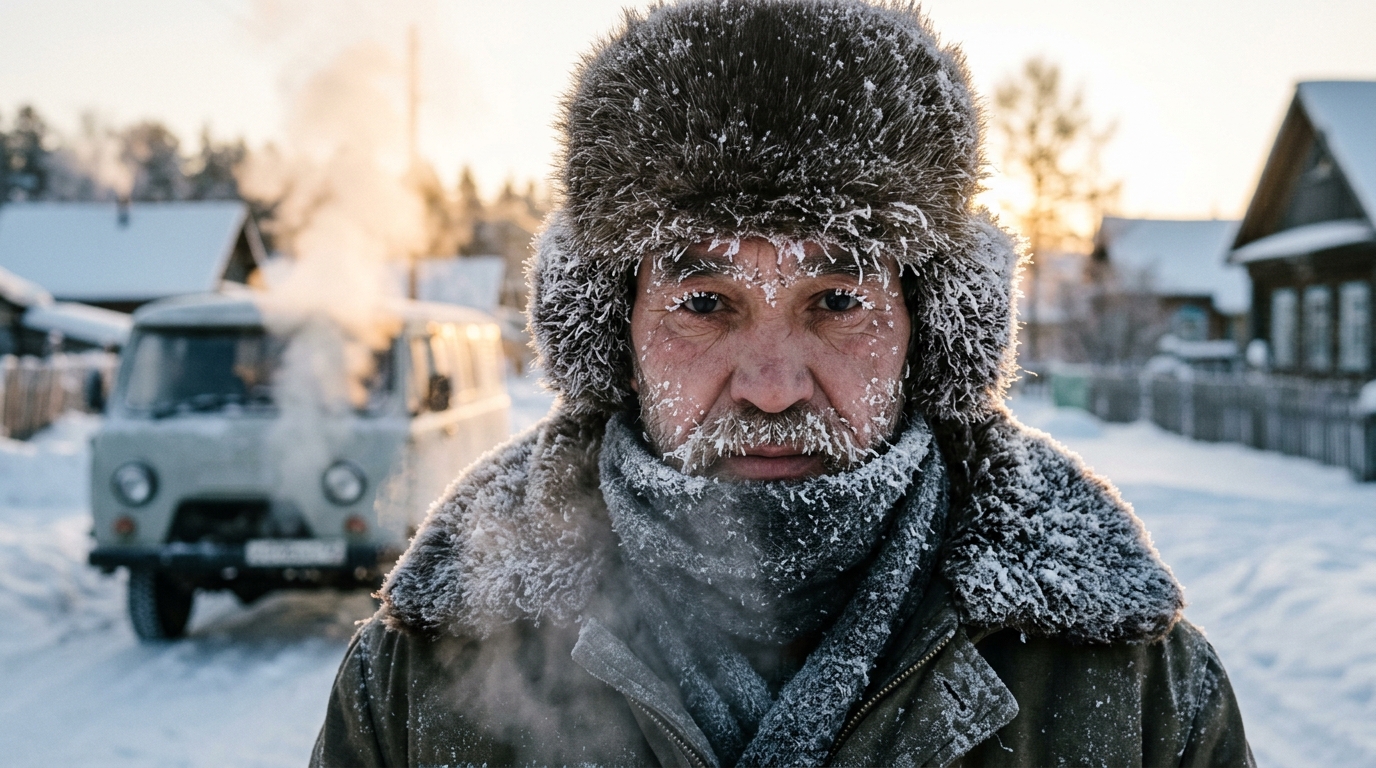
Imagine having to keep your car’s engine running for hours, simply because turning it off would mean you could never restart it. In eastern Siberia, this isn’t an excessive precaution—it’s a matter of survival. The village of Oymyakon, nestled in the Sakha Republic, holds a record that no one envies: the coldest permanently inhabited place on the planet, with -67.7 °C logged in 1933. A figure that makes your head spin just writing it, and that raises a fascinating question for anyone interested in the physical limits of living beings: how do humans manage to exist, generation after generation, in such a hostile environment?
- Oymyakon, an eastern Siberian village, recorded -67.7 °C in 1933, a record for a permanently inhabited location.
- Residents leave their cars running at all times, because extreme cold thickens the oil and drains the batteries, making any restart impossible.
- Around 500 residents withstand winters averaging -50 °C thanks to continuous wood heating, a fat-rich diet, and fur clothing.
- A Cold Beyond Human Understanding
- Cars That Never Stop
- Surviving Where Nothing Should Live
- A Climate That Shapes Every Daily Gesture
A Cold Beyond Human Understanding
To truly grasp the scale of the phenomenon, one must go back to February 1933, when Oymyakon’s thermometers displayed -67.7 °C. This figure, validated by the World Meteorological Organization, stands as one of the lowest temperatures ever recorded in a place where families live year-round. The neighboring town of Verkhoyansk contends for this unenviable title, having flirted with -67.6 °C in 1892. Two localities, one stakes: to determine which officially earns the label of the inhabited cold pole.
To put things in perspective, the coldest temperature ever measured on Earth remains -94.7 °C, captured by a NASA satellite over eastern Antarctica. But that region is utterly barren, with no human soul within hundreds of kilometers. The same goes for the South Pole, where the mercury can drop to -88 °C: the coldest point on the globe, yet no one lives there permanently. Oymyakon, by contrast, keeps its unique status: a real village with homes, residents, and daily life, where extreme cold is not a one-off anomaly but a recurrent winter reality.
Cars That Never Stop
In Oymyakon, mechanics follow rules that seem straight out of a science-fiction novel. When an engine cools to such extremes, the oil thickens, metals contract unevenly, and batteries lose a large portion of their ability to deliver the current needed to start. The result: locals have grown accustomed to leaving their vehicle running whenever they step out, even for a few minutes. Parking a car with the engine off in front of a store risks returning to a completely inert lump of frozen metal that no local mechanic could revive on site.
This mechanical constraint alone illustrates how Siberian cold redefines the most banal actions. Here, in France, we cut the ignition as we step out to buy a baguette without thinking. There, this simple habit can immobilize a vehicle for days, as it is gradually warmed up, sometimes with flames applied directly beneath the engine block. One anecdote tells of a public thermometer installed as a tourist attraction in the village that eventually malfunctioned after showing -62 °C, proof that even measuring instruments struggle to cope with such extreme thermal shocks.
Surviving Where Nothing Should Live
About 500 residents populate Oymyakon, a figure that has changed little since the 2012 census, which counted precisely 512 souls. By comparison, the neighboring town of Verkhoyansk gathers a little more than 1,100 people, evidence that these extreme conditions do not stop certain communities from persisting, even growing modestly. To endure winters where the average hovers around -50 °C in January and February, inhabitants rely on age-old solutions: wood and coal burn continuously in stoves, providing constant heat without which no dwelling would remain livable for more than a few hours.
What stands out most is the body’s adaptability and human habits to an environment that, on paper, seems incompatible with life. The local diet, rich in meat and fats, supplies the energy needed to combat heat loss. The clothing, often fur, creates an insulation that few modern textiles can match in such extreme conditions. Here we touch on a form of biological and cultural resilience that would deserve, in itself, a full dossier on the mechanisms by which the human body acclimates to polar cold.
A Climate That Shapes Every Daily Gesture
The proximity to the Arctic Circle adds another constraint to daily life: daylight becomes a scarce resource in winter. Days can be limited to a mere three hours of light in December, expanding to as much as 21 hours during the summer months. This extreme variation literally rhythms the lives of the inhabitants, who must organize activities around windows of brightness that can be very short—almost like compressing an entire day’s work into a handful of gray, icy hours.
Even the most routine tasks take on a spectacular turn under this climate. Tossing a glass of hot water into the air becomes a small local spectacle, as the liquid turns into a cloud of ice crystals before it hits the ground. This image, often relayed in reports about the region, aptly sums up the singularity of Oymyakon: a place where physics itself seems to behave differently, where cold does not merely chill, it redefines the laws of possibility.
Oymyakon thus remains a fascinating case study for anyone interested in the limits of human adaptation. This Siberian village proves that life always finds a way to settle, even in the harshest corners of our planet, provided one can work with the rules imposed by nature. Between engines running relentlessly, homes heated continuously, and days paced by capricious light, Oymyakon perfectly illustrates the unique capacity of some communities to turn the extreme into simple routine.
