
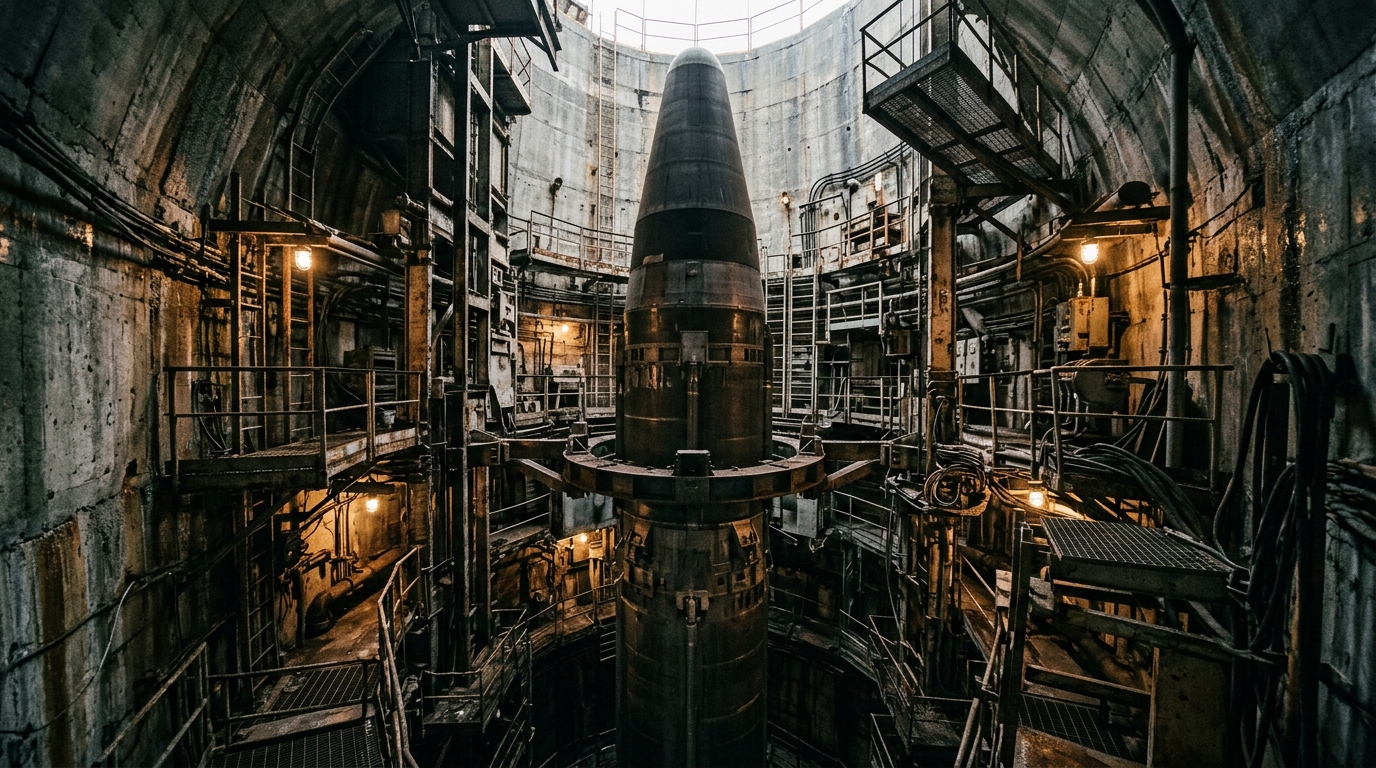
Imagine a missile capable of blotting a city off the map, concealed beneath tens of meters of concrete and steel, engineered to survive a Soviet nuclear strike. On paper, the Titan I looked every bit like the ultimate shield of American deterrence during the Cold War. Yet this 23-meter-tall giant hid an unsuspected fragility, a flaw that had nothing to do with Soviet espionage or satellite surveillance. The problem lay elsewhere, hidden in the very bowels of its mechanical design. To understand how a system meant to guarantee national security ended up obsolete after barely three years of service, you have to descend to the bottom of its silo, where everything played out in just a few minutes.
- The Titan I used a cryogenic fuel (liquid oxygen and kerosene) that could not be stored inside the missile, requiring refueling just before launch.
- The first missile at each site required about 15 minutes before liftoff, and had to be hoisted out of the silo into the open before ignition.
- Facing the arrival of Titan II and the Minuteman, faster systems using either storable propellants or solid fuel, the Titan I was withdrawn from service in 1965 after less than three years of operation.
- Fifteen minutes that change everything: the Achilles’ heel of the first silo-based ICBM
- Liquid oxygen, a capricious fuel that doomed Titan I
- Race against time: why hoisting a missile before firing becomes untenable
- From silo to scrap: how Titan I accelerated the Minuteman era
Quinze minutes qui changent tout : le talon d’Achille du premier ICBM en silo
Developed from January 1955 as a fallback to the Atlas program, Titan I was initially meant to compensate for a potential failure of its cousin, while paving the way for a more powerful missile. It quickly became the first American intercontinental ballistic missile to be stored in a hardened underground silo, a major innovation designed to render it invulnerable to enemy strikes. At its peak, between 1962 and 1965, 54 units were operational, spread across five American air bases, including Lowry, Ellsworth, and Beale.
But this technical feat hid a major flaw. At each site equipped with three missiles, the first required an inescapable delay of about 15 minutes before liftoff, while the two others could be launched in seven and a half minutes. In the midst of a nuclear crisis, that quarter-hour felt like an eternity, a time gap in which the entire deterrence strategy could crumble.
L’oxygène liquide, un carburant capricieux qui condamne le Titan I
The true source of this vulnerability lay in a technical choice that seemed prudent at the time: the use of a cryogenic fuel consisting of refined kerosene and liquid oxygen. This mixture, highly flammable, offered strong energy performance but imposed a fundamental physical constraint. The liquid oxygen had to be kept at cryogenic temperatures, which made any long-term storage inside the missile completely impossible.
Practically, fueling the tanks had to wait for the order to fire, an operation that used no fewer than 200,000 pounds of liquid oxygen and RP-1, equivalent to several tens of tons of fuel. It was therefore impossible to keep the missile ready to launch at all times, contrary to what one might expect of a weapon designed to respond to a lightning-fast strike. This chemical constraint would become, more than any espionage maneuver, the system’s true structural weakness.
Course contre la montre : pourquoi hisser un missile avant de tirer devient intenable
Once fueling was complete, another step made the Titan I particularly vulnerable: it had to be hoisted out of its protective silo using a giant elevator before it could be fired. In other words, the whole point of the hardened silo collapsed at the critical moment, as the missile found itself exposed on the surface for several minutes. The sites were hardened to only about 100 psi, a protection far from adequate against a direct nuclear assault.
Adding to the strategic fragility was a heavy operational burden. The crews responsible for the silos had to perform more than 80 daily operations just to keep the system running, an enormous workload for a device intended to guarantee a rapid response. Each missile, capable of carrying a W38 or W49 nuclear warhead with a yield up to 3.75 megatons, stood as a formidable weapon on paper, yet was effectively paralyzed by its own firing procedure.
Du silo à la casse : comment le Titan I a précipité l’ère du Minuteman
This flaw became glaring with the advent of a new generation of missiles using storable propellants, known as hypergols. The Titan II, propelled by nitrogen tetroxide and hydrazine, could be kept already fueled inside its silo, enabling direct launch in under 60 seconds without ever needing to surface. The Minuteman missiles, by contrast, relied on solid propellant, fully eliminating the constraint of last-minute refueling.
Facing this now evident technical obsolescence, the decision to retire Titan I was made in January and February 1965, ending an operational career of barely three years. Unlike other missiles of the era such as the Thor, Atlas, or Titan II, which found a second life in space launch programs, Titan I’s inventory was partly scrapped, never reused in a space launch program. A fairly radical fate for a weapon that, barely three years earlier, had symbolized the pinnacle of American ballistic technology.
The story of Titan I reveals that the real threat to a strategic weapon does not always come from the external enemy, but sometimes from its own technical compromises. A cryogenic fuel that looked attractive on paper, a firing procedure that was too slow, a silo meant to protect but which ultimately forced the missile to be exposed: this is how engineering prowess can become a strategic dead end in just a few years. A lesson that still resonates today, at a time when rapid response remains a central challenge for any defense technology.
