
Thousands of metres below the surface, where darkness, cold, and crushing pressure prevail, life still thrives. In 2019, a scientific expedition revealed the existence of beings as fragile as they are unexpected: three new species of snailfishes, whose features continue to astonish researchers. Their discovery serves as a reminder of how the oceans, despite decades of exploration, remain a predominantly unexplored realm.
An unlikely encounter in the abyss
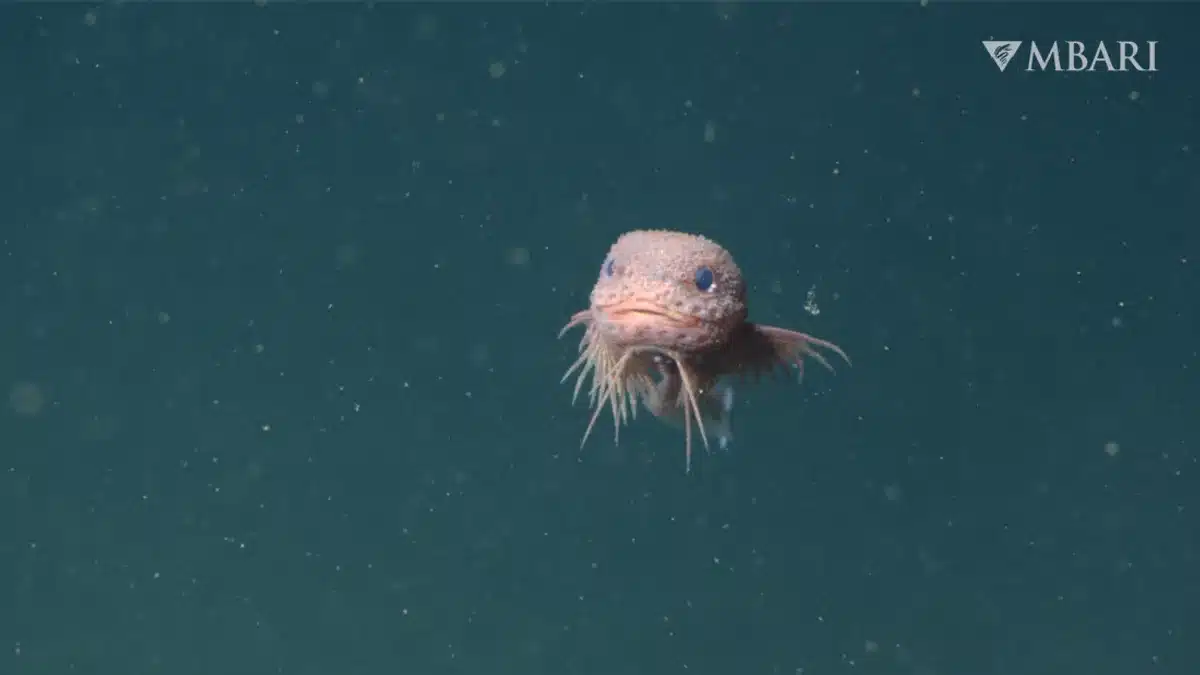
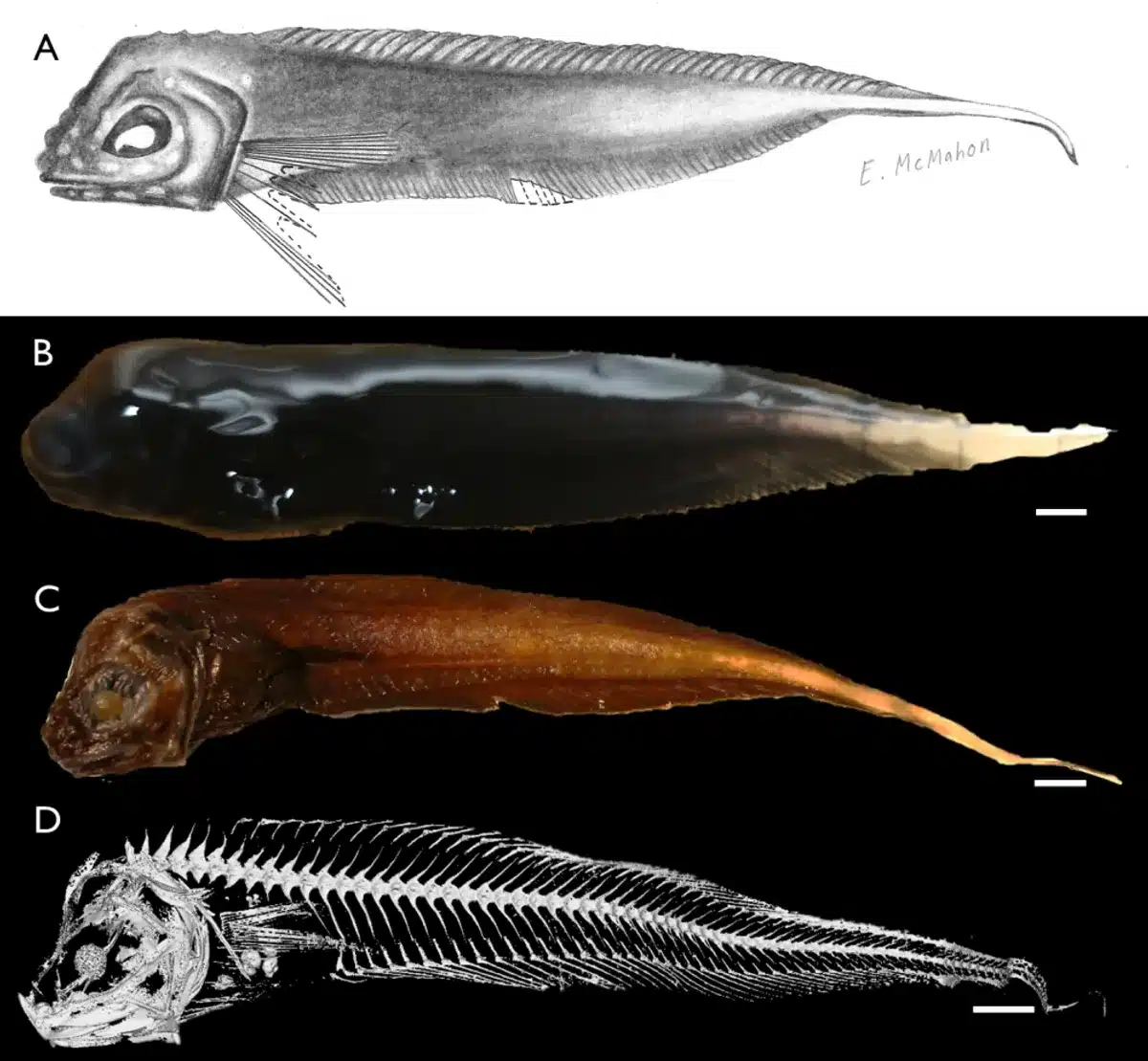
During a dive conducted with the help of the submersible Alvin, a team of researchers filmed a strange creature: a pink, bumpy mass, with oversized eyes and an unusually large number of pectoral fins. The animal, brought to the surface for study, turned out to be a new species of snailfish. Named Careproctus colliculi, or the bumpy snailfish, it was quickly joined by two “cousins” previously unknown: a dark snailfish, Careproctus yanceyi, and a smooth snailfish of the genus Paraliparis.
These three specimens were observed in the Pacific Ocean, at the Station M research site, an area nonetheless one of the most documented in the deep sea. The fact that two of these newly described species were collected during the same dive underscores how mysterious deep-sea biodiversity remains, even in regions studied for decades.
Creatures adapted to an extreme world
Snailfishes belong to the Liparidae family, a group comprising more than 400 known species. Their peculiarity lies in occupying a wide range of habitats: some live in simple tidal pools, others colonize the deepest parts of the ocean. Despite this diversity, they share a recognizable silhouette, featuring a large head and a gelatinous body.
The bumpy snailfish captivates with its 22 rays of pectoral fins, clearly visible in videos captured by the robots from the Monterey Bay Aquarium Research Institute (MBARI). These rays do not merely assist with locomotion: they also enable the animal to perceive its surroundings. Many fishes are capable of “tasting” through these structures, and the newly described species appear to use their fins as true sensory organs. In a world where sunlight is absent, this ability constitutes a vital advantage.
Color, an insignificant detail in the darkness
Among the three described species, color differences are striking: pink for the bumpy snailfish, black for the other two. Yet, thousands of metres deep, these chromatic variations lose all biological significance. As explained by biologist Mackenzie Gerringer, who led the study, these fish likely interact through other signals, such as water vibrations or dissolved chemical cues. A few flashes of bioluminescence exist in these depths, but their exact role in the animals’ perception remains to be clarified.
This surprising diversity illustrates an abyssal rule: what seems insignificant to our eyes can prove essential for survival in a world radically different from ours.
A living laboratory to understand resilience
Studying these species is also about understanding how life adapts to extreme conditions. In the abyss, temperatures are freezing, pressure exceeds hundreds of times what we experience at the surface, and food is scarce. Yet snailfishes thrive. Their gelatinous bodies, their distinctive metabolism, and their sensory capabilities enable them to transform this hostile environment into a natural habitat.
For Mackenzie Gerringer, a biology professor at SUNY Geneseo, these discoveries are not merely scientific progress. They represent a source of wonder and a call to protect deep-sea ecosystems. The oceans cover more than 70 percent of our planet, and the abyssal zone constitutes the largest habitat. Yet it remains largely unexplored and vulnerable to human threats, including deep-sea mining.
The abyss, a fragile heritage to preserve
The study, published in the journal Ichthyology & Herpetology, reminds us that there is still much to learn about the seafloor. Discovering three new species within a zone so well studied demonstrates that we have explored only a tiny fraction of this world. For scientists, these snailfishes are both an object of study and a symbol: one of life’s resilience and the necessity to understand better before exploiting.
The abyssal zones are not merely a frightening or inhospitable backdrop. They are the home to organisms that challenge our knowledge and push the boundaries of biology. Each discovery, like that of these snailfishes, brings us a little closer to a fundamental truth: our planet still holds countless mysteries, and it is our collective responsibility to safeguard them.
