
A 1,000-ton ice hull floating on a lake in the Canadian Rockies, protected by a simple wooden roof to fool prying eyes. This isn’t a legend: it’s Project Habakkuk, one of the most far‑fetched military programs of World War II, personally approved by Winston Churchill. Beneath the frozen waters of Patricia Lake in Alberta lies the wreck of an ice aircraft carrier built in 1943 under Churchill’s orders. Well over eighty years later, its relics still rest at the bottom of the water.
At a Glance
- A British inventor proposed building aircraft carriers out of ice to bypass steel shortages
- Pykrete, a revolutionary composite, proved tougher than concrete and resistant to bullets
- The secret prototype would melt after three years, but its remnants still lie more than 30 meters deep
An Unsinkable Aircraft Carrier to Beat the U-Boats
1942. The Battle of the Atlantic takes a dire turn for the Allies. German submarines harass convoys beyond the reach of land-based aircraft, and steel is in dangerously short supply for constructing new ships. It is in this context that a somewhat eccentric British inventor, Geoffrey Pyke, proposes a solution as audacious as it is brilliant: build aircraft carriers not from metal, but from ice. Project Habakkuk was a secret Allied experiment begun in the early 1940s under Pyke’s leadership, envisioning a carrier composed not of steel or wood but of ice. The economic argument wins over the Admiralty: ice costs almost nothing to produce compared with steel.
The project name isn’t incidental. According to several accounts, Pyke chose the name from a biblical passage where the prophet Habakkuk foresees a miracle that no one will believe. A sly bit of irony, given how insane the idea seemed at the time.
Pykrete: The Material Tested by Revolver Fire
Pure ice melts too quickly and shatters easily. Scientists then developed a composite called pykrete: a blend of water and wood pulp frozen together. This mixture—about 85% water and 15% wood pulp—proved to be stronger than concrete, resistant to bullets and torpedoes, and melted far more slowly than ordinary ice. A famous demonstration is said to have converted even the skeptical: at a strategic meeting, a military official fired a pistol at a block of conventional ice, which exploded into shards, then fired at a block of pykrete, which stood firm without flinching.
The properties of the material were astonishing. The substance was so tough that reports claimed a torpedo impact would only leave a surface dent about one meter deep. It suggested the possibility of a fleet of floating fortresses, literally invincible, able to shrug off German torpedoes without sinking.
A Secret Construction Site Deep in the Rockies
The question remained: how would the idea fare in real-world conditions? In January 1943, Patricia Lake was selected as the testing ground to construct a prototype, with the planned ship measuring 600 meters in length and the model built at a 1:10 scale. The site wasn’t chosen at random: the lake was already closed to the public for parachute-ski training, it was close to railway facilities, and a nearby camp housed conscientious objectors who could be put to work. Ironically, these men—opposed to the war in principle—were recruited to build a secret weapon without ever learning what it really was. They never found out what it was. They called it Noah’s Ark. They knew it was for the war effort, but they didn’t know exactly what.
The project advanced at a surprisingly brisk pace. At the start of 1943, a 60-foot-long prototype was erected, with wooden walls and floors, tar, refrigeration pipes, and a massive block of ice carved from the lake. Marine archaeologist Susan Langley, who studied the site, describes the structure as “a big shoebox, with a huge iceberg in the middle and refrigeration piping running around it like a ribcage.” The end result was an 18-meter by 9-meter block weighing about 1,000 tons, kept frozen by a single horsepower engine. Measured against the power needed for a conventional warship, it seemed almost ridiculous.
Three Years to Melt, and a Wreck Still Visible
Technically, the test worked. It worked quite well: the engineers managed to keep the model frozen through the entire summer of 1943. But the dream of a 600-meter giant aircraft carrier collided with crushing budgetary realities. Scaling up would have required astronomical quantities of materials: the final vessel would have needed 300,000 tons of wood pulp, 35,000 tons of insulation, and a colossal amount of steel for reinforcement. Add to that the arrival of longer-range bombers, capable of crossing the Atlantic without refueling, and the strategic urgency faded. These challenges, combined with advances in aviation technology, led to the project’s cancellation by the end of 1943.
Once the credits were cut, nobody bothered to dismantle the prototype properly. They simply removed the refrigeration equipment and let nature take its course. After the project was abandoned, the refrigeration gear was removed and the model was left there, gradually sinking into the lake. Contrary to fears of a rapid melt, the structure took a surprisingly long time to disappear: by some accounts, almost three years before it fully disappeared.
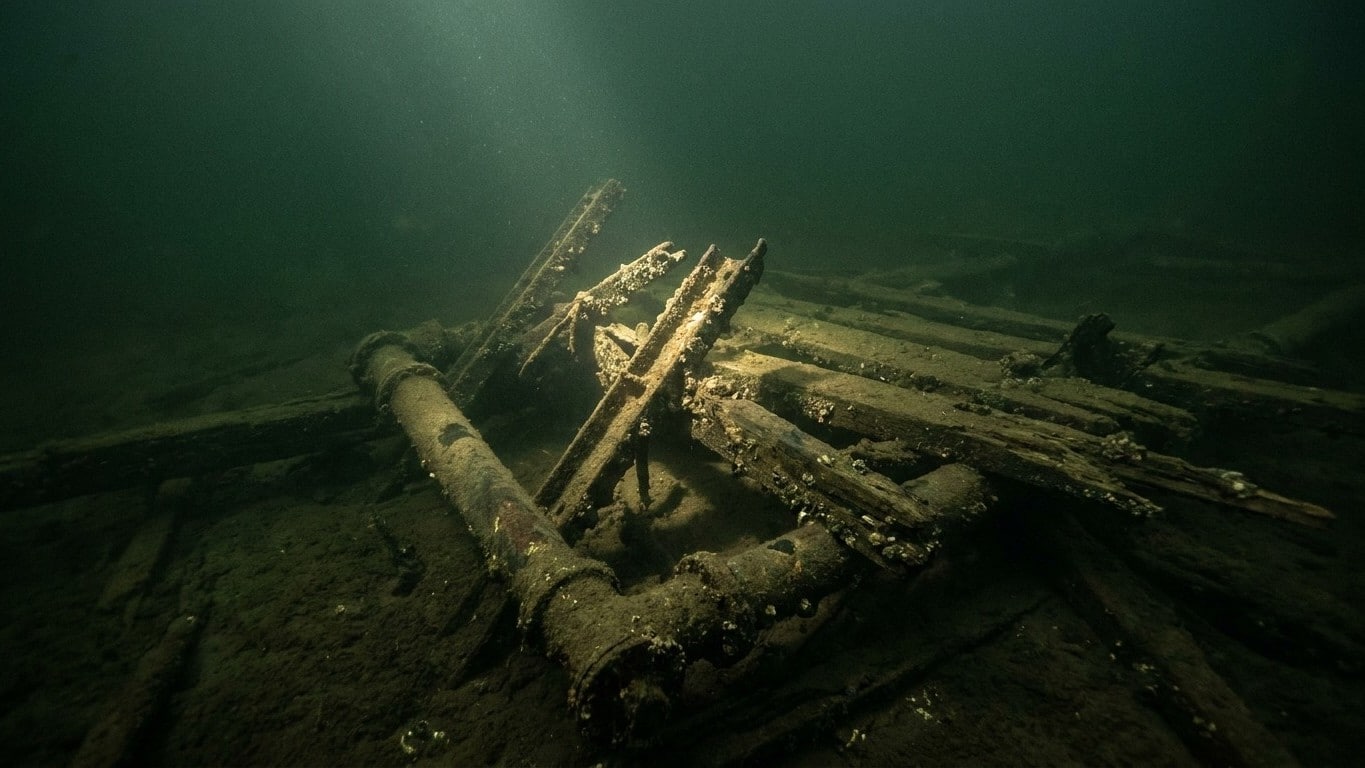
The story could have ended there, but a curious diver heard, forty years later, an improbable rumor about “an airplane made of ice” still being in the lake. Langley reported in 1982 hearing such a conversation about a frozen aircraft still at Patricia Lake, and she wanted to know more. Her 1984 dive, followed by an official expedition the next year, confirmed the unbelievable: a 1985 dive expedition found the wreckage of the model on a steep incline near the shoreline, at a depth between 26 and 43 meters.
Today, refrigeration pipes and wooden beams, weathered by time, still lie on the bottom of Patricia Lake, within Jasper National Park. A submerged plaque even marks the site for passing divers, turning this aborted military folly into a discreet tourist curiosity. Of all the exotic weapons projects imagined during World War II, this one is likely the only one whose wreck literally melted away on site.
Sources: revue-histoire.fr | effervesciences.info
