
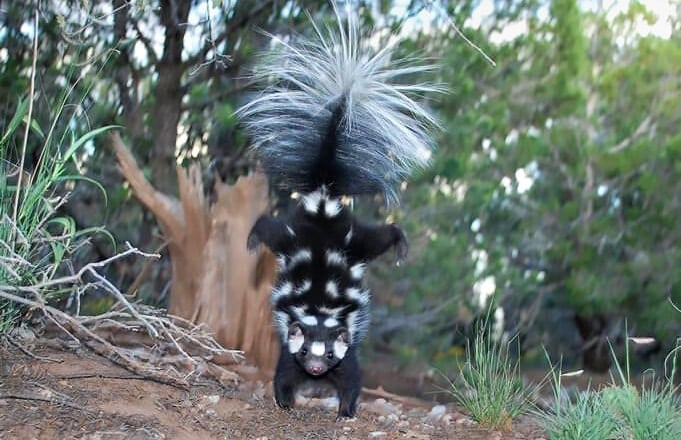
According to new research based on hundreds of DNA samples, there are in fact more skunk species than previously thought. Like polecats, these animals spray a foul-smelling liquid when threatened. And they typically warn you by performing a handstand.
Black fur, white stripes, malodorous liquid secretions – everyone can identify the striped skunk, the most common in North America. The spotted skunk, smaller (less than 1 kg), is a bit more discreet. Well, that’s putting it mildly. Indeed, these latter animals stand out by performing a handstand as a warning before they begin spraying their notorious smelly liquid. So, if you see one of these skunks plant its forelimbs before lifting its hindquarters, you should probably step back a bit, no matter how impressive the maneuver.
By “discreet,” they mean “less studied.” And for good reason, spotted skunks tend to do everything they can to keep people at a distance, to the point that researchers have long debated the number of species. Some proposed two, others counted fourteen. In the end, everyone agreed on four. In reality, there are a few more.
At least seven species
As part of a study, the results of which were published in the journal Molecular Phylogenetics and Evolution, a team examined more than two hundred DNA samples taken from spotted skunks, from Canada to Costa Rica. According to these analyses, led by Molly McDonough, a phylogenomicist at the University of Chicago, there would actually be seven species.
This new discovery shows that spotted skunks have diversified more than their close relatives, striped skunks and the eastern hog-nosed skunk (Conepatus leuconotus). For scientists, there could be a link to the size of these mammals, which are the smallest members of this family of caniform mammals.
“We might say they resemble rodents more closely,” explains Dr. Ferguson, referring to the animals’ limited ability to travel far and their relatively rapid reproductive cycles. These factors seem to have allowed spotted skunks to branch into new species over the course of the Plio-Pleistocene glacial cycles, as the North American climate evolved.
Different gestation periods
Researchers also note that six of these seven species can be divided into two groups (or clades), one located further to the east and the other to the west. The seventh species (named Spilogale yucatanensis) would be somewhat “aside,” as it originates from the Yucatán Peninsula in Mexico.
The most striking distinction between the two groups is that they seem to reproduce in different ways. In the eastern clade, females tend to mate in March or April to give birth in May or June (gestation of 50 to 65 days). In the west, they typically reproduce in the autumn, around September or October, then give birth in April or May (total gestation of 210 to 230 days).
How can such a difference in gestation be explained? For researchers, the “western skunks” could employ a strategy known as delayed implantation. In this process, a fertilized egg enters a period of dormancy before development. The mechanism, observed in other species, commonly helps conserve resources and survive seasonal food shortages. The offspring would then be born when conditions are more favorable.
