
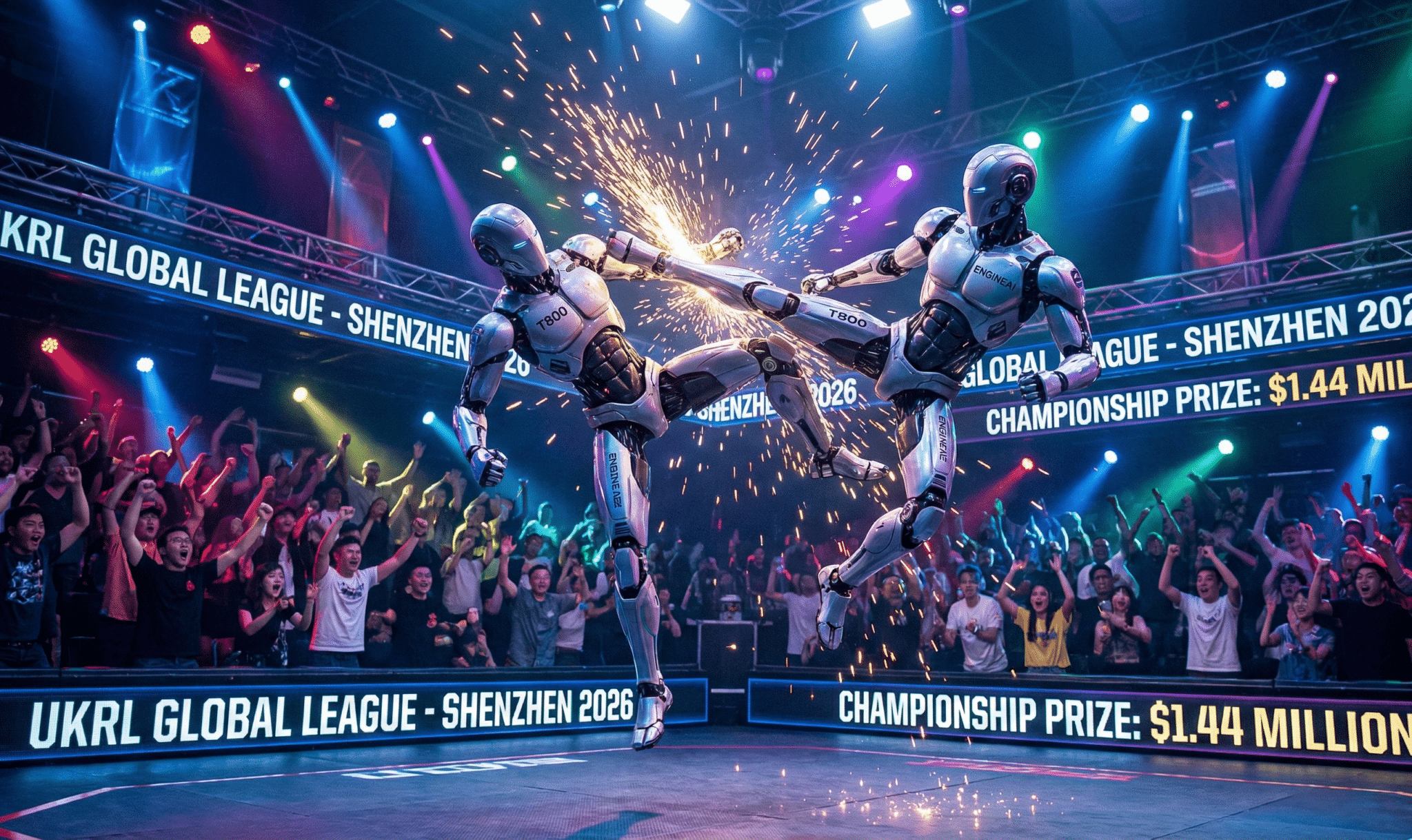
Remember the movie Real Steel where boxing robots battled in electrified arenas? It’s no longer science fiction. Last Monday in Shenzhen (the Chinese Silicon Valley), a new era of sport began. China has inaugurated the Ultimate Robot Knockout Legend (UKRL), the very first global league dedicated to humanoid combat. Forget the small wheeled robots of the “French Cup of Robotics”: here we’re talking about agile, bipedal machines capable of backflips and spinning kicks, with a colossal prize at stake.
The T800: a name that is no accident
The organizers spared no effort in naming their gladiator. The standard robot used for these duels is called the T800, a direct, deliberate nod to the killer cyborg from Terminator. Built by EngineAI, it isn’t a toy. It is a marvel of aerospace-grade aluminum engineering, able to run for 4 hours thanks to semiconductor batteries.
But it is its agility that intimidates (and fascinates). With motors delivering a monstrous torque of 450 Nm and a 360-degree LiDAR vision system, the T800 doesn’t merely walk awkwardly. It can perform capoeira-like movements, sidelong kicks, and aerial rotations. It is a metal gymnast designed for impact.
An Open-Source Strategy to Crush the Competition
The genius of this tournament isn’t just the spectacle; it’s the business model. Unlike Formula 1 where each team builds its own car, here, the T800 robots are provided free of charge to participating teams. Why such generosity? To accelerate research. By entrusting these machines to developers, students, and startups, China “crowdsources” innovation.
The objective is simple: whoever codes the best combat AI, capable of managing dynamic balance and violent impacts, will walk away with a belt in solid gold valued at 10 million yuan (roughly $1.44 million). It’s an R&D accelerator wearing a TV-show cloak. According to experts, these fights help test the durability of components (gear reducers, artificial tendons) far faster than in a laboratory setting.
From the Ring to the Factory?
If the viral imagery of robots throwing right hands is captivating and draws young talents toward robotics, some experts urge caution. Tian Feng, an industry specialist, warns: “The combat demands extreme and brief movements.” The risk is that we end up creating robots superb at fighting but unable to perform tasks like folding laundry or working on a production line, which require steadiness and gentleness. Regardless, season 2026 is underway and will run through December. The race for robotic armament has found its playground, and it looks suspiciously like a boxing ring.
Sources: World’s first humanoid robot combat league launched in SZ_Latest News-Shenzhen Government Online (sz.gov.cn) | World’s First Commercial Humanoid Robot Fighting League Launches in China (yicaiglobal.com)
Article prepared with the help of AI · Our method
