
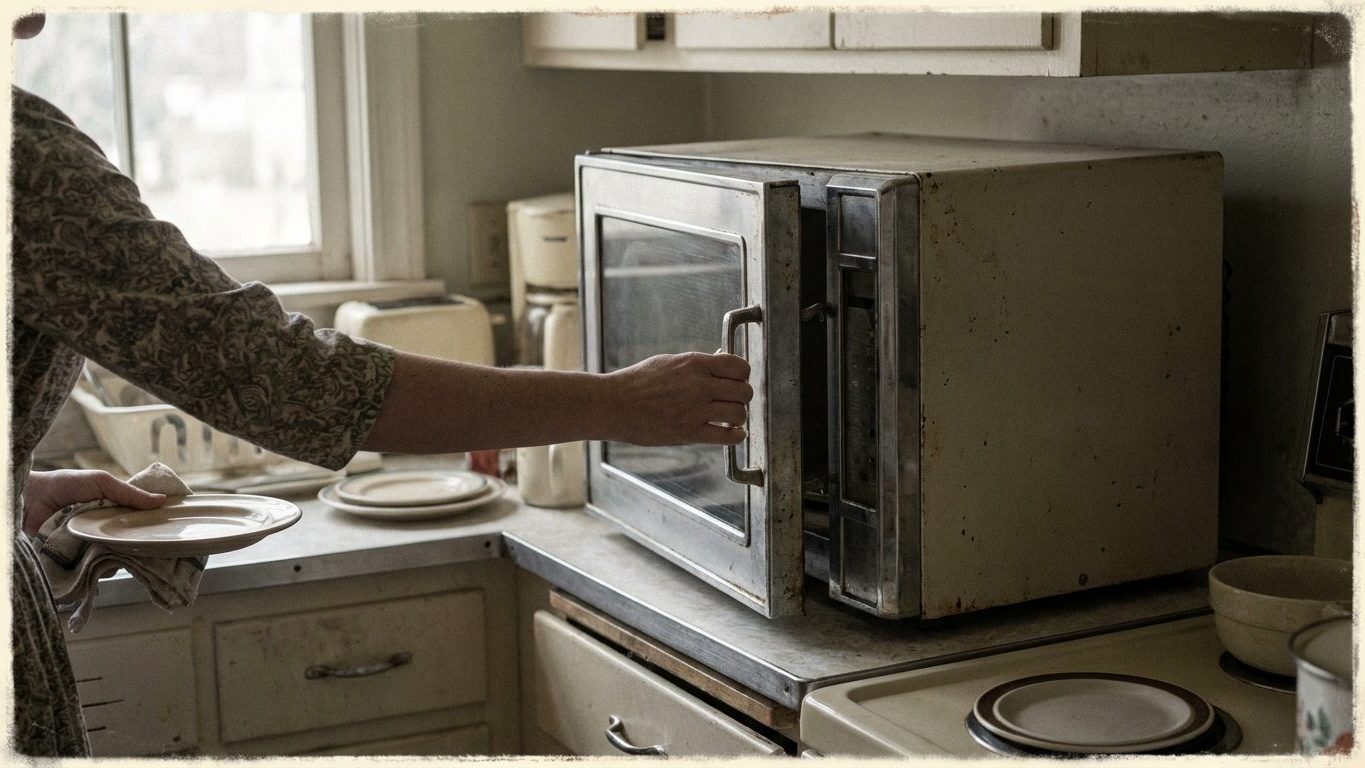
An engineer is busy near a radar equipment in operation, in a workshop where military components are tested. He slips his hand into his pocket, reflexively, to retrieve the chocolate bar he had tucked away a little earlier. It has melted. Not softened by the heat of a poorly ventilated room: liquefied, as if it had spent hours in direct sun.
Yet the room isn’t hot. There is nothing abnormal in the air, nothing that would explain such a neat melt. The engineer doesn’t walk away. He recalls the electronic tube he has just handled, that central radar component capable of emitting ultra-short waves, and he links the powered device to the candy transformed into a soft paste in his pocket.
This tube is called a magnetron. It equipped the detection systems used during World War II, designed to detect distant aircraft, not to heat anything. No one in this workshop is trying to cook. They are aiming to improve the accuracy of a radar, a topic that, on the surface, has nothing to do with a piece of chocolate.
- A chocolate bar melted in the pocket of an engineer near a magnetron revealed microwaves’ ability to heat foods from the inside
- Microwaves excite water molecules thousands of times per second, generating friction and heat, unlike traditional cooking methods
- The transition from a military magnetron to a domestic kitchen appliance required years of development to miniaturize, secure, and commercialize the technology
An Invisible Stirring, a Very Real Heat
The phenomenon rests on a simple property of microwaves: they excite water molecules. Placed in this radiation, these molecules begin to oscillate very rapidly, tens of thousands of times per second, and this motion generates friction at the microscopic scale. This friction produces heat.
Chocolate contains water, even in small amounts, like most foods. Microwaves pass through matter and heat whatever they encounter from the inside, unlike a flame or a heater that warms the surface before pushing heat toward the core. It is this reversal of the cooking direction that makes the process so distinctive.
The engineer does not stop at observing the phenomenon on his chocolate bar. He brings corn kernels close to the magnetron, and the kernels pop into popcorn before his eyes. He tries the experiment with an egg, which bursts under the pressure of the steam formed inside the shell.
From the Military Workshop to the Bulky Appliance
From observation to device, the path is direct in the engineer’s mind, though much longer in industrial reality. He envisions sealing the magnetron inside a metal enclosure capable of directing the waves toward a food placed inside, rather than letting them scatter in an workshop. The idea works, but the result looks nothing like what we now place on a kitchen countertop.
The first models are bulky. One must miniaturize components designed for military industry, cut their manufacturing costs, make them quiet and safe for everyday use. Public consumerization only comes much later, after years of development aimed at turning this device from an industrial curiosity into a kitchen appliance.
This slowness is not surprising. A component designed to detect airplanes does not become a kitchen appliance overnight.
Why Metal Is Problematic
Not all materials react to microwaves in the same way. Water, fats, and sugars absorb the radiation and heat up, which explains why a moist dish heats efficiently while a dry plate remains warm. Glass and certain ceramics, on the other hand, let the waves pass through without reacting: that is why an appropriate container hardly heats up by itself, with only its contents warming.
Metal, by contrast, reflects microwaves instead of absorbing them. Placed in a cavity designed to concentrate this radiation, it bounces the waves in all directions and can cause sparks, especially on thin or pointed surfaces like the edges of aluminum foil or a fork. The oven itself is a metal enclosure, but sealed and calculated to contain the waves, which has nothing to do with an isolated metal object placed inside.
This difference in how materials behave explains why some containers remain usable without risk and others do not.
An Accident That Became Routine
The device that now dominates almost every kitchen wasn’t born from culinary research. It sprang from an engineer who worked on radar detection and had no intention of revolutionizing how meals are prepared.
This disproportion deserves a closer look. On one side, a fleeting moment: a candy that melts in a pocket, without warning, without anyone seeking it. On the other, an object so commonplace that its presence on the worktop goes almost unnoticed, capable of reheating a dish in minutes where a pot would require far more.
The radar that helped detect enemy airplanes ended up warming lasagna. Few 20th-century inventions have seen such a gap between their origin and their destiny.
Sources: neozone.org | rtbf.be
