
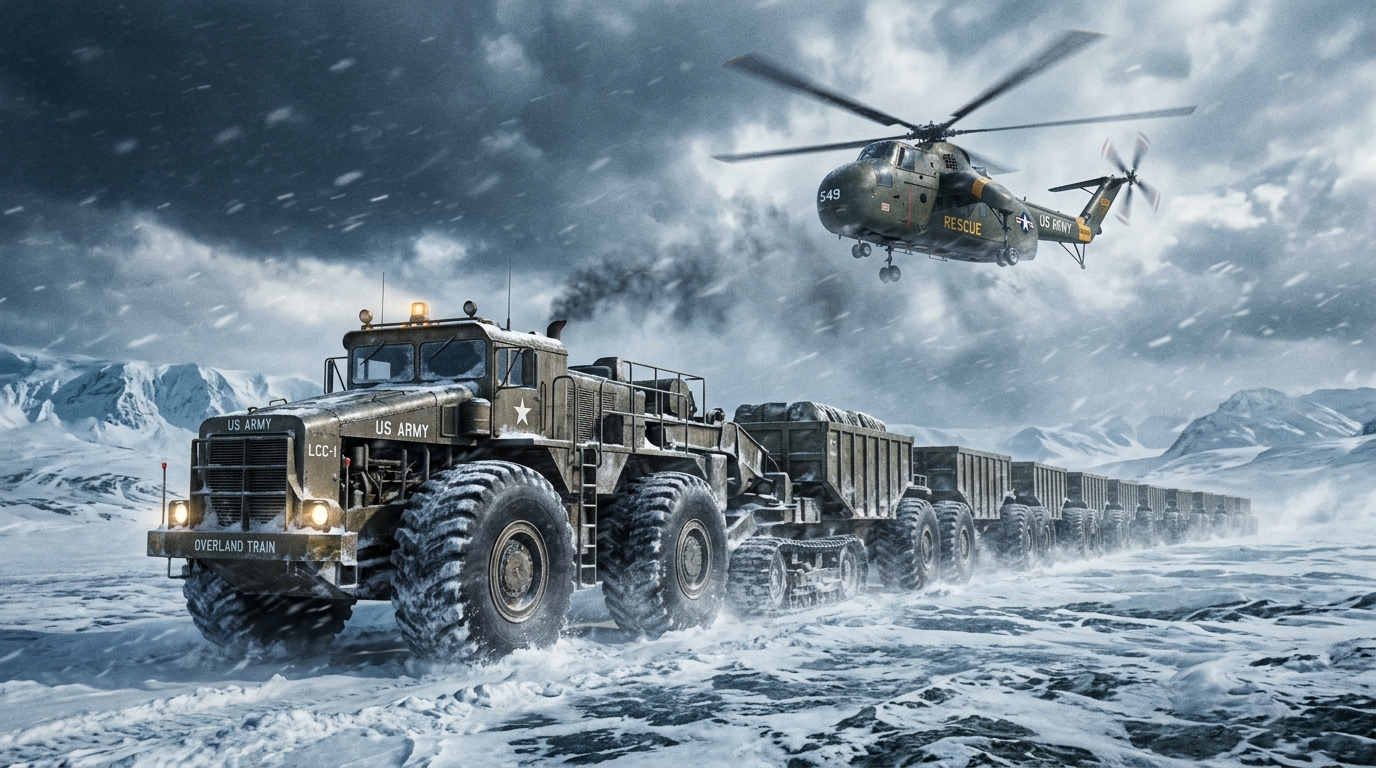
In 1962, in the blistering Arizona desert, a 172-meter-long machine brought the American military to a halt over a problem as vast as itself: what to do with a steel giant designed to face the Arctic’s ice, but that would never get its wheels there? This story, as little known as it is captivating, deserves a closer look, because it narrates both the industrial ingenuity of the Cold War and the speed with which one innovation can render another utterly obsolete.
- The TC-497 Overland Train Mark II measured 172 meters and could haul up to 150 tons of freight thanks to 4 gas turbines and 54 electric motors.
- Tested in 1962 in the Yuma Desert of Arizona, it never ran in the Arctic for which it had been designed.
- Its abandonment in 1971 was driven by the rise of heavy-lift helicopters and by budget priorities tied to the Vietnam War.
- A Train Without Rails, an Idea Born in the Cold War
- How 170 Meters of Steel Were Meant to Tame the Far North
- The Unexpected Enemy That Brought Down the Giant
- Why Helicopters Ended the Project
A Train Without Rails, an Idea Born in the Cold War
To understand why the United States once contemplated building the longest all-terrain vehicle in history, one must revisit the perpetual tension that prevailed between the two blocs. Washington needed to move hundreds of tons of equipment into the Arctic to build the famous DEW line, a radar network meant to detect any Soviet attack coming from the North Pole. The problem was that, at the time, this region had neither roads, nor airstrips, nor infrastructures of any real substance.
The army then turned to a rather unconventional engineer, R.G. LeTourneau, a designer renowned for his gigantic earth-moving machines. His mission was to conceive a means of transport able to travel without rails or roads, relying solely on independently driven wheels. This project followed the LCC-1, a previous land train that had already proven itself in Arctic conditions and validated the concept in practice.
How 170 Meters of Steel Were Meant to Tame the Far North
The outcome of this work was the TC-497 Overland Train Mark II, a name that hardly captures the scale of the machine. With its 572 feet, roughly 172 meters in length, this articulated convoy still holds the record as the longest off-road vehicle ever built. To put its size into perspective, it took nearly two football fields laid end to end to cover its total length.
Hidden under the hood, so to speak, was a remarkable drivetrain: four gas turbines manufactured by Solar, each delivering 1,170 horsepower, powering no fewer than 54 electric motors distributed across the convoy’s wheels. With this architecture, the TC-497 could haul up to 150 tons of freight over nearly 400 miles at a cruising pace of 20 mph, about 32 kilometers per hour. A seemingly modest tempo, perhaps, but a formidable feat for a vehicle of such mass moving across terrain as hostile as ice sheets or tundra.
The Unexpected Enemy That Reduced the Giant
Here is one of the most intriguing facets of this tale: contrary to what one might expect, the TC-497 never set a single wheel on the Arctic terrain for which it was specifically designed. Its tests in 1962 occurred on the desert testing grounds of Yuma, Arizona—an environment utterly at odds with polar cold. Real-world trials on ice and snow never took place; the convoy became mired in sand and heat instead of freezing surfaces.
One might assume the project’s demise stemmed from a technical failure or the machine’s inability to cope with polar conditions. It was not the case. The true reason for its abandonment lay not in the mechanics or the climate, but in the near-simultaneous emergence of a completely different technology—more agile and far less bulky.
Why Helicopters Ended the Project
While the TC-497 lingered in the Yuma desert, a new generation of heavy-lift helicopters emerged, exemplified by the Sikorsky CH-54 Tarhe. These aircraft could perform the same logistical mission as the ground train, flying over obstacles rather than painstakingly traversing ice at a crawl of roughly thirty kilometers per hour. The military calculation was simple: why maintain a colossal 170-meter machine, packed with turbines and dozens of electric motors, when a helicopter could deliver the same payload much faster and with far fewer constraints?
To this technological obsolescence was added the relentless budget reality. The Vietnam War was in full swing, siphoning essential resources toward priorities far more urgent than Arctic freight transport. The project, already weakened by the advent of helicopters, was eventually abandoned for good. In 1971, the TC-497 was auctioned off as scrap. Today, only its cockpit has survived intact, on display at the Yuma Proving Ground Heritage Center, the last tangible testament to a project that was as titanic as it was fleeting.
This forgotten chapter of the TC-497 exemplifies the unwritten rule of military innovation: a machine can be technically impressive, yet still fail to find a place on the field unless it remains relevant in the face of advancing technologies. The steel giant was built to master the Arctic, but it was ultimately the sky, via the rotor of a helicopter, that prevailed. A humbling lesson for any engineering triumph, no matter how spectacular.
