
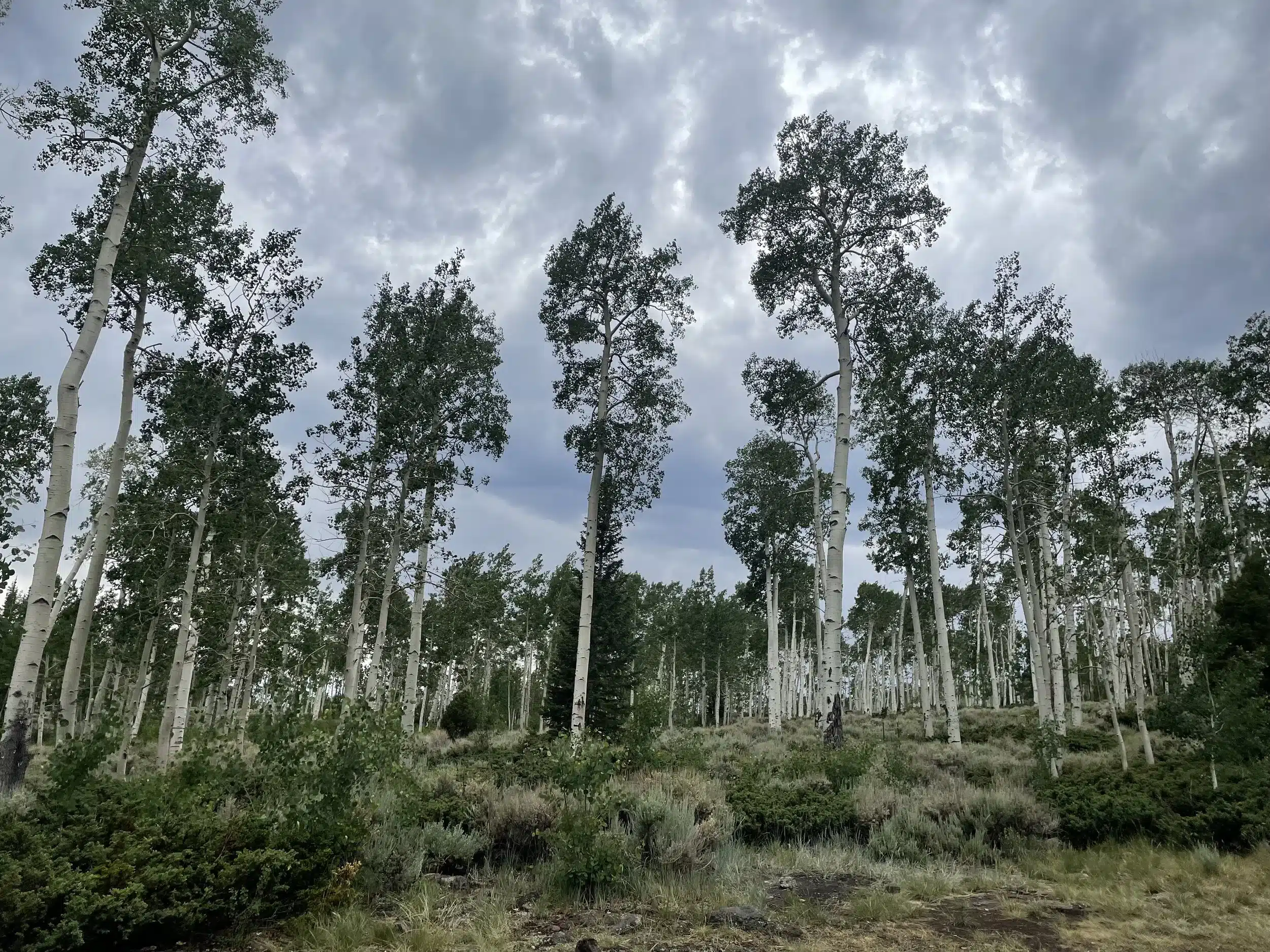
It weighs 6,000 tonnes, covers 40 hectares and may have lived for as long as 12,000 years. Pando, the forest of a single tree in Utah, is the largest living organism on the planet. For the first time, a sound artist has managed to hear it — by slipping a hydrophone into its roots. What the device captured exceeded all expectations.
What you will learn
- What Pando is and why this world’s unique organism defies our definition of a tree
- How a hydrophone inserted into its roots captured the vibrations of millions of leaves simultaneously
- Why these sound recordings could become a scientific tool to monitor Pando’s health
47,000 stems, a single organism
In the state of Utah, at the heart of the American Rockies, there grows a forest that isn’t really a forest. At first glance, you see thousands of aspens — slender trees with fluttering leaves arranged over roughly forty hectares. But in reality, they share the same DNA. All 47,000 stems emerge from a single and shared root system.
This organism is called Pando, from the Latin for “I spread.” It is a solitary male aspen — Populus tremuloides — that gradually colonized its territory not through sexual reproduction, but by root expansion. The new stems aren’t new trees. They are new branches of a single individual, growing from deep beneath the soil.
Its total mass approaches 6,000 tonnes. Its stems rise up to 24 meters. And its estimated age — between 10,000 and 12,000 years — makes it one of the oldest living beings ever documented on Earth.
A hydrophone in the roots
It was in this extraordinary context that sound artist Jeff Rice was invited on residency by the Friends of Pando association. His mission: explore this organism through sound. To listen to what 12 millennia of existence has to say.
Rice started with a simple experiment. He inserted a hydrophone — a microphone originally designed for aquatic environments — into a cavity at the base of a branch, guiding it down to root level. Hydrophones do not necessarily require water to function: they also capture vibrations transmitted by solid surfaces, such as wood or soil.
He did not expect much.
What he heard
The surprise was immediate. Putting on his headphones, Rice perceived a faint sound — diffuse, continuous, almost imperceptible. A murmur from the depths. Then a storm rose above the forest. And the sound transformed into something far more striking: a dull, deep rumble, resonating through the roots like a giant breath.
The explanation Rice proposed at the 184th meeting of the Acoustical Society of America is as poetic as it is scientifically plausible: the millions of leaves of Pando, stirred by wind and rain, transmit their vibrations through the branches, up to the trunks, then into the shared root network. What the hydrophone captures is the echo of an entire forest, propagated through a single organism.
The device also detected the sound of tapping made on a branch located 27 meters away — a sound inaudible in air at that distance, but perfectly transmitted through wood.
To listen here
A confirmation of root interconnection
These results provide experimental support for a hypothesis that is already widely accepted but difficult to demonstrate directly: Pando’s root system is truly interconnected, capable of propagating signals from one end of its territory to the other.
Researchers emphasize, however, that a more rigorous experimental protocol will be necessary to confirm that the sound propagates indeed through the roots and not through the surrounding soil. A technically important distinction to scientifically validate these observations.
Yet the tool opens perspectives far beyond mere acoustic curiosity. Lance Oditt, founder of Friends of Pando, envisions using these sounds to map the entanglement of roots in a non-destructive way — a means of seeing without digging, exploring without harming.
A giant in danger
Behind the amazement lies a troubling reality. Pando is deteriorating. Human activities — deforestation, the disappearance of predators that once kept herbivore populations in check — are weakening this millennial organism. Without predators to curb deer and elk, young shoots are browsed before reaching maturity. The regeneration of the organism is compromised.
The sound recordings could play a concrete role in its preservation. The natural sounds of an ecosystem constitute an archive of its biodiversity and an indicator of its health. Documenting Pando’s sounds today creates a baseline to measure future changes.
Listening to the largest living being on Earth isn’t merely an aesthetic experience. It may also be a way to understand it better — before it’s too late.
Source: Listening to the largest tree on Earth #ASA184 (eurekalert.org)
Article prepared with the help of AI · Our method
