
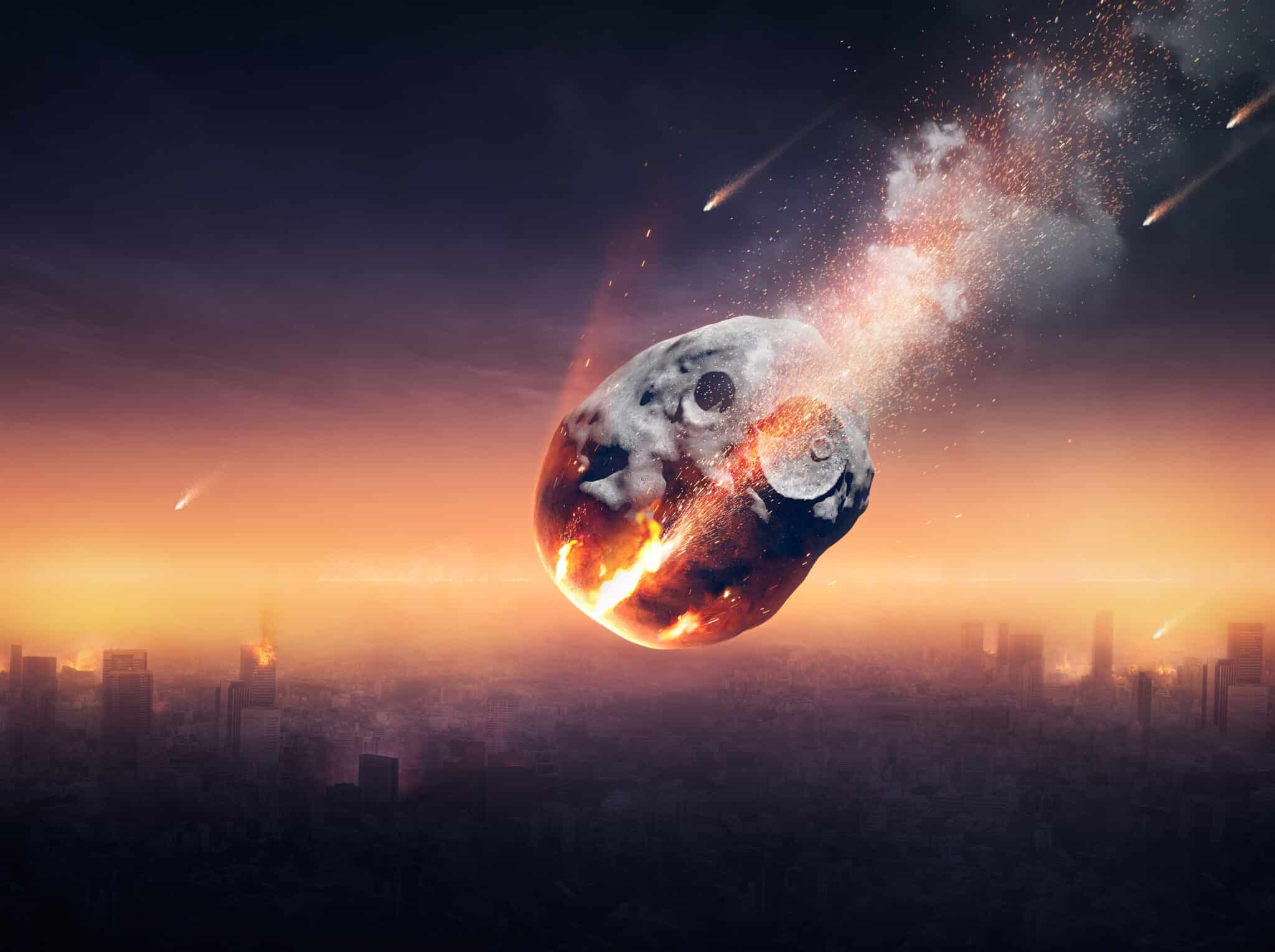
Thousands of asteroids orbit the Sun. Space agencies track most of them, but one of these rocks could still appear suddenly on a collision course with Earth. An application available on the Neal.fun website allows you to visualize the consequences of such impacts.
Asteroid Simulator was developed by Neal Agarwal. This space and coding enthusiast, who grew up with disaster films like Deep Impact and Armageddon, says he has always wanted to create a tool that would let people visualize their own impact scenarios. The mathematics and physics behind this simulator are based on research papers by Dr. Gareth Collins and Dr. Clemens Rumpf, both asteroid specialists.
How does it work?
The first step is to choose the composition of your asteroid (iron, rock, carbon, or gold). Next, its diameter can be set up to 1.6 kilometers and its speed from 1,000 to 250,000 miles per hour (1,600 km/h to 400,000 km/h). The impact angle can be adjusted up to 90 degrees.
Finally, you simply select an impact zone. Once the program runs, Asteroid Simulator will tell you about the devastation caused. It will first show you the crater’s width and depth, the number of people vaporized by the impact, and the amount of energy released. It will then inform you about the size and effects of the fireball, the shockwave, the wind speed, and the earthquake generated by the impact.
Take, for example, the city of Paris targeted by an iron asteroid over 1.5 km in diameter, streaking at 400,000 km/h with a 45° impact angle. The simulator then predicts a crater 43 km wide, within which it estimates that 8,700,859 people would be vaporized. It also forecasts a fireball more than 160 km wide, a shockwave of 250 decibels (any person within 500 km would likely suffer lung injuries), wind speeds exceeding 14,000 km/h, and an earthquake registering 9.3 on the Richter scale. In the end, the death toll would run into tens of millions.
LINK TO THE SIMULATION
New Milestone Reached
In recent years, astronomers have intensified their efforts to catalog objects larger than 140 meters in diameter whose orbits bring them closer to Earth (near-Earth objects). An asteroid is considered a near-Earth object if its trajectory brings it within 1.3 astronomical units (AU) of the Sun. For reference, one AU is the distance between the Earth and the Sun, about 150 million kilometers.
To spot them, several telescopes sweep wide swaths of the sky in search of objects moving against a starry backdrop. By October 2022, the number of known near-Earth objects, of all sizes, had crossed the 30,000 mark; the ESA now lists more than 42,500. In 2022, more than half of them had been discovered in the six years prior. Among these near-Earth objects, roughly 2,000 appear on ESA’s risk list, with a “nonzero” chance of impacting Earth.
Sources: This Asteroid Impact Simulator Lets You Destroy the World (gizmodo.com) | 30 000 near-Earth asteroids discovered and rising (esa.int)
Article prepared with the help of an AI · Our method
