
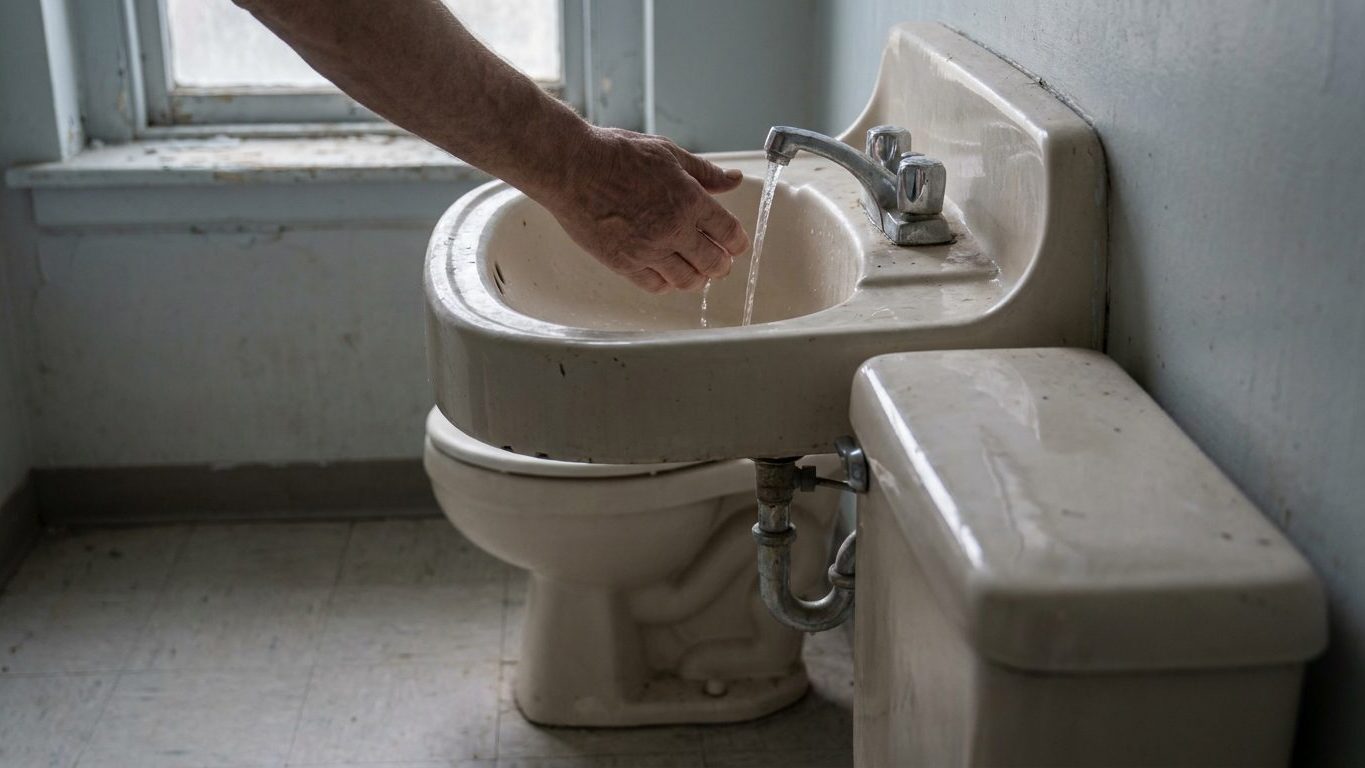
A plumbing mishap was enough to stir up trouble in the comments of a blog devoted to Japan: a French resident there recounts that what surprised him most was the sink placed directly above the toilet tank. He adds that the water used when washing hands, both before and after relieving oneself, runs straight into the tank and fills it. His question, left unanswered for years on that forum, sums up the entire dossier: why had no one thought to import this system to our country?
The verdict comes bluntly.
In France, toilets are not merely for evacuation. They account for a substantial portion of a household’s water bill: on average, a person uses 30 liters of water for their WC each day, i.e., 20% of their daily consumption. The traditional mechanism, still installed in a large portion of the housing stock, flushes between 9 and 12 liters per use, while a dual-flush model drops to 3 or 6 liters, compared with 7 liters for a modern flush. This water is not a byproduct: it comes from the same network as the kitchen tap water, treated to drinking-water standards, delivered and billed as such.
The price displayed underscores the absurdity of the gesture. With an average rate of €4.30 per cubic meter in 2024, a four-person family equipped with a 9-liter classic flush spends about €282 per year solely on toilet water.
- A French family of four spends €282 annually on potable water for toilets alone
- The Japanese temizuki system reuses hand-washing water to fill the flush tank without a pump or electricity
- France legally bans at-home greywater recycling, unlike rainwater collection which has been regulated since 2008
The Pipe and the Basin: The Japanese Solution in Three Steps
The setup can be read in a single image. A small sink sits on the tank lid; clean water arriving from the public supply first passes through the basin used for hand washing, then flows into the tank that had just been emptied by the previous flush. No pump, no electronic board, no additional connection to the network: the same drop of water serves twice—once for washing hands, once for the next toilet.
Nothing new under the rising sun.
This principle has been in Japanese homes since the 1950s–1960s, to the point of becoming so commonplace that today it is sold as a simple retrofit kit that can be installed on any existing tank, with no plumbing work. Japan has not stopped there: since 2012, Toto’s modern toilets use 3.8 liters per flush, versus 9 liters required by a traditional flush. Another piece of the dossier is the waterless urinal, already installed in many public spaces, which simply uses no water at all with each use. On the scale of an entire country, millions of cubic meters of potable water never end up in the pipes.
The Japanese Panel and the Rest of the File
The contrast is all the stronger because Japan broadly adopted the logic of small and large flushes long before France began to widely implement dual-flush in its renovations. The country also normalized, well ahead of us, the idea that a single drop of water can perform two functions before heading to the sewers.
The message that emerges from these exchanges is unequivocal.
Flushing with water that has already been treated, filtered and made potable at considerable cost, and then letting it go down the drain without it having served any other purpose, appears from an external vantage point as a missed engineering opportunity rather than a technical inevitability. The pipe exists, the basin exists; what France missed for decades was simply the connection between the two.
Can We Do the Same in France?
The answer hinges on two separate networks, and a regulatory framework that treats them differently. On the greywater side—water that comes from the shower, sink or washing machine—the rule remains strict: from a regulatory standpoint, greywater cannot be recycled for domestic uses such as toilet flushing, with ANSES specifying in 2015 that this prohibition stems from the risk of contamination in the event of an interconnection between the potable-water network and greywater networks. A system like temizuki, which would mix network water and hand-wash water in the same circuit before reuse, would therefore run into this sanitary barrier.
Rainwater, by contrast, opens a legal door. The reference text allows the use of rainwater for toilet supply, floor washing and laundry, an usage governed by the arrêté du 21 août 2008 relating to rainwater recovery, replaced since by an arrêté du 12 juillet 2024. Practically, this requires a tank, an interior network completely separated from the potable water system, dedicated signage, and, depending on the case, a declaration with the town hall.
The Japanese kit, for its part, requires neither a tank nor a dual network: it simply circulates once more water that is already potable before it leaves the home. Perhaps this is what makes the Japanese view of our toilets so severe: no need for an additional treatment plant, just a pipe laid in the right place.
Sources: senat.fr | notre-environnement.gouv.fr | blog-plomberie.com
