
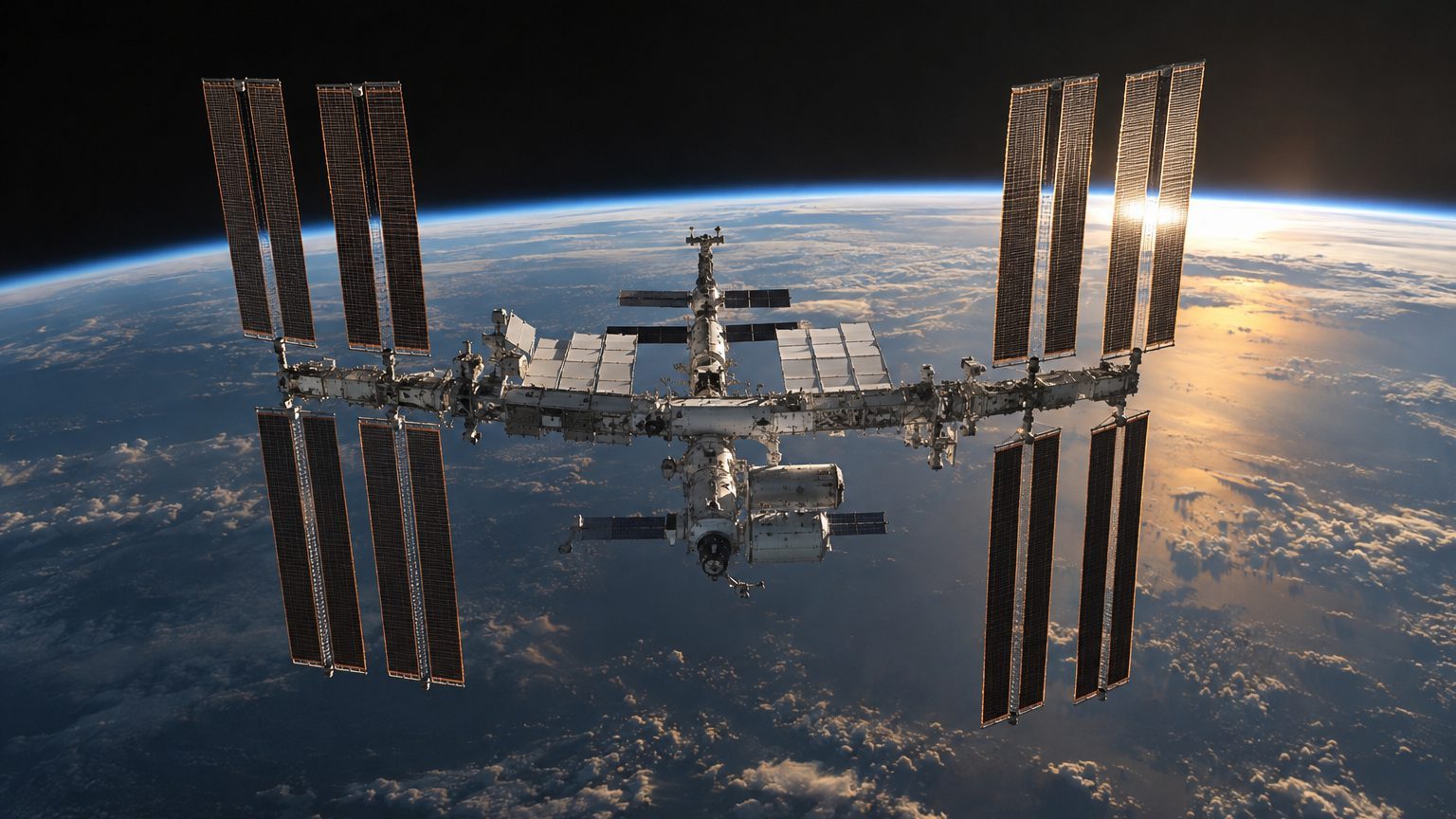
843 million dollars. That is the total potential value of the contract NASA announced on June 26, 2024 to acquire a vehicle that will never return. Its mission: to push the International Space Station out of its orbit when its operation ends, targeted for 2030, for a controlled reentry into the atmosphere.
A one-way trip, in the strict sense.
- NASA has ordered a spacecraft for 843 million dollars intended solely to deorbit the ISS around 2030.
- The vehicle will diverge from the Dragon cargo and will be equipped with 46 thrusters instead of 16, and six times more propellant.
- The 2030 deadline remains flexible, and Congress could extend the station’s operation or mandate a transition to commercial facilities.
A capped cheque, a launch billed separately
The NASA press release is clear: this is a sole-source contract, with a potential total value of 843 million dollars. Potential, because this amount is a ceiling and not a final invoice. It does not cover the rocket, since the launch is purchased separately. The selected company, SpaceX, develops and delivers the vehicle, which the American agency will then own and operate itself.
The vehicle would derive from the Dragon cargo spacecraft, already used to resupply the station. At the time of the announcement, NASA had not disclosed any drawings or design details, SpaceNews reported.
The full price therefore exceeds the headline figure. In July 2024, SpacePolicyOnline spoke of a package of roughly 1.5 billion dollars to build and launch the craft, which NASA was still seeking to finance through Congress. For fiscal year 2024, the agency had requested 180 million dollars for this purpose, and lawmakers had granted nothing.
420 tonnes at 400 kilometres altitude
The station weighs about 420 tonnes (roughly 925,000 pounds according to NASA), about the mass of around 280 cars weighing 1.5 tonnes each, and it travels roughly 400 kilometres above our heads. In clear skies, it can be spotted with the naked eye at dusk, without binoculars. It appears as a very bright point crossing the sky in a few minutes, not blinking like an aircraft. Tracking apps provide the time of overhead passage for each city.
This bright point has an expiration date.
The challenge is not only about mass. According to Space Daily’s analysis, the vehicle must move a structure far heavier than itself without exceeding what aging modules and girders can bear. It must dock, help control the orientation of the assembly, and then execute the final reentry maneuvers.
A tug tailored for the task
An ordinary Dragon would not suffice. Public descriptions speak of an elongated rear compartment, with 46 Draco thrusters compared to 16 on a standard Dragon, and six times as much propellant.
This autonomy addresses a specific concern. According to public information, NASA launched this project in fear of a sudden withdrawal by Russia, which would have left the other partners with few options for a controlled reentry. Its aerospace safety advisory panel had for several years recommended developing a native capability. Russian Progress cargo ships still have a role: reports from April 2026 describe a strategy that combines the American vehicle with two Progress ships.
Additionally, ocean experts have voiced reservations. Most components should burn up, but dense or heat-resistant parts could reach the surface.
2030, a deadline that stays flexible
2030 marks the end of operations, not the day of the fall: the reentry would occur around 2030, with some calendars placing it early 2031. In a 2026 report, the GAO, the U.S. congressional audit office, states that in 2027 NASA will decide whether to launch the vehicle in 2029 to begin the descent, or to extend the station. This choice depends on commercial stations, one of which is expected to demonstrate, no later than 2030, a 30-day mission with four astronauts. Without a ready successor, postponement remains possible.
Between the vehicle’s arrival and the end, the station does not plummet all at once. In July 2024, NASA explained that the orbit would degrade naturally over 12 to 18 months before the vehicle’s intervention, with the crew staying aboard as long as possible to maintain the system, according to program chief Dana Weigel. The GAO notes that the longer the station remains uncrewed, the greater the risk of a serious failure, and therefore of an uncontrolled deorbit.
Congress could also redraw the map. A Senate committee has included in a bill an extension to 2032 and a prohibition on deorbiting the ISS until a replacement is operational, reports Scientific American.
The vehicle itself, meanwhile, could wait on the ground.
The project progresses despite these uncertainties. According to NASA’s 2027 budget request, cited by Space Daily, cost and schedule references were approved in February 2026, officially placing the project in development. Delivery is scheduled for late 2028.
Sources: spacenews.com | space.com | spacepolicyonline.com
