
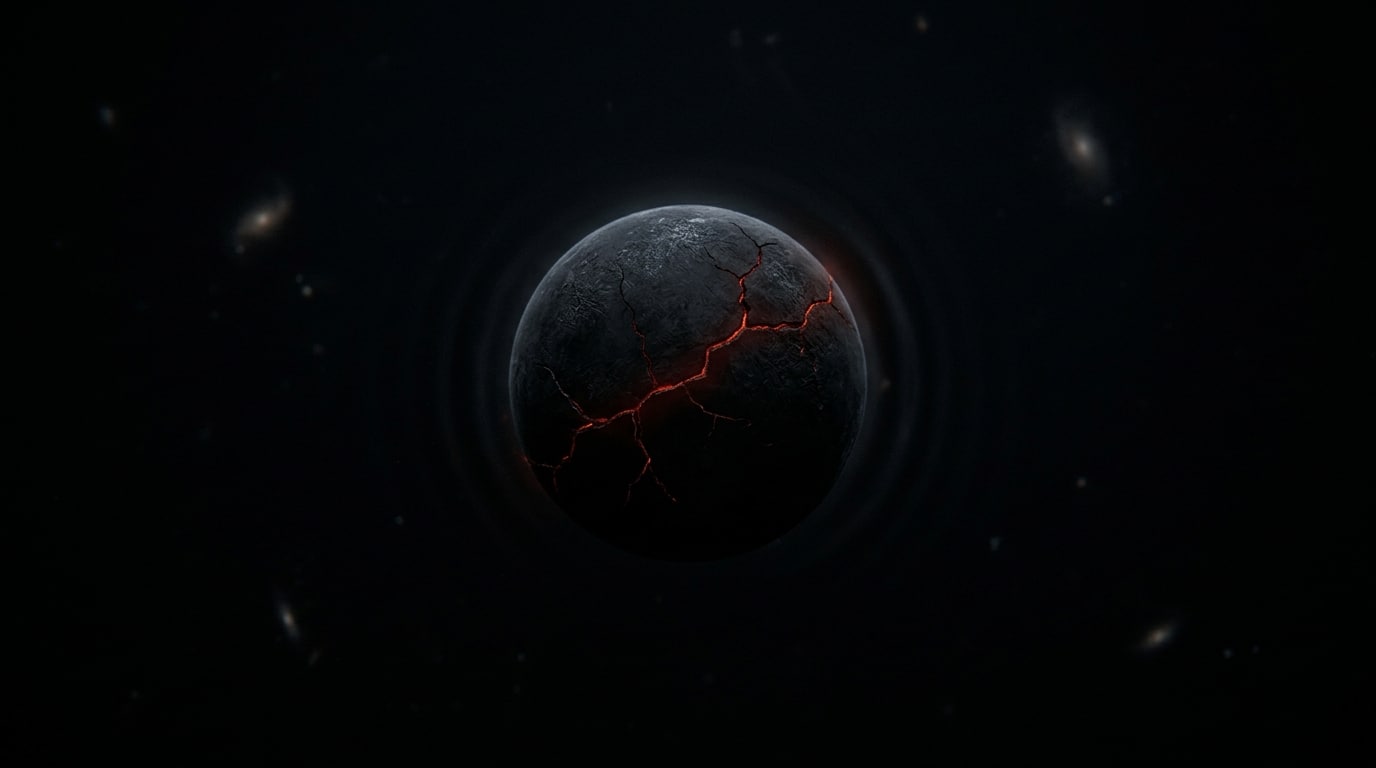
To be explicit from the outset: nobody will be there to witness this. Neither you, nor I, nor humanity as a whole, nor even the stars we know today. Yet a serious study predicts the explosive end of the universe’s most inconspicuous objects, the black dwarfs, on a timescale so dizzying it defies intuition.
- The physicist Matt Caplan studied the ultimate fate of black dwarfs—stellar remnants that are completely extinguished and have never been observed to date
- The mechanism at play would be pycnonuclear fusion, a quantum tunneling effect that gradually accumulates iron-56 at the cores of these stars until a critical mass triggers their collapse
- The most massive black dwarfs would explode first after about 10^1100 years, and none would remain after roughly 10^32000 years
- A Universe Already Dead That Still Carries a Final Explosive Breath
- Iron, the Silent Thief That Feeds on the Core of Black Dwarfs
- When Quantum Fusion Rekindles the Spark of a Supernova Extinct for Ages
An Illinois State University physicist, Matt Caplan, has turned his attention to the ultimate fate of these stellar corpses that no one has ever observed. His work, published in Monthly Notices of the Royal Astronomical Society, sketches a scenario in which cold and darkness do not necessarily imply eternal rest. Some black dwarfs would eventually explode, and the mechanism involved has little to do with what one might spontaneously imagine.
A Universe That’s Already Dead Yet Still Holds a Final Explosive Breath
To grasp the scale of what is at stake, one must first imagine a Universe radically different from the one we know. Stars like the Sun end their lives as white dwarfs—dense stellar embers that slowly cool over billions of years. After a span so long it defies comprehension, these white dwarfs would finally freeze completely and become black dwarfs, utterly extinguished, emitting no light at all.
This ultimate stage has never been observed, and for good reason: the Universe is only 13.8 billion years old, a mere blink compared with the time needed for a white dwarf to fully become a black dwarf. We are dealing with pure theory, albeit a theory built on solid and verifiable physics.
It is precisely this distant future, when all stars have long since cooled, that Caplan sought to explore. His finding is striking: even in this frozen setting, something would continue to unfold at the hearts of these dead stars. A process so slow that one would have to wait 10^1100 years before seeing the first tangible effect.
To give a sense of the magnitude of this number, Caplan told National Geographic that writing it out in full would fill an entire page with zeros. A figure that makes the age of our entire Universe seem trivial by comparison.
Iron, the Silent Thief That Feeds on the Core of Black Dwarfs
The mechanism Caplan identifies rests on a quiet but relentless process: the gradual build-up of iron at the center of these extinguished stars. In living massive stars, it is precisely this accumulation of iron within the core that precedes gravitational collapse leading to a standard supernova. Logical, since iron marks the endpoint of energy-producing nuclear fusion.
However today, only stars exceeding roughly ten solar masses possess the gravity and density necessary to forge iron within their interiors. Caplan himself clarified this in his university’s release: black dwarfs, which are far less massive, would normally have no reason to meet such a fate under current physical conditions.
This is where the study challenges established certainties. On a timescale unimaginably long, a quantum process that has been neglected until now would alter the game and gradually transform the internal composition of these dead stars.
When Quantum Fusion Rekindles the Spark of a Supernova Extinct for Ages
The phenomenon bears a formidable name: pycnonuclear fusion. In concrete terms, it is a quantum tunneling effect — a strange mechanism that allows nuclei trapped in the ultra-dense core of a black dwarf to fuse with one another, even in the absence of heat-driven energy.
Patiently, this fusion would shift the star’s internal makeup toward iron-56, the most stable isotope known. Caplan’s calculations link this iron-56 together with manganese-56 to a Fermi energy of 4.207 MeV, corresponding to a central density of roughly 1.19 billion grams per cubic centimeter. These numbers are vertigo-inducing, yet they provide the precise physical foundation for his model.
Once this critical iron mass is reached, the star can no longer support its own weight. Its core would collapse abruptly, triggering a supernova—exactly like a classical massive star—but here the event would occur ages after the star’s apparent death. It is the slow accumulation of iron via quantum fusion that would drive the gravitational collapse and the supernova explosion of black dwarfs exceeding 1.2 solar masses within about 10^1100 years.
Logically, not all black dwarfs would explode at once. Caplan estimates that the most massive ones, where internal pressure more strongly favors pycnonuclear fusion, would detonate first. Then, on equally extravagant timescales, progressively lighter-mass black dwarfs would follow, until none remain after roughly 10^32000 years, a figure that makes the 10^1100 years of the first event seem modest by comparison.
Meanwhile, astronomers continue to observe stellar explosions much closer in time. In April, a team led by James Munday at the University of Warwick identified a pair of white dwarfs at 150 light-years away, totaling 1.56 solar masses—enough to eventually trigger a Type Ia supernova. A few months later, in July, the European Southern Observatory presented the first direct visual evidence of a double detonation of a white dwarf, thanks to the MUSE instrument on the Very Large Telescope directed at the remnant SNR 0509-67.5. Analysis revealed two distinct calcium layers, a hallmark of this explosive model. These recent findings remind us that even if Caplan’s scenario belongs to an almost inconceivable future, the life cycles of white dwarfs continue to reveal their secrets here and now.
👉 A small gesture for Space Group? Follow us on Google, add us to your bookmarks, and find us on Google News so you won’t miss any discoveries.
