
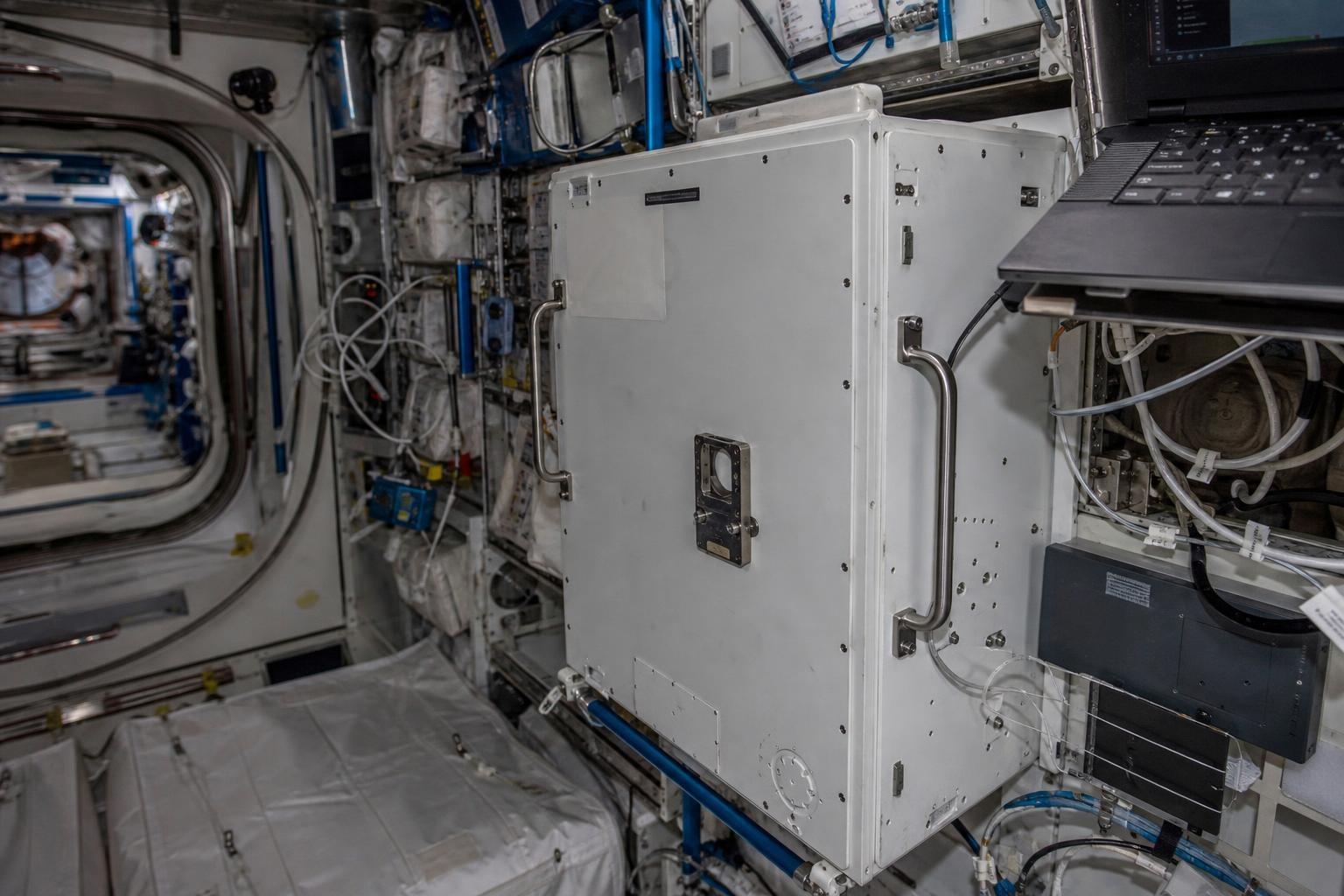
Aboard the International Space Station, a compact experiment no bigger than a minifridge hosts temperatures unimaginably close to absolute zero. In that quiet metal box, atoms slow nearly to a standstill, revealing quantum behavior that’s usually buried under the bustle of warmer motion. It’s a place so cold that the background of deep space—about 2.7 Kelvin—feels almost tropical by comparison.
Inside the cold box
NASA’s Cold Atom Laboratory (CAL) squeezes an entire ultracold-atom setup into a rugged, automated enclosure. Inside sits a vacuum chamber, magnetic coils, and finely tuned lasers that herd and chill a thin vapor of selected atoms. With magnetic fields and evaporative cooling, the apparatus orchestrates a delicate cascade of steps until the atoms cross a threshold and form a Bose–Einstein condensate.
At that point, a cloud of atoms behaves like a single quantum entity, spreading like a wave instead of jostling like tiny marbles. “At these temperatures, atoms stop behaving like marbles and start acting like ripples,” a vivid shorthand for a regime where the everyday rules bend.
Colder than space, and why that matters
Space is cold because it’s almost empty, but not this cold. CAL reaches billionths—and in select modes, even trillionths—of a degree above absolute zero, far below the coldest known nebulae. That extreme chill slows atomic motion to a crawl, stretching the time and distance over which fragile quantum states can be studied.
Cooler atoms make better sensors, more stable clocks, and exquisitely sensitive interferometers for probing gravity, inertia, and fundamental constants. The colder the sample, the longer you can watch it evolve without thermal noise spoiling the show.
Microgravity changes the rules
Earthbound atoms fall, so lab experiments must hold them up with traps that add unwanted kicks and distortions. In orbit, microgravity lets atoms drift nearly weightless, expanding for hundreds of milliseconds—or even seconds—with minimal disturbance.
- Longer free-drift times mean sharper measurements, lower effective temperatures, and cleaner interference patterns that are impossible to sustain on the ground.
“Space turns seconds into eternity for drifting atoms,” a poetic way to say that microgravity stretches the window for precision physics.
What the team is learning
CAL regularly produces ultracold clouds of rubidium and potassium, serving as a platform for basic and applied research. Scientists can tune interactions from repulsive to attractive, shape the cloud with tailored magnetic fields, and watch it evolve as a coherent quantum fluid.
They are exploring how quantum gases flow, how they respond to tiny nudges, and how to split and recombine atomic waves for sensing. Each experiment is a step toward improved navigation, resilient timing in space, and new tools for mapping gravity around planets and moons.
Engineering a pocket arctic
Running a quantum lab on a space station is a feat of systems engineering. CAL must work autonomously, shrug off vibrations, and sip power while keeping its vacuum and lasers perfectly aligned. The box is commanded from the ground, with sequences uploaded, executed, and refined as results arrive.
Inside, atoms are cooled in stages: first with laser light that saps their motion, then with magnetic and evaporative techniques that skim off the warmest stragglers. The final state is whisper-quiet, a quantum hush where even tiny magnetic ripples or thermal leaks can undo the magic.
What “coldest known spot” really implies
When scientists say this is the coldest known place, they mean the coldest environment where we can reliably prepare and hold matter at such temperatures. Some Earth labs have reached comparable regimes for brief moments, but CAL sustains ultracold operations routinely, in the unique calm of microgravity.
It’s a reminder that “cold” isn’t just about thermometers; it’s about isolation, control, and the ability to repeat precise quantum states on command. In orbit, the lab meets those demands with remarkable consistency.
New doors opening
The promise is not only better physics but better technology. Ultracold-atom sensors could guide spacecraft without external signals, map subsurface ice or voids on alien worlds, and test principles like the equivalence of inertial and gravitational mass with unprecedented fidelity.
“As the hardware shrinks and the techniques mature, quantum sensors will ride alongside cameras and radios,” a vision of spacecraft that navigate by counting atomic ripples rather than tracking distant beacons.
Why a minifridge matters
Packing an arctic for atoms into a hand-me-down appliance footprint is more than clever miniaturization. It’s a proof that frontier quantum science can leave the basement lab, survive launch, and operate for years in the world’s most exclusive orbiting outpost.
Up there, sheltered from gravity’s constant tug, matter reveals a calmer, more wave-like self. In that small, steady box, NASA isn’t just making things colder; it’s making the universe’s most delicate patterns easier to see.
