
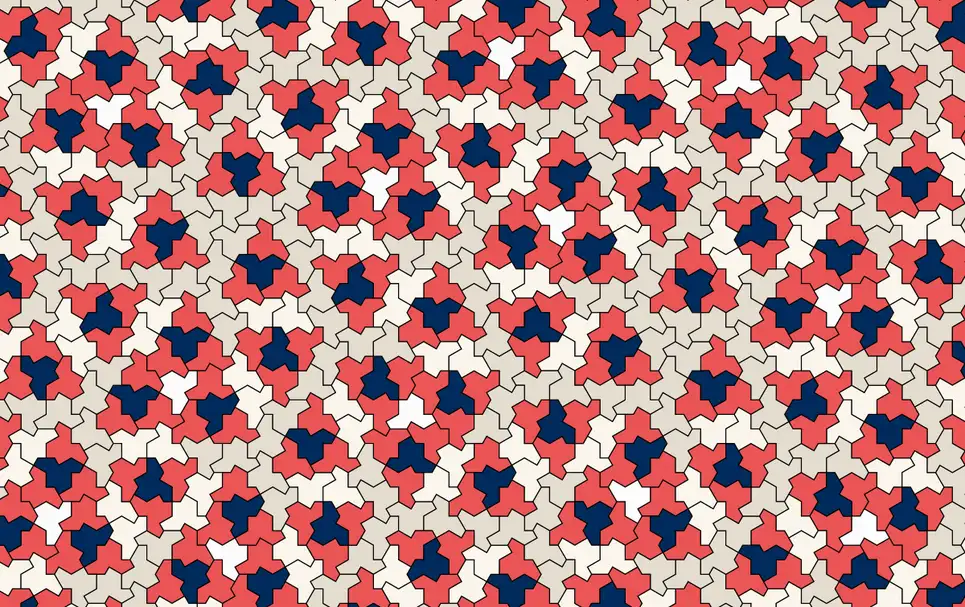
Months ago, after a decade of failed attempts, David Smith, a self-styled形 enthusiast from Bridlington in East Yorkshire, England, finally discovered his “einstein.” This isn’t about the famous physicist. In plainer terms, an einstein is an “aperiodic monotile,” a shape that can cover an infinite two‑dimensional plane solely through a non-repeating pattern. What should we take away from this remarkable discovery?
An Einstein Pulled from the Hat
This time, the “einstein” that could (perhaps) alter the landscape of mathematics and physics is a tiny oblique polygon. The term derives from the German “ein stein,” meaning “a stone” or more loosely “a shape.” Nicknamed “The Hat,” this shape can do something unlike any other: it can tessellate with itself in such a way that it can cover an infinite surface without ever forming a repeating pattern. By contrast, your wallpaper or tiles probably rely on an infinite pattern that repeats periodically.
Until now, the most famous aperiodic tiling (one that never repeats) was created by Roger Penrose in 1974. Yet it required two distinct shapes to work. Over the past five decades, mathematicians have wondered whether it might be possible to achieve the feat with a single shape.
We now know that it’s indeed possible thanks to amateur mathematician David Smith. He enlisted academics from the United Kingdom and the United States to verify his discovery. Their “Hat,” a thirteen‑sided form, is a polykite composed of eight “kites” (diamond shapes) joined along their edges. While the paper has not yet undergone peer review, experts say it is likely to stand up to close scrutiny.
A Long Endeavor
Identifying this shape and proving its aperiodicity required a hefty dose of creativity and some very powerful computers. “You’re literally looking for one thing in a million. You filter out the 999,999 boring ones, and you obtain something strange that deserves deeper exploration,” explains Chaim Goodman-Strauss of the National Museum of Mathematics to New Scientist. “And then, by hand, you start examining them and trying to understand them.”
Once this shape was suspected, the first step was to define a set of four “metatiles,” simple forms that replace small clusters of one, two, or four hats. These, in turn, organize into even larger “supertiles,” and so on, a behavior common in nonperiodic tilings. The researchers then managed to show that this kind of hierarchical assembly is the only way to achieve tiling of their surface.
What Applications for This New Shape?
The implications of this discovery extend beyond the local university’s mathematics department. Aperiodic tilings are indeed important in the development of quasicrystals. Unlike crystals, which have a perfectly regular periodic structure, quasicrystals feature an irregular yet ordered arrangement. This structure is sufficiently organized to produce repeating motifs without ever matching exactly.
Discovered in 1982, these quasicrystals possess unique properties that could prove useful across many fields. For instance, they exhibit very low thermal conductivity, making them appealing for thermal insulation applications. They also display distinctive optical properties that could be exploited in solar-energy technologies and optics. For the rest of us, this new shape might simply become another option for bathroom tiles.
👉 A small gesture for Space Group? Follow us on Google, bookmark us, and find us on Google News so you don’t miss any discoveries.
