
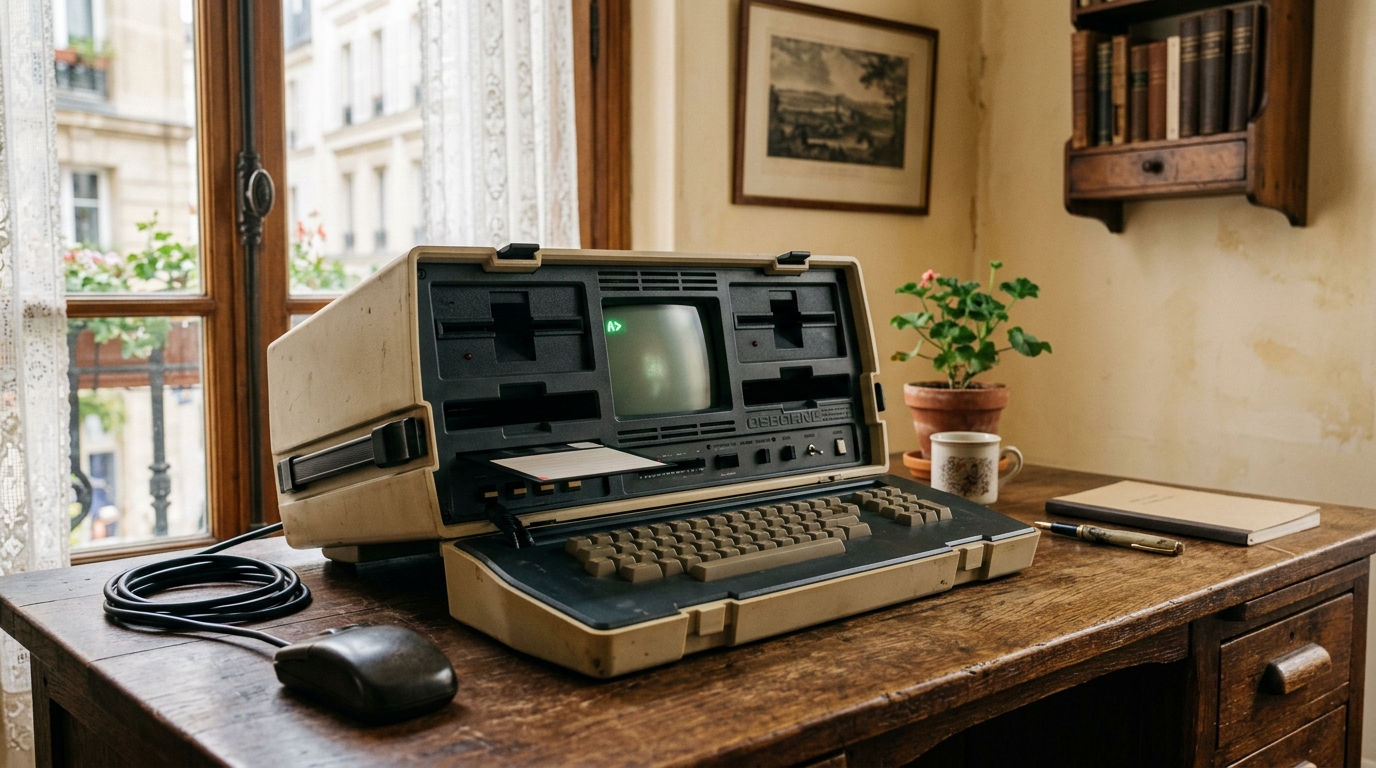
Imagine lugging a sewing machine under your airplane seat, not to mend a button but to draft a financial report. That was precisely what an modest American manufacturer proposed in the early 1980s, with a machine that would upend our relationship with nomadic work before it collapsed as quickly as it had claimed the spotlight. Its story deserves attention, for it tells us more than a mere tech anecdote: it exposes how a company can undermine itself even while holding the market’s hottest product in its hands.
- The Osborne 1, released in 1981, is widely regarded as the first mass-produced portable computer, despite weighing about 10.7 kg and sporting a 5-inch screen.
- The momentum was immense, with 125,000 units built in 1982 and as many as 10,000 machines per month at its zenith.
- The company collapsed after publicly announcing a successor before its release, triggering the halt of current-model sales, a phenomenon now known as the “Osborne effect.”
- A 10.7‑kg monster that changed computing
- This machine everyone wanted despite its heft
- The fatal mistake that had nothing to do with the hardware
- The lesson Silicon Valley still hasn’t learned
- What the Osborne 1’s history really tells us about computing
A 10.7‑kilogram behemoth that changed computing
In April 1981, Osborne Computer Corporation unveiled the Osborne 1 to the world, a device today recognized by the Computer History Museum as the first portable computer produced at scale. The label “portable” here deserves quotation marks, as the machine looked more like a traveling salesman’s briefcase than a portable gadget in the sense we understand today. With a weight of 10.7 kilograms, it was about as heavy as a sewing machine, and its monochrome 5-inch display displayed a mere 52 characters per line across 24 lines.
Beneath the hood sat an 8‑bit Zilog Z80 processor running at 4 MHz, 64 KB of RAM, and two 5‑inch quarter floppy drives. A modest configuration by today’s standards, but adequate for the era, especially since the device initially lacked a built‑in battery: an option existed, but it delivered only about an hour of autonomy, greatly curtailing the promised freedom suggested by the word “portable.”
This machine that everyone wanted despite its heft
Adam Osborne, the man behind the project, had a straightforward idea: craft a computer compact enough for a business traveler to slip under a plane seat. At a time when personal computers still proudly dominated fixed desks, this mobility promise—though constrained—felt revolutionary. And the public didn’t miss the point.
The numbers speak for themselves: by 1982, 125,000 units were built, and the company surpassed the million-dollar mark in monthly sales by September. At its peak, up to 10,000 machines found buyers each month, while Osborne himself hadn’t expected more than 10,000 in total over the entire market run. Another persuasive factor: the unit ship‑with a bundle of software whose value nearly matched the device itself, a business strategy quickly echoed by CP/M-based machine makers.
The fatal mistake that had nothing to do with the hardware
So, a company riding high, with demand well beyond even its most optimistic forecasts. And yet, within months, it collapses. The weight, the small screen, or the paltry battery life do not explain the abrupt fall. The real culprit lies elsewhere, in a purely strategic decision.
By publicly announcing the imminent arrival of a far more capable successor, the firm essentially killed its own cash cow. Prospective customers, informed that a better model was on the way, stopped buying the Osborne 1 and chose to wait. But the new model took time to arrive, and in the interim, inventories piled up while orders plummeted. This phenomenon, which historians of technology would later dub the Osborne effect, perfectly illustrates how miscalibrated communication can strangle thriving sales.
The lesson Silicon Valley still hasn’t learned
What makes this story so captivating is that it isn’t an issue of engineering or product quality, but a timing error in marketing. While the technical teams continued selling a device that worked well, management was already announcing its replacement, thereby eroding customer confidence in the current product. Competitors, notably Compaq, exploited the moment to position themselves as the new industry leaders of the 1980s, while Osborne struggled to recover from this strategic blunder.
Strangely, this forty-plus-year-old lesson still escapes some technology firms today, which announce future products before the previous versions have found their audience. The lure of teasing the future remains strong, even if it undermines the present.
What the Osborne 1 story really tells us about computing
The Osborne 1 was pulled from the market in 1983, barely two years after its triumphant debut. A short lifespan for a device that had managed to democratize the very idea of portable computing. Its technical heritage is modest compared with today’s ultraportables that weigh less than a kilo, but its conceptual legacy endures: the Osborne 1 proved there was a market for mobile computing, paving the way for the Compaq Portable and a countless stream of laptops that followed.
Ultimately, this tale serves as a reminder of a timeless business truth: a superb product alone rarely guarantees a company’s survival if the surrounding strategy wobbles. The Osborne 1’s commercial success could have extended for years if only the announcement of its successor had been more carefully thought out.
As we reflect on that 10.7‑kilogram brick tucked under an airplane seat, we measure the distance our devices have traversed to become light and discreet. Yet the takeaway remains: in the history of technology, giants don’t always fall because of hardware flaws; more often, a single remark uttered at the wrong moment can do the job. A cautionary note for any company tempted to announce the next generation of its products too early.
