
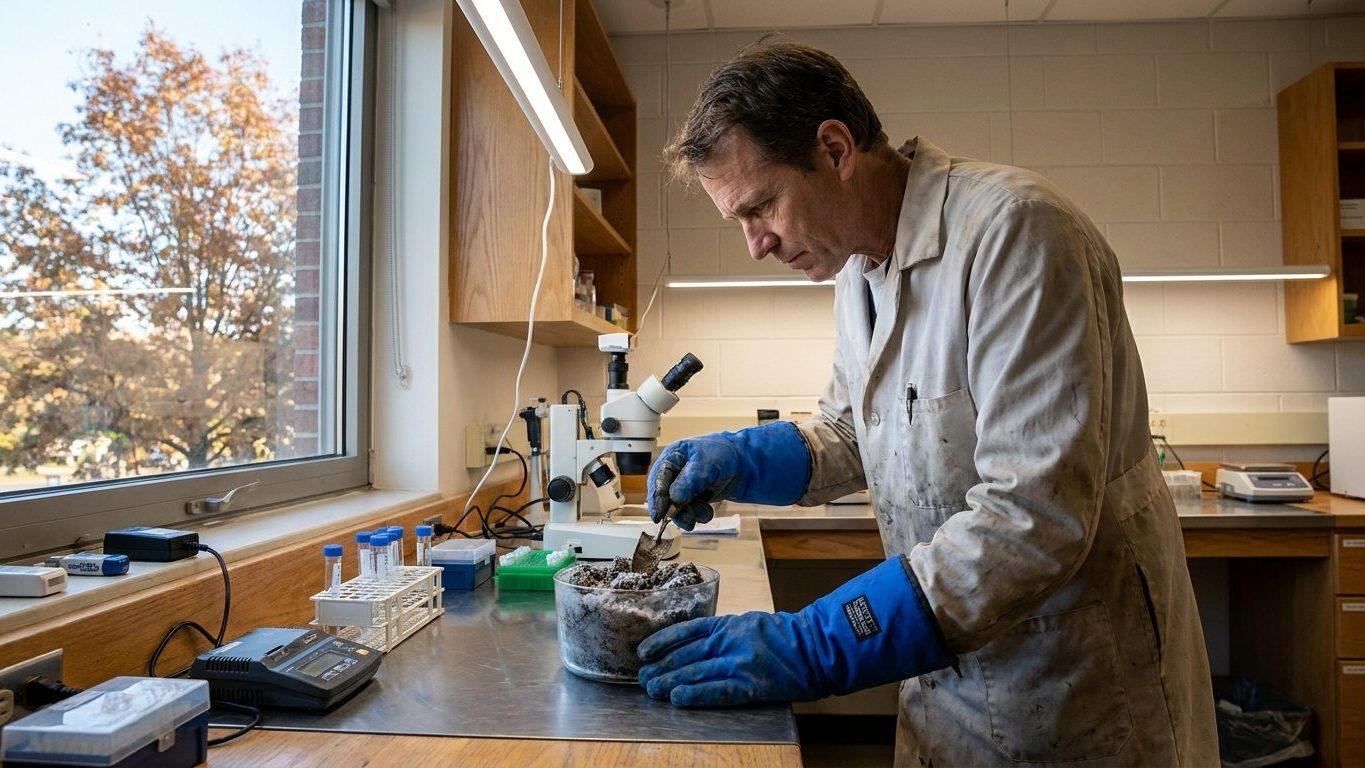
In 2014, a French team announced that it had reactivated a giant virus extracted from the Siberian frozen ground: tens of thousands of years of freezing had not killed it. French researchers uncovered a new giant virus frozen in the Siberian permafrost for more than 30,000 years. In the laboratory, simply bringing it into contact with its usual host was enough to awaken it, as if time had never frozen it.
Thirty thousand years. That is the duration of the pathogen’s slumber before its revival.
Named Pithovirus sibericum, this virus was isolated by a team from the Genomic Information and Structural Laboratory (LIGS) in Marseille, led by Jean-Michel Claverie and Chantal Abergel. The virus was found in a sample of permanently frozen soil taken at a depth of 30 meters in the coastal tundra of Chukotka, near the East Siberian Sea, where the average yearly temperature sits around -13.4°C. Radiocarbon dating confirmed the antiquity of the sample: the vegetation growing there dates back to more than 30,000 years ago, a time when mammoths and Neanderthals still roamed the Earth.
- A giant virus frozen for 30,000 years in the Siberian permafrost was reactivated by French researchers in 2014
- Pithovirus sibericum measures about 1.5 micrometers and targets only amoebae, posing no risk to humans
- Melting permafrost due to climate change could release other pathogens long dormant in Arctic soils
A microscopic giant, harmless to humans
The size of Pithovirus first struck the researchers. It measures roughly 1.5 micrometers, making it the largest known member of a class of giant viruses identified about a decade earlier. Its shape, reminiscent of an ancient amphora, earned it the name: the Greek word “pithos” indeed means a jar.
The crucial point lies in its target. This is not a virus that, once reactivated, would be lethal to humans: the viruses studied by the team are deliberately chosen for safety. Pithovirus infects exclusively a single-celled organism known as Acanthamoeba, an amoeba. In the lab, the researchers thawed the virus and watched its replication in a culture dish, where it infected this simple host. The amoebae began to die one after another, a clear sign that the infectious agent remained perfectly functional.
So there is nothing to fear for human health.
This methodological choice is not incidental. The researchers deliberately employ the amoeba as bait, a harmless lure to trap viruses. Chantal Abergel summed up the approach plainly: “The viruses we work with are chosen not to be dangerous to humans.” The amoeba serves as a biological indicator, a tool that allows detection of viable viral particles without ever handling pathogens that could threaten humans.
What this experiment truly reveals
The significance of the finding goes far beyond the fate of a Siberian amoeba. The experiment demonstrates that a virus can remain biologically active after tens of thousands of years spent in ice, challenging the intuition that freezing equals destruction or at least a definitive inert state. Even after more than 30,000 years buried in permafrost, the virus stayed active and quickly infected its host once the researchers exposed the amoebae in culture. The extreme cold proved not a tomb, but a kind of biological pause.
That survival capacity is not unique to Pithovirus. In 2015, the same team isolated a second giant virus from the same permafrost sample, named Mollivirus sibericum. The fact that two distinct viruses could be readily reactivated from a prehistoric permafrost should be worrying in the context of a warming climate, the researchers noted in their publication. This is a fact, not a single hypothesis.
The question now concerns the scale of the phenomenon. The discovery prompted scientists to ask what other microbes might still be waiting, hidden in thawing permafrost, for another opportunity to infect. The authors of the study published in the Proceedings of the National Academy of Sciences expressed this concern with caution, avoiding alarmism: the reactivation of this ancestral virus, used as a safe indicator of the possible presence of pathogenic viruses, suggests that the thawing of permafrost—whether due to climate warming or to industrial exploitation of circumpolar regions—may not be free from future threats to human or animal health.
Caution among researchers, vigilance in the Arctic
Jean-Michel Claverie did not shy away from the most sensitive subject, that of pathogens historically battled by humanity. In a BBC interview at the time, he offered the cautious hypothesis: if these viruses survive in the same way as amoeba-infecting viruses, then smallpox would not be eradicated from the planet, only from its surface. It remained a conditional statement, a working hypothesis rather than an established scientific certainty.
The geographic context fuels this vigilance. The Arctic is a region highly sensitive to climate change and also subject to intensive extraction of its mineral and hydrocarbon resources. As permafrost recedes, access to layers of soil frozen for millennia becomes easier for human activities. The resurgence of active viruses uncovered by permafrost thawing has thus become a plausible scenario, noted by scientific commentators at the time of publication.
Since this foundational discovery, other members of the Pithoviridae family have been isolated from permafrost, as well as from more recent samples. In 2016, a related isolate, Pithovirus massiliensis, was discovered in a wastewater sample collected in southern France, evidence that this viral family has not vanished and continues to circulate quietly in environments far more ordinary than a Siberian frozen ground.
Sources: recherchespolaires.inist.fr | france24.com
