
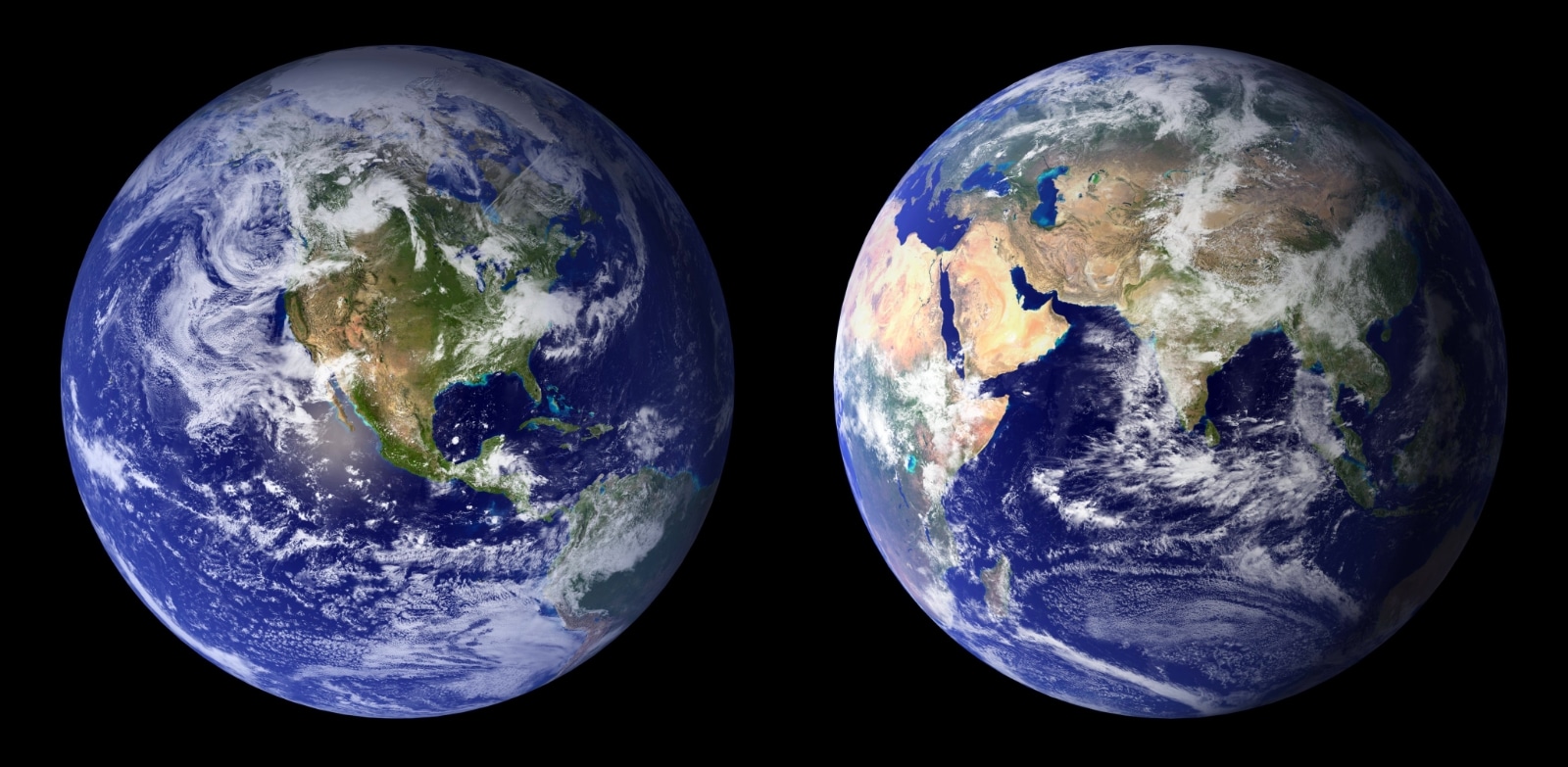
The Coriolis force arising from Earth’s rotation is a strong constraint on the motion of the atmosphere and the ocean. Despite its importance, the physical interpretation of this effect remains a challenging topic. In this article, we present the physical mechanism behind Coriolis deflection. We will focus on the Northern Hemisphere and show that this phenomenon is not merely an optical illusion, as is sometimes claimed. For more information, readers are invited to consult the resources listed at the bottom of the page.
The rotation of the Earth is a fundamental factor that explains why the dynamics of geophysical fluids is so far from intuitive. When they are subjected to differential heating – higher temperatures near the tropics than at the poles – the ocean and the atmosphere begin to move. However, at large scales, these fluids possess only limited freedom of motion. Indeed, they inevitably endure constraints arising from belonging to a rotating sphere.
Organization of the General Circulation
These strong constraints* explain the presence of a very particular structuring of the atmospheric and oceanic circulation at large scales. That is, already at thousand-kilometer scales. Notably, the Hadley cells, whose polar boundary marks the desert belt around 30°N / 30°S, the presence of the west-to-east jet stream at mid-latitudes, the alternating depressions and anticyclones that accompany it, or the west-boundary currents of the oceans such as the Gulf Stream. In short, the tropical atmospheric circulation organizes itself into large thermal cells, while that of the extratropical world takes the form of large spiraled swirls. This global pattern results from a very fine balance between the pressure force associated with differential heating and the Coriolis effect tied to the planet’s rotation. It is thus referred to as a quasi-geostrophic balance.
Despite its popularity, the Coriolis effect is often presented ambiguously. More precisely, while its mathematical derivation is fairly straightforward, the physical interpretation it prompts constitutes another matter. Thus, as we shall see in the rest of this article, the Coriolis deflection associated with a rotating planet is not merely an optical effect tied to a change of reference frame, as it is sometimes heard. Far from it.
Coriolis Force and Circle of Inertia
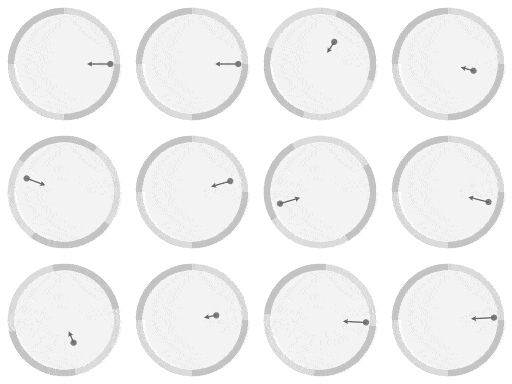
The Coriolis effect can be summarized quite simply. Any body will experience a deflection to the right of its motion in the Northern Hemisphere, to the left in the Southern Hemisphere. This deflection is mainly visible at large scales and becomes more pronounced the faster the object moves and the farther it is from the equator. It is important to recognize here that the deflection would eventually bring the objects back to their original position.
In doing so, if no other force opposes the deflection, the elements will describe, approximately, circles. These are called circles of inertia. For an initial speed of 10 m/s at 60° latitude, the circle’s radius barely reaches 100 kilometers. In effect, objects become as if trapped by a portion of their environment – see the animation below. On Earth, the pressure force pushes particles to move with more freedom over much larger distances. But not as freely as if the planet were static.
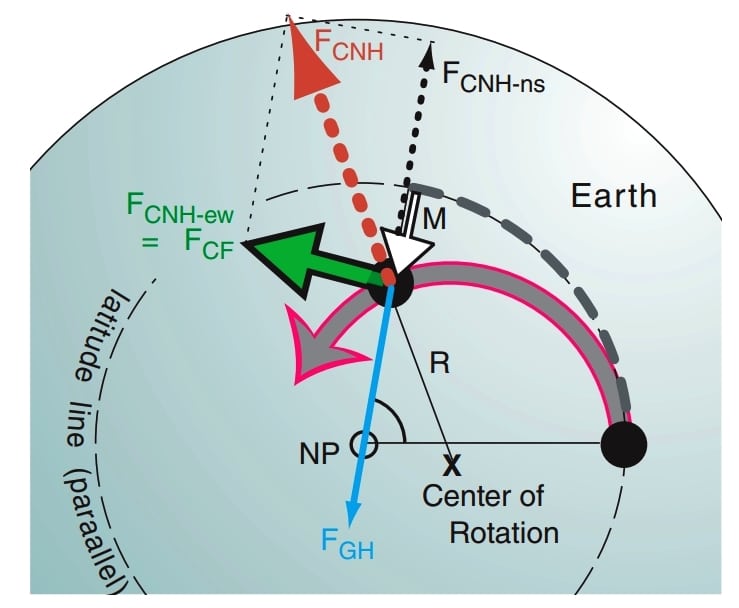
To properly understand the physics of the Coriolis force, let us begin by studying the case of an object at rest relative to the ground. We adopt the absolute viewpoint of an observer fixed with respect to the stars. As the figure below shows, Earth’s gravity and the centrifugal force arising from planetary rotation balance to form an effective gravity – also called weight. It points perpendicular to the surface and defines the local vertical. Because of this balance, the planet became slightly oblate during its formation. To study horizontal motions, one can decompose each force into horizontal components (see the figure below).
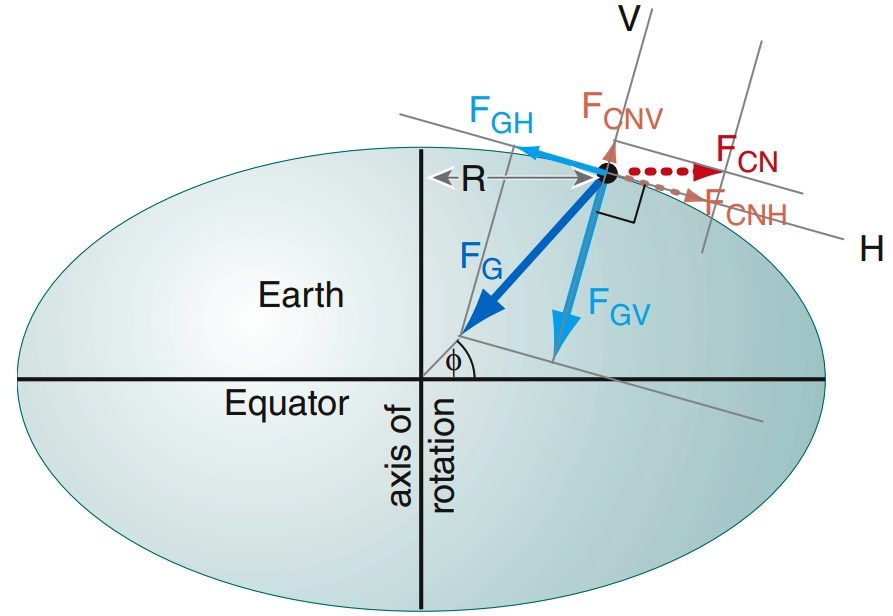
Note that, in place of a centrifugal force, one should rather talk about the inertia of the object which, without gravity, would continue its motion in a straight line, diverging toward infinity. This tendency gives the impression of a force pushing outward from the trajectory. It is also comprehensible in terms of centripetal acceleration: the object is constantly accelerated toward the Earth’s center. This is why it does not drift in a straight line to infinity but remains attached to the globe.
A disequilibrium between gravity and centrifugal force
What happens if the object is moving toward the east? Mechanically, the centrifugal force – its inertia – will be larger and gravity, which has not changed, will resist less effectively. Consequently, it will drift toward the south relative to the underlying surface (and also upward, but the vertical component of the Coriolis effect will not be of interest in this article). If, on the contrary, the object moves toward the west, the centrifugal force – its inertia – will be smaller and gravity will hold it more effectively. Consequently, it will drift toward the north. In both cases, the deflection occurs to the right of the motion in the Northern Hemisphere.
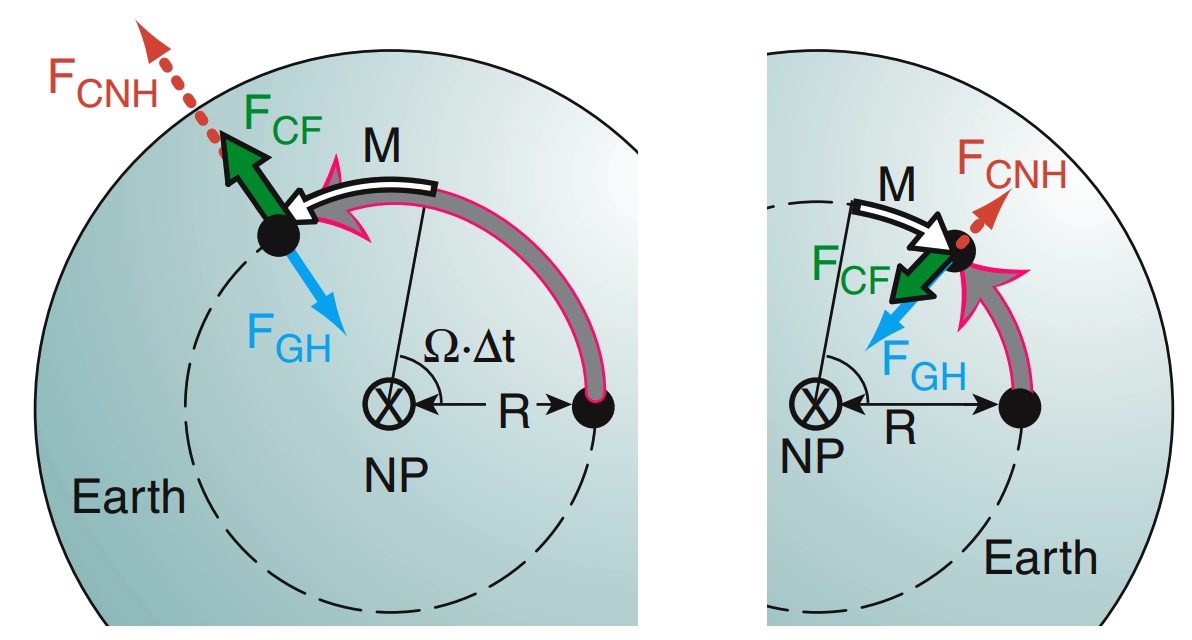
The reasoning becomes more intricate for north-south motions. Yet it still hinges on the emergence of a disequilibrium between the inertia of the object and Earth’s gravity. If the object moves northward, its absolute-path trajectory will form a circular arc crossing parallels – see the illustration below. Moreover, the orientation of the centrifugal force shifts so that gravity rebalances with a deflection toward the east. For a southward motion, the change in orientation of the centrifugal force will call for a deflection toward the west. Again, this deflection consistently occurs to the right of the motion in the Northern Hemisphere. The actual motions thereby experience the resultant of the north-south and east-west components of the Coriolis force.
On the Misinterpretation of the Coriolis Force
It becomes clear from this that the Coriolis force is not merely an optical illusion or a mathematical trick resulting from a frame change. Gravity – in other words, a real force – participates in its dynamics. Furthermore, it can be shown that the absolute speed of objects is not conserved. This fact invalidates the popular explanation of trade winds which would claim that air parcels accelerate westward as they reach latitudes where Earth’s rotation is faster. Not only does this reasoning yield unrealistic wind values, but it is physically wrong. Indeed, the latitudinal variation of rotation speed — higher at the equator than near the poles — does not enter into the process. And there are many such examples. Needless to say that inadequate explanations hinder a nuanced understanding of atmospheric and oceanic dynamics.
One might then ask why so many texts continue to promote them. Probably for historical reasons, but also due to the persistence of a misinterpretation of the Coriolis effect, as detailed by Anders Persson, an expert on the subject at SMHI, in numerous articles.
Finally, let us note that the carousel or rotating platform example, often used to provide a visual glimpse of the Coriolis force, is very misleading. Indeed, what is observed in these experiments primarily results from the centrifugal force. And for good reason, the object moves outward rapidly, tracing an expanding spiral. An appropriate setup designed to visualize the Coriolis effect would instead show a localized, near-circular motion, which is nothing but the circle of inertia described earlier in this article. Thus, although the Coriolis effect was discovered and understood by its author nearly two centuries ago, progress toward a refined and shared understanding remains evident. In the end, the study of atmospheric and oceanic dynamics will become all the more transparent as a result.
* The stratification of the atmosphere – stable on large scales – is also important, but is not the subject of this article.
Sources : How Do We Understand the Coriolis Force ?, Bulletin of the American Meteorological Society / Is the Coriolis effect an ‘optical illusion’ ?, Quarterly Journal of the Royal Meteorological Society / Meteorology for Scientists and Engineers, Roland B. Stull / Atmospheric Motions, Encyclopedia of Global Environmental Change / An Intuitive Approach to the Coriolis Effect, Kristian Silver.
