
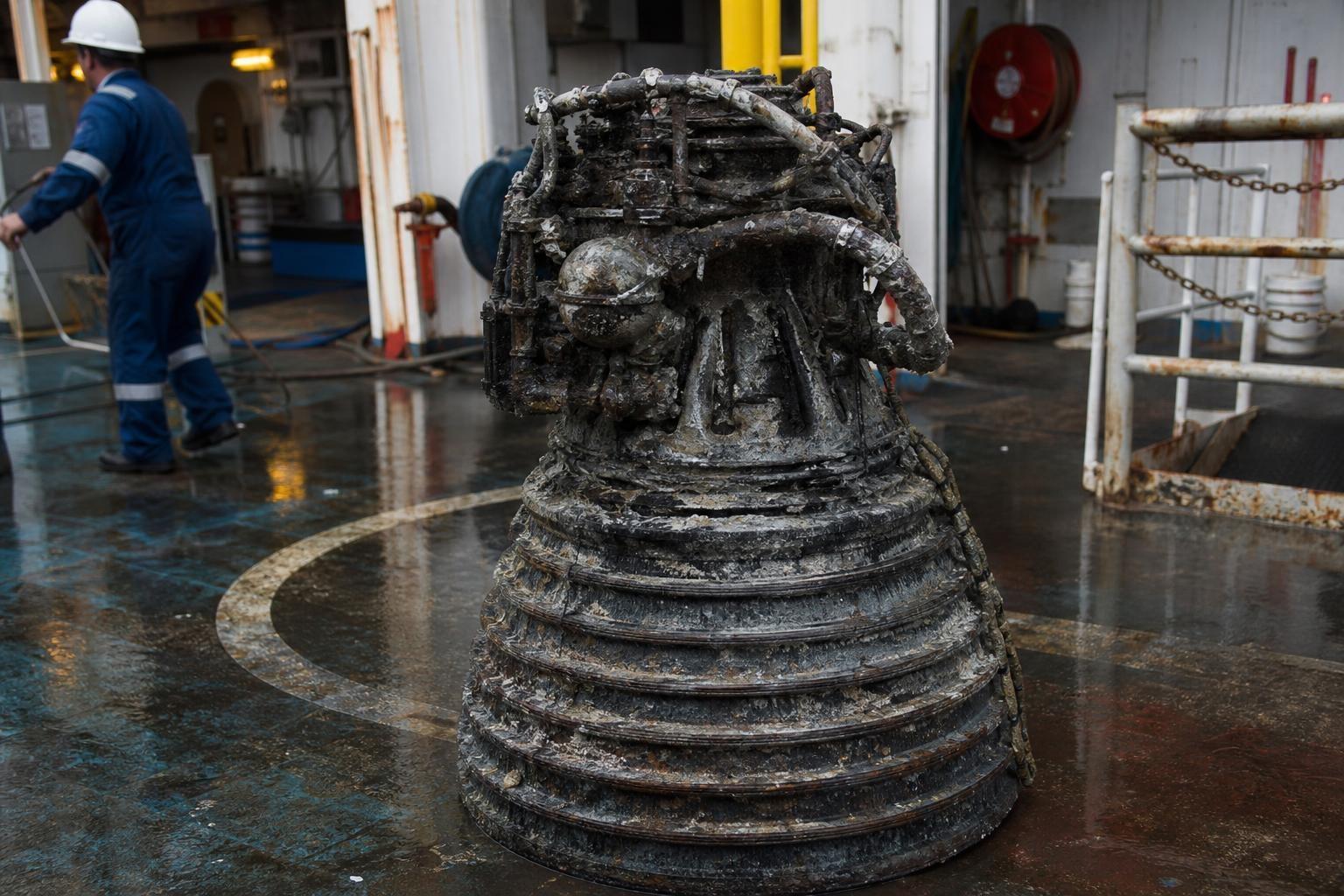
They went looking for giants, and they found them in the dark. In 2013, a privately funded expedition sent robots 4.3 kilometers down into the Atlantic to search for the hardest-working machines of the Space Age. They came back with engines that once shook the Earth—and later analysis tied one set of fragments to the mission that first carried humans to the Moon.
Hunting the rockets in the abyss
The search began as a map, not a myth. Sonar traced a wide debris field where first-stage hardware from the Saturn V had fallen decades earlier. “Black as ink, quiet as snowfall,” was how the team described the seafloor, a landscape of twisted metal and silt.
At nearly 14,000 feet, pressure hammers every bolt. Remotely operated vehicles did the careful work: hovering, photographing, and lifting with clawed arms. A single thrust chamber—scored by salt and time—rose like a cathedral column from the mud.
What these engines were—and why they were there
Each F-1 engine was a titan, producing roughly 1.5 million pounds of thrust. Five of them powered the Saturn V’s first stage, the S-IC, a hurricane of fire built to work for just a couple of minutes.
After staging, the hardware fell into the ocean, anonymous and spent. No recovery was planned; the sea became a vault for industrial art at planetary scale. Decades later, curiosity turned the vault into a museum without walls.
Money, motives, and permissions
This was philanthropy, not salvage-for-sale. The project was funded by a tech entrepreneur who grew up watching Saturn V launches, more pilgrim than profiteer. NASA maintained ownership, while the team agreed to conserve and eventually display the artifacts for the public.
“Call it technological archaeology,” one observer mused. Call it a modern love letter to analog bravery and precision metalwork.
Wrestling history from the deep
The work was deliberate, physical, and oddly tender. Frames were lowered, straps cinched, and loads inched upward through four kilometers of black water. “Pull, breathe, hold,” a diver once said about lifts like this—though only the robots went down, the deck crew still felt that rhythm.
They found injector plates, turbo pumps, and the great bell of a thrust chamber. Corrosion had skinned off labels, but stamped numbers hid beneath the mineral crust. Enough clues survived to point to the flight that took Armstrong, Aldrin, and Collins beyond Earth.
From brine to gallery
Salt is a patient enemy, so conservation had to be even more patient. The hardware soaked in baths that drew out ions; conservators teased away concretions with picks, light tools, and distilled water. Bit by bit, serials emerged, and with them a documented link to the most storied launch of the century.
Pieces now rest in museums, including Seattle’s Museum of Flight, where visitors can stand eye-to-eye with metal that once faced the furnace of combustion. Not polished to showroom shine, but left with ocean scars, they feel both ancient and absolutely modern.
Why this mattered beyond nostalgia
These engines are proof that scale and subtlety can coexist. A human hand can span a single bolt, yet a cluster of five F-1s lifted 2,900 tons on a tongue of flame. Touch the pitted steel, and the math of heroism becomes concrete again.
For a new generation, the recovery reframed Apollo not as a sepia postcard, but as a living problem to be solved with tools, teamwork, and late-night persistence. “We brought up more than metal; we raised a story,” one team member said, and the phrasing feels exactly right.
The choreography of a once-impossible job
- Scan the seabed with deep sonar, trace a pattern of fallen hardware
- Drop ROVs into ice-cold darkness, verify shapes, and tag targets
- Rig lifting frames, mind currents and strain-gauges on the winch
- Cradle the artifacts on deck, then rush them into freshwater and controlled storage
Every step felt like a handshake across time—engineers of the past gripping the wrists of engineers in the present.
The echo that keeps traveling
What began as a search became a way to measure values. Risk, craft, and curiosity still matter; they simply travel by new routes. The engines remind us that exploration is a chain, not a single spark—oceans to rockets, decks to deserts, workshops to launch pads.
“Not relics, but lessons,” someone wrote in a visitor log. Stand near those battered bells, and you can almost hear the countdown’s old cadence—not as nostalgia, but as permission to build the next impossible, one careful piece at a time.
