
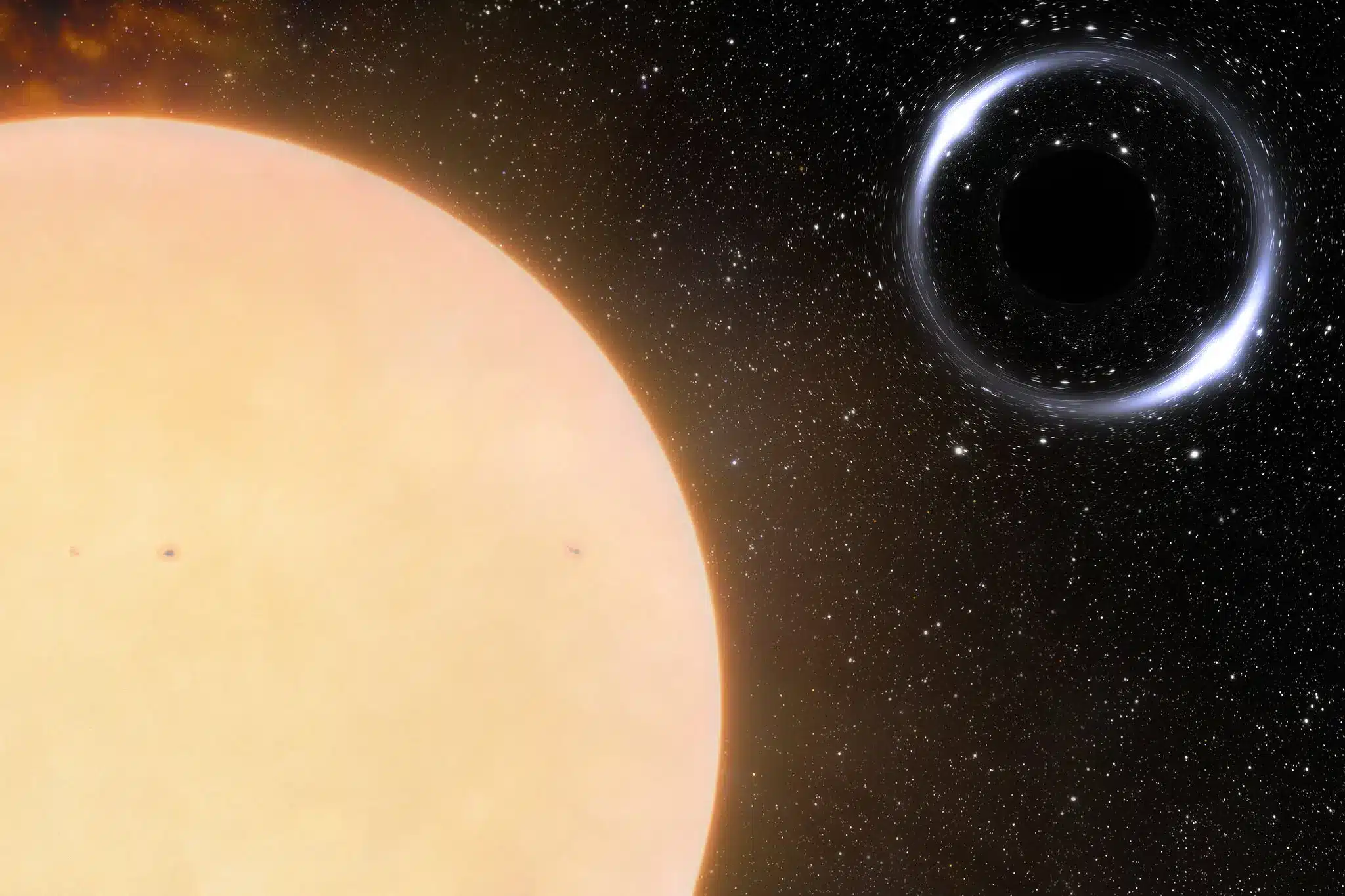
Astronomers have confirmed the discovery of the closest known black hole. This behemoth, roughly ten times more massive than the Sun, orbits its binary companion at a distance comparable to the Earth–Sun separation. It is located about 1,600 light-years away in the Serpent-Bearer constellation.
According to some models, our galaxy could harbor tens of millions of black holes. To date, astronomers have identified only about twenty, all detected in X-ray wavelengths as they accrete a companion star (or any matter that ventures a bit too close). However, not all black holes “shine.” Most are dormant and wander through the galaxy, waiting for their next cosmic meal.
Kareem El‑Badry, an astrophysicist at the Harvard–Smithsonian Center for Astrophysics, has been hunting these hidden beasts for four years. As part of a new search campaign leveraging data from the GAIA spacecraft, which mapped the positions, motions, and other properties of millions of stars in the Milky Way, the astronomer announces he has found one that is “very close” to Earth.
Ten Solar Masses
In detail, Dr. El‑Badry and his team spotted a star remarkably similar to the Sun at roughly 1,600 light-years away, except that it seemed to “wobble” in an odd way, as if influenced by an unseen companion. To dive deeper, the astronomers secured time on the Gemini North telescope, perched atop Mauna Kea in Hawaii, to measure the speed and period of this oscillation. This allowed them to determine the relative masses of the two objects involved.
The technique is most often used to detect exoplanets orbiting a star. Here, the object is of a very different scale. Based on the estimates, it would be about ten times more massive than the Sun. In other words, the companion must be a black hole. This object, now named Gaia BH1, remains relatively distant from its stellar partner — about the same distance as the Earth from the Sun.
“Take the solar system, place a black hole where the Sun is and the Sun where the Earth is, and you obtain this system,” summarizes Dr. El‑Badry in a press release.
This is the closest known black hole. Its discovery also hints at a substantial population of dormant black holes in binary systems.
The finding also raises questions about our assumed understanding of how these binary systems evolve. The progenitor of this black hole would have been a star of roughly twenty solar masses, the authors estimate. Yet, current theories of stellar death and subsequent collapse into a black hole predict a supernova explosion that should have severely disturbed the second star. And yet, that companion appears entirely normal to us.
Sources: Astronomers Discover Closest Black Hole to Earth (cfa.harvard.edu) | Astronomers Discover Closest Black Hole to Earth (noirlab.edu)
Article prepared with the help of AI · Our method
