
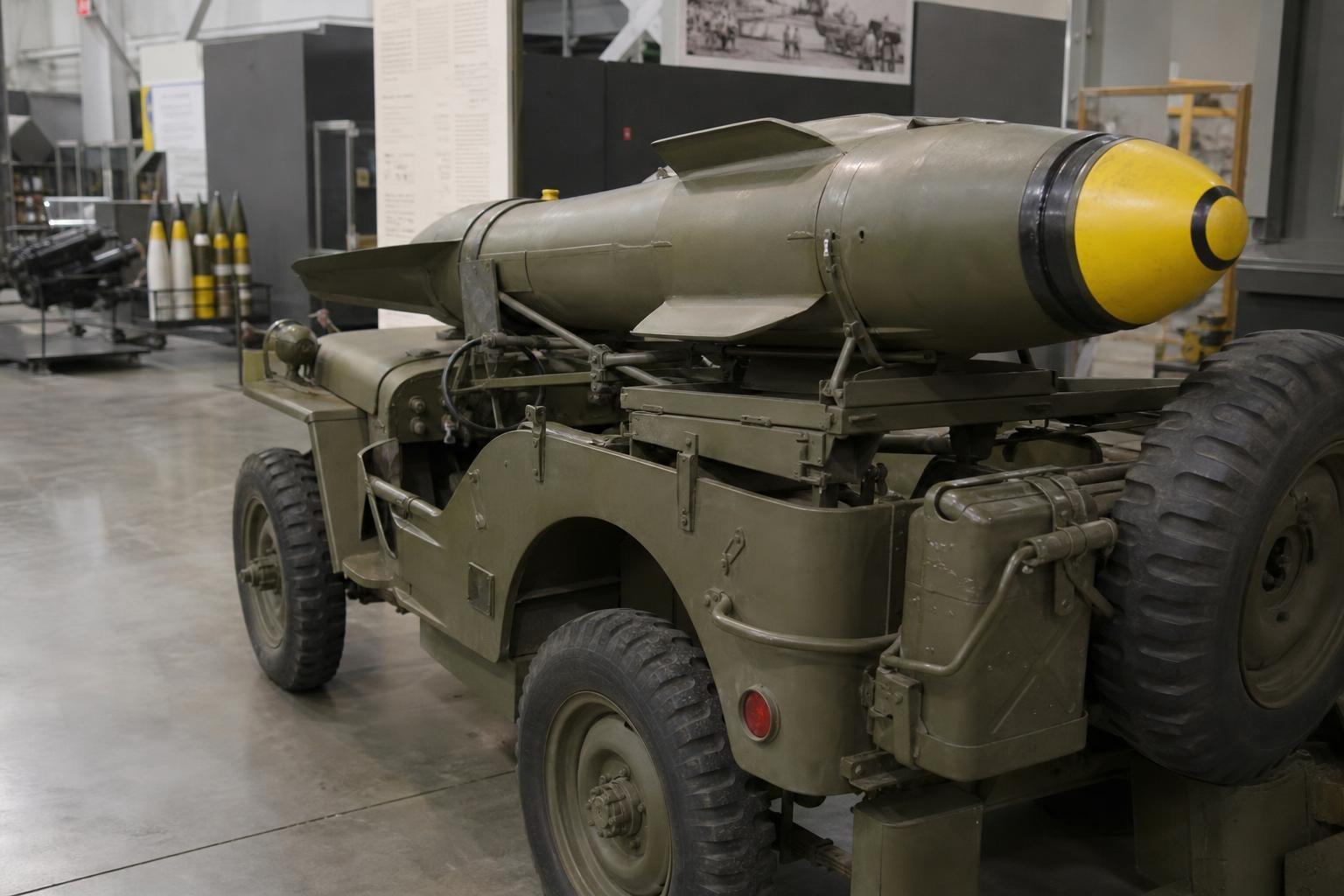
A small team rolls up in a dusty jeep, lugging an aluminum tube, a tripod, and an oddly squat projectile with fins. The crew isn’t hauling a mortar or a recoilless rifle. They’re fielding a device that could carve a glowing circle into the map of Europe. For a brief moment in the 1960s, the United States thought this was not only possible, but practical.
The strange logic of “small” nukes
Cold War planners were obsessed with flexibility. If the Warsaw Pact sent tanks pouring through the gaps, NATO wanted options between surrender and Armageddon.
A battlefield nuclear shot, they argued, might be “decisive,” yet still contained. It could crater a bridge, shatter a column, or flip the switch on an entire valley. “A pocket-sized apocalypse,” as one officer later quipped.
In theory, this was deterrence with a scalpel. In practice, it walked the razor’s edge between tactical necessity and existential risk.
Meet the Davy Crockett
Nicknamed after a frontier folk hero, the Davy Crockett was a family of lightweight, jeep- or tripod-mounted nuclear launchers—the M28 and the M29—firing the M388 projectile with a W54 warhead.
The smaller launcher could lob its atomic round a bit over a mile, roughly 2 kilometers. The larger variant could reach farther, but never truly far. Accuracy was modest, and the potential blast was anything but modest.
The warhead’s yield was minuscule by strategic standards—on the order of tens of tons of TNT—yet still enough to flatten structures, irradiate ground, and turn a chokepoint into a no-go zone.
Deployed to U.S. units in Europe, it was meant to seed the landscape with sudden, nuclear obstacles—especially where concrete fortifications would be too slow to build.
- Yield: roughly tens of tons of TNT, far below megaton class
- Range: about 2 km for the M28; up to around 4 km for the M29
- Warhead: W54, compact and relatively lightweight
- Crew: small team capable of mounting on a tripod or jeep
How it worked—and how it didn’t
Technically, the system was a recoilless “spigot” launcher that shoved a finned projectile into a high arc. Crews dialed in settings, braced for the flash, and hoped the wind and math were on their side.
“It was like throwing a thunderbolt with your bare hands,” soldiers later said—admiring the ingenuity, doubting the wisdom. The minimum safe distances were uncomfortably close; even a “small” detonation threw out blast, heat, and fallout. A misjudged shot could harm the very troops it was supposed to save.
And accuracy? Not sniper-like. The circular error probable was large, the sights simple, and the environment unforgiving. If the target was mobile, luck became a major actor. If the wind kicked up, so did uncertainty.
The paradox was stark: a weapon designed to be near the front made that very front a dangerous place to stand.
Strategy meets absurdity
To its supporters, this was a clever, last-ditch deterrent. A few hidden teams could “shut the door” on an armored thrust. A handful of atomic roadblocks might buy time for reinforcements or for politics to catch its breath.
To its critics, it was theater of the absurd. “You don’t tidy up nuclear war,” one skeptic might have said. Use it—and escalation pulls you forward like a rip current. Don’t use it—and you’ve packed an existential liability in a jeep.
Both views carried truth. The Davy Crockett distilled the Cold War contradiction: avoid the big war by preparing for a thousand smaller ones, any of which could spark the big one.
Why it vanished
By the late 1960s, the Davy Crockett’s star was fading. Better anti-tank missiles promised precision without fallout. Allied commanders worried about friendly casualties and political panic if even a “tiny” nuclear weapon went off.
The broader climate also shifted. Arms-control talks, nonproliferation norms, and a heightened fear of rapid escalation made battlefield nukes feel less like clever tools and more like triggers. Within a few years, the system was quietly retired, leaving behind crates of training rounds and tidy, museum-ready plaques.
The afterimage
In hindsight, the Davy Crockett reads like a dispatch from an alternate timeline—one where nuclear parity pushed engineers to shrink the unthinkable into portable form. It wasn’t madness so much as meticulous, procedural logic, applied to a premise that now feels painfully naive.
Yet the questions it raised haven’t truly left us. How small can you make Armageddon before it stops being unthinkable? How do you signal resolve without inviting catastrophe? Where is the line between credible deterrence and reckless temptation?
“Make it tiny,” some argued. “Make it local.” And still, the blast outpaces the map. The Davy Crockett reminds us that even the smallest mushroom cloud belongs to the sky, and that on a battlefield measured in kilometers, the most dangerous radius is often the human mind.
