
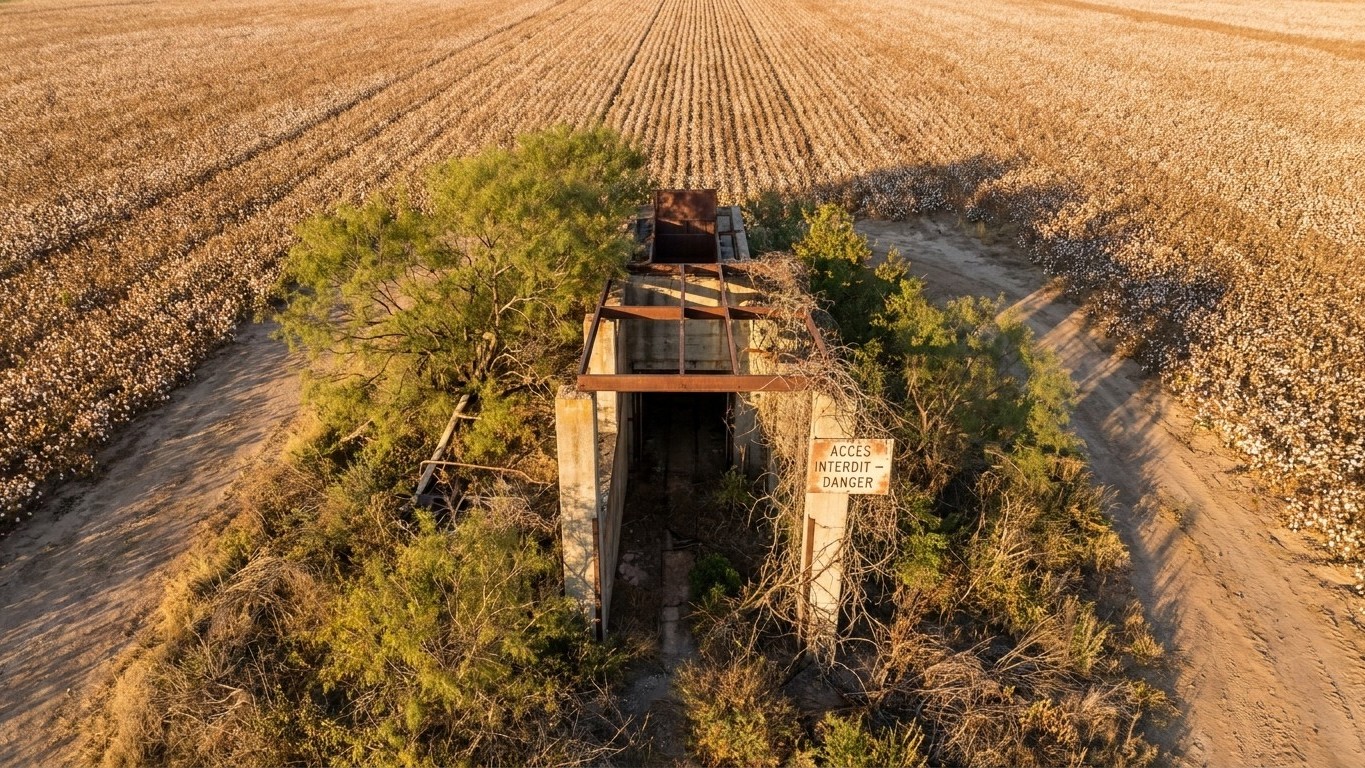
Under the fields of Waxahachie, south of Dallas, lies a tunnel more than 22 kilometers long that no one ever finished digging. Beneath fields near Waxahachie, Texas, 22.5 kilometers of tunnel remain from an American particle accelerator that was never completed, terminated by Congress in October 1993, leaving its underground passages, access shafts, and surface buildings without an operating machine. Two billion dollars sunk, thousands of jobs vanished overnight, and a machine meant to revolutionize world physics that never came to be. Here is the story of the Superconducting Super Collider, the most ambitious particle accelerator ever imagined, and the greatest American scientific fiasco of the 20th century.
Key takeaways
- A giant 22.5 km tunnel dug in Texas for a revolutionary machine that never materialized
- Costs tripled in six years, forcing Congress to abandon the project in 1993 after $2 billion had been spent
- Europe finished the job, fifteen years later
A Pharaonic Project Born of the Cold War
Everything began in 1987. The Superconducting Super Collider was a particle accelerator project launched after President Ronald Reagan’s approval in June 1987. The aim? To build the most powerful machine ever designed to probe the infinitely small. After a fierce competition among American states, President Reagan approved in November 1988 a construction site near Waxahachie, Texas, in Ellis County, about 50 kilometers south of Dallas.
The numbers are dizzying: the circular tunnel to be dug would measure 87 kilometers in circumference. To put it in perspective, it is like digging a beltway linking Paris to Chartres, entirely underground, through rock. Inside, two proton beams were to collide at a combined energy of 40 TeV, roughly three times the energy of collisions that would later become those of the European Large Hadron Collider (LHC). On paper, the United States seemed poised to crush European competition and to keep a decade of advantage in discovering the Higgs boson, that elusive particle that gives mass to all others.
The construction really kicked off in 1991. The drilling machines advanced, crews settled in, Waxahachie saw thousands of physicists and engineers from around the world pour in. Many had left their academic careers to try the venture, some even making their living elsewhere afterward, “where they did very well, thank you.” For two years, the small Texas county became the nerve center of high-energy physics.
The Budget Drift That Changed Everything
The flaw was present from the start, but no one wanted to see it. In 1987, Congress estimated the total cost of the project at about $4.4 billion. A year later, at most, the Department of Energy already set its first estimate at $5.9 billion. And the spiral didn’t stop there: the estimated overall cost rose to about $8.2 billion in 1991, then exceeded $10 billion in 1993, with the Energy Secretary even mentioning a figure close to $11 billion, a threefold increase from the initial estimate.
Why such overruns? The answer lies in one sentence: no one had ever attempted such a project before. Since accelerators of this magnitude remained largely unknown, the project grew in size and scope once construction began, always demanding more money and materials to adapt. Added to this were heavy political factors: the end of the need to prove American scientific supremacy after the collapse of the Soviet Union, the belief that several smaller scientific experiments could be funded for the same cost, and Congress’s appetite to cut spending.
The presidency of Bill Clinton nevertheless tried a final act of defiance. In 1993, he urged Congress to continue “supporting this important and demanding effort” until its completion, arguing that abandoning the SSC would signal a retreat in America’s leadership in fundamental science. It made no difference. After $2 billion had been spent, including $400 million by the host state of Texas and the rest by the Department of Energy, the House of Representatives rejected funding on October 19, 1993, and Senate negotiators failed to restore it. A titanic construction project was halted abruptly, barely one-fifth complete.
A Giant Hole, 2000 Jobs Lost, and a Site Searching for Its Calling
Work had reached roughly 20% completion when federal funding ceased. Concrete facts: the teams had already bored the tunnels, dug 17 access shafts, and erected 18,600 square meters of buildings, with more than $2 billion already spent. The human shock, however, was brutal. At the moment of cancellation, 2,000 people were still working on the project. Some drilling crews continued doggedly: the engineer in charge kept digging until the last dollar was available, in 1994, hoping that something would change.
What remains today of this unfinished dream? Nature and people have reclaimed their space, each in their own way. The access shafts were filled, and what remains of the tunnel now collects rainwater. On the surface, the site has had several lives. After being transferred to Ellis County, which had long searched in vain for a buyer, the property was finally sold in August 2006 to a group of investors led by the late J.B. Hunt. The idea at the time: convert the site into a high-security data center, a project spearheaded by Collider Data Center, which had hired a specialized firm to market the site as a data center. But Hunt’s death soon after the purchase shelved that project. In 2012, a twist: the chemical company Magnablend bought the property and its facilities, not without opposition from the local community. Even today, the SSC buildings are occupied by this Waxahachie chemical manufacturer.
Europe Finished the Work, Fifteen Years Later
The cruel irony of history bites hard for American physics. What Texas never completed, Europe built by reusing its own infrastructure in a smart way. The LHC leveraged existing engineering infrastructure and the 27-kilometer underground cavern of the Large Electron-Positron Collider, employing innovative magnet designs to bend higher-energy particles within the available tunnel. The result: a much more modest bill, since the LHC ultimately cost around $5 billion to build.
On July 4, 2012, nearly twenty years after the abandonment of the Texan site, Europe achieved what America had abandoned. The ATLAS and CMS collaborations at the Large Hadron Collider announced the discovery of a new particle with properties compatible with the Higgs boson predicted by the Standard Model of particle physics. A year later, that discovery led to the Nobel Prize in Physics awarded to François Englert and Peter Higgs in 2013.
One question continues to haunt some American physicists: would the SSC have allowed the Higgs boson to be discovered much earlier, with a collision energy three times that of the LHC? A Texas Monthly journalist who investigated the matter found no one who seriously doubted it. What remains today is not a major scientific breakthrough, but a tunnel drowned by rainwater, somewhere between a chemical warehouse and Texan cotton fields, a silent vestige of an ambition that exceeded the resources people were willing to devote to it.
Sources: tdlr.texas.gov | archives.utah.gov | dallasnews.com
