
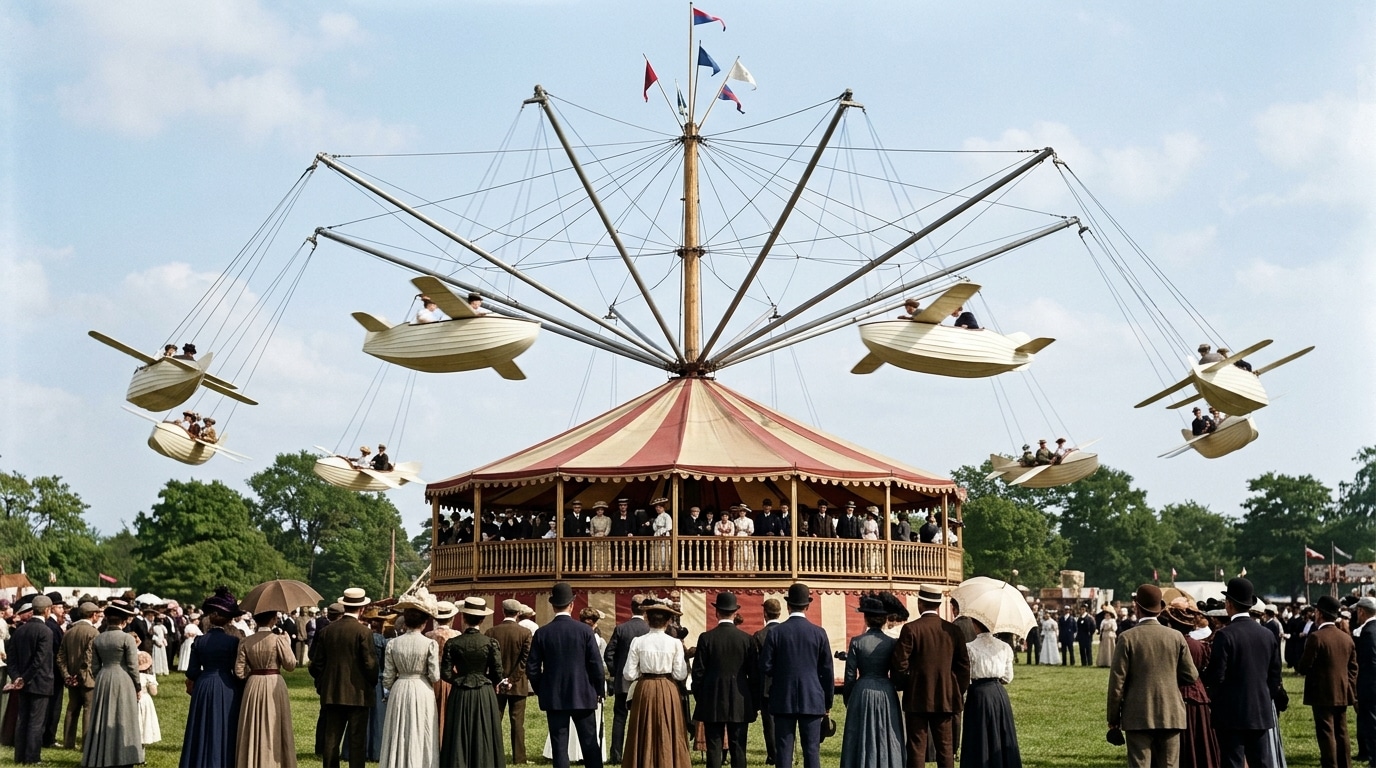
He invented one of the deadliest weapons in military history, then built a ride. Hiram Maxim, the father of the eponymous machine gun, turned to aviation before ending up as a carnival showman. His attraction continues to operate today on Blackpool’s seafront, unchanged for more than a century.
- Hiram Maxim, inventor of the machine gun, tested a steam-powered flying biplane in 1894 before designing the Captive Flying Machine in 1902.
- Installed at Blackpool Pleasure Beach in 1904, the ride has rotated with little interruption for over 120 years thanks to ten metal arms bearing suspended nacelles.
- Since 2017, the ride has been Grade II listed by Historic England, which recognizes it as Europe’s oldest continuously operating carnival ride.
- When the inventor of mechanical death dreamed of becoming a magician of the skies
- A century of uninterrupted rotations along the seafront
- The elder ride that defies time, wear and storms
The story seems almost too good to be true. A man who shaped modern warfare with a weapon capable of firing hundreds of rounds per minute ends up designing flying machines for the public’s pleasure a few years later. Yet that is precisely what happened with Hiram Maxim, and the result of this unlikely career shift endures on Blackpool’s seafront.
When the inventor of mechanical death dreamed of becoming a magician of the skies
Before turning to flight, Hiram Maxim had already left a mark on military history. His machine gun, bearing his name, transformed the battlefields of the late nineteenth century. But the man meant to stop there. He nourished an obsession with an equally bold technical challenge: making a heavier‑than‑air machine fly.
In 1894, Maxim attempted the feat at Baldwyn’s Park, in Kent. His biplane weighed more than 3.6 tonnes and carried two steam engines, each delivering 180 horsepower, driving propellers 5.3 metres in diameter. A monster of engineering for the era, built to test the lift produced by different wing profiles in a concrete way.
The test lasted only a few seconds. The apparatus rose about 1.4 metres off the ground and travelled 281 metres before breaking the retaining rail meant to keep it grounded. A technical flight, not a free flight, but a demonstration sufficient to prove the machine did generate real lift.
Maxim never pursued this route toward a manned, autonomous airplane. He chose to repurpose his aerodynamic testing bench in a very different way, turning it into a fairground attraction capable of making the public feel like they were flying, without ever truly leaving the ground.
A century of uninterrupted rotations along the seafront
Thus was born the Captive Flying Machine, literally the captive flying contraption. Designed in 1902, it was first shown to the public in May 1904 during the Italian Exhibition at Earl’s Court in London. The concept directly borrowed the aerodynamic principles of the Baldwyn’s Park biplane, but applied to a far more peaceful purpose: entertainment.
The same year, the ride was installed at Blackpool Pleasure Beach on the English coast, where it has scarcely halted since. Ten metal arms radiate from a central driving hub and bear gondolas suspended by cables, offering visitors a sense of circular flight, long before the invention of modern thrill rides.
A technical detail worth noting: the ride used mercury vapor rectifiers, a technology just invented in 1902, to power its electric motor. In other words, Blackpool housed one of the earliest public attractions to benefit from this electrical innovation, making it a valuable witness to the history of engineering as much as entertainment.
In 2014, ITV News celebrated the attraction’s 110th anniversary by inviting a Typhoon fighter pilot to try it, symbolically measuring the distance traveled between this century‑old machine and modern aviation.
The elder ride that defies time and storms
This mechanical heritage has not escaped the notice of British authorities. Since April 19, 2017, the ride has been officially listed on the National Heritage List for England, designated as Grade II under the name Sir Hiram Maxim’s Captive Flying Machine, at Ocean Boulevard, Blackpool.
Historic England, the body responsible for the listing, justifies its decision with three combined arguments. It would be Britain’s oldest stationary ride, the only known example of its kind in the world, and the oldest continuously operating carnival ride on the entire European continent. A triple record that places this attraction in a class of its own.
The original structure has weathered the decades with a few adjustments. In 1934, architect Joseph Emberton added a concrete marquee around the platform, about 12 feet above the ground, while the arms span a diameter of 45 feet. The steel lattice tower and the wooden boarding platform have remained faithful to the original spirit.
Blackpool Pleasure Beach, now renamed Pleasure Beach Resort since February 2024, continues to invest in its newer attractions, such as Aviktas, a gyro swing opened for the park’s 130th anniversary with an announced budget of 8.72 million pounds. But amid these novelties, Maxim’s old ride keeps turning, a steadfast guardian of a history where war, aviation, and the carnival strangely intersect.
Hard to find a better symbol of industrial reinvention than this centenarian ride. The man who had invented a weapon of mass destruction ended up giving the public a peaceful attraction, still standing more than 120 years after its creation. A grand, real-life lesson in history, accessible to anyone strolling along Blackpool’s seafront.
