
People often think that a single plant cannot topple an entire ecosystem. Tahiti proves otherwise. In 1937, an amateur botanist planted a decorative shrub from tropical America in his garden. Almost a century later, this same species covers two-thirds of the island and threatens to erase half of its endemic flora.
- Introduced in 1937 by Harrison W. Smith, Miconia calvescens escaped from the garden to invade 65 to 70% of Tahiti.
- Nicknamed “green cancer,” this shrub threatens to drive nearly half of the island’s 107 endemic species to extinction by shading the forest floor from light.
- A pathogenic fungus was introduced in 2000 to curb its spread, but the plant has also spread to Moorea, the Leeward Islands, the Marquesas, and as far as Guadeloupe.
- 1937, the year when a botanical garden sowed disaster
- The “green cancer”: how an ornamental shrub colonized 65% of the island
- Endemic plants on borrowed time in the face of the silent invasion
1937, the year a botanical garden sowed disaster
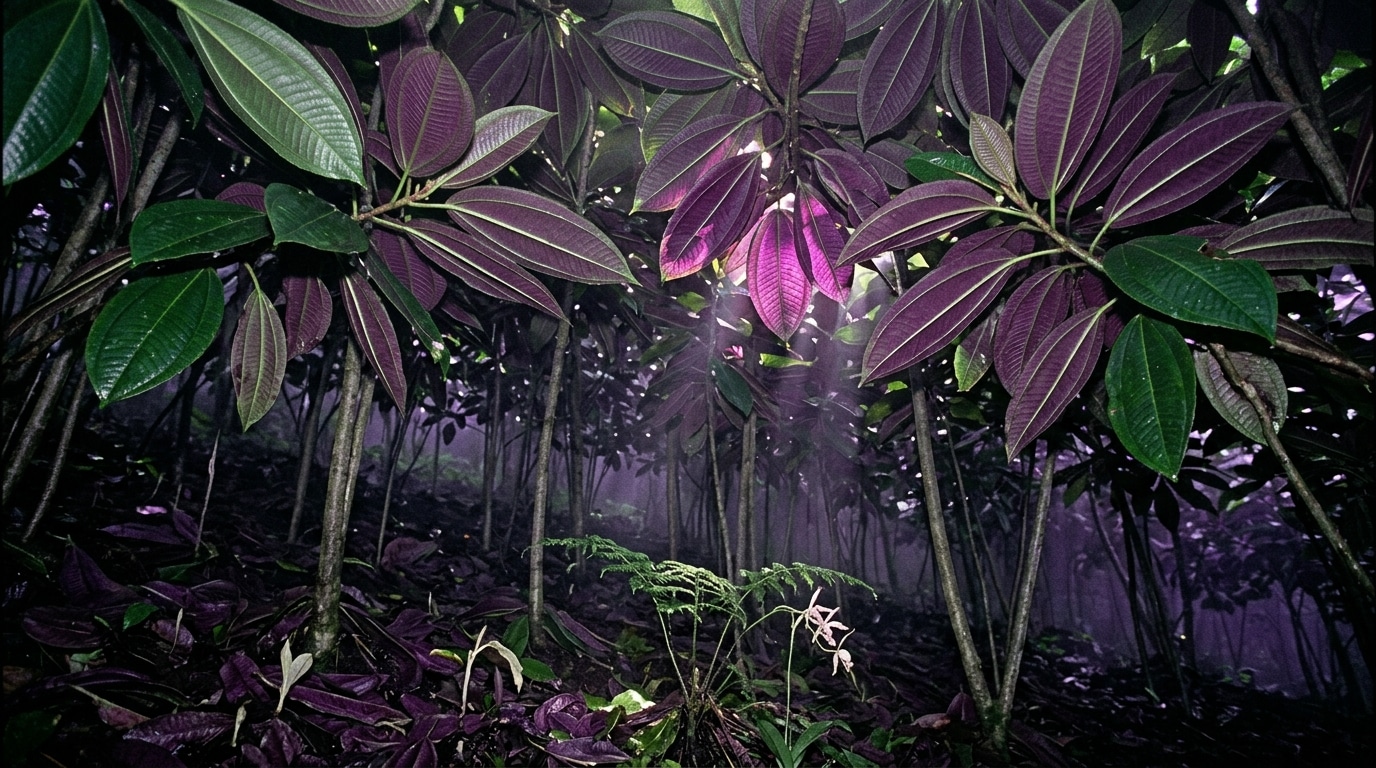
The story begins in an almost innocent, almost endearing way. Harrison W. Smith, an American with a passion for botany, decides to enrich his private garden in the Papeari district on Tahiti’s humid coastal zone. He chooses Miconia calvescens, a shrub native to tropical America, prized for its broad purple leaves on the underside.
Nothing at the time hinted at the ecological catastrophe to come. The shrub is planted as a simple horticultural curiosity, right next to the island’s native forest. This detail would prove crucial for what followed.
The immediate proximity to a preserved natural environment offers the plant a ready-made entry point. Its seeds are tiny and produced in enormous quantities, and they needed only a few decades to slip from the garden and colonize the nearby slopes.
The “green cancer”: how an ornamental shrub colonized 65% of the island
The local nickname for this plant speaks volumes about the damage it wreaks. Referred to as the “green cancer” in Tahiti, Miconia calvescens spreads in a metastatic fashion, advancing relentlessly and seemingly impervious to lasting interruption.
According to the work of botanist Jean-Yves Meyer, published as early as 1996, the shrub already dominated the forest across 65% of the 1,045 square kilometers that make up Tahiti. A staggering figure for a species introduced barely six decades earlier in a single garden.
The French Office for Biodiversity confirms the magnitude of the phenomenon: miconia is now present on more than 70% of Tahiti’s territory. It has also been spotted on Moorea, in the Leeward Islands as well as Raiatea and Tahaa, and in the Marquesas, at Fatu Hiva and Nuku Hiva.
What stands out most is the plant’s rate of growth. A single specimen can reach 12 meters in height within eight years. Its broad leaves form a true vegetative umbrella, casting the understory into near-permanent shadow and depriving native plants of the light they require to survive.
Within fifty years, the species had even climbed to elevations of up to 1,400 meters, taking up residence in Tahiti’s famous cloud forests—those misty ecosystems that serve as biodiversity sanctuaries.
Endemic plants on borrowed time in the face of the silent invasion
Behind these impressive figures lies a reality that threatens the very heart of local biodiversity. Based on the work of Meyer and Florence, between 70 and 100 Tahitian native plant species are now directly threatened by this quiet invasion, including 35 to 45 that are strictly endemic to French Polynesia.
Franck Courchamp, a research director at the Ecologie, Systématique et Evolution laboratory, affiliated with CNRS, Paris-Sud, and AgroParisTech, does not mince words on the gravity of the situation. He warns that this harmful tree could push nearly half of the island’s 107 endemic species toward extinction.
In response to this alarming assessment, Polynesian authorities attempted a biological counteroffensive. In 2000, the environmental agency introduced a pathogenic fungus named Colletotrichum gloeosporioides f. sp. miconiae. The aim was to slow the spread by attacking the shrub’s leaves directly.
The results proved spectacular, though in mixed fashion. In only three years, the fungus spread across the entire island of Tahiti, infecting almost all miconia plants, before being detected on Moorea as well.
This rapid expansion illustrates both the potential strength of biological control and the difficulty of controlling its long-term consequences. The International Union for Conservation of Nature has incluso Miconia calvescens among the world’s 100 most invasive species, a list reserved for the most troubling cases on a global scale.
The threat has since extended beyond the Pacific. In Guadeloupe, the plant is banned from the entire territory by a ministerial decree dating from August 2019. The DEAL has been actively combating it, eradicating more than 6,370 specimens in Saint-Claude since 2020, including more than 310 mature trees, and removing more than 1,000 in Gourbeyre since the discovery of this outbreak in May 2025, including 134 mature trees.
Tahiti’s miconia saga condenses the paradoxes of ornamental horticulture into a single tale. A plant chosen for its beauty can, under certain conditions, become one of the most serious threats to a fragile island ecosystem. What began in a private garden in 1937 continues to shape Tahiti’s forests today, often for the worse.
