
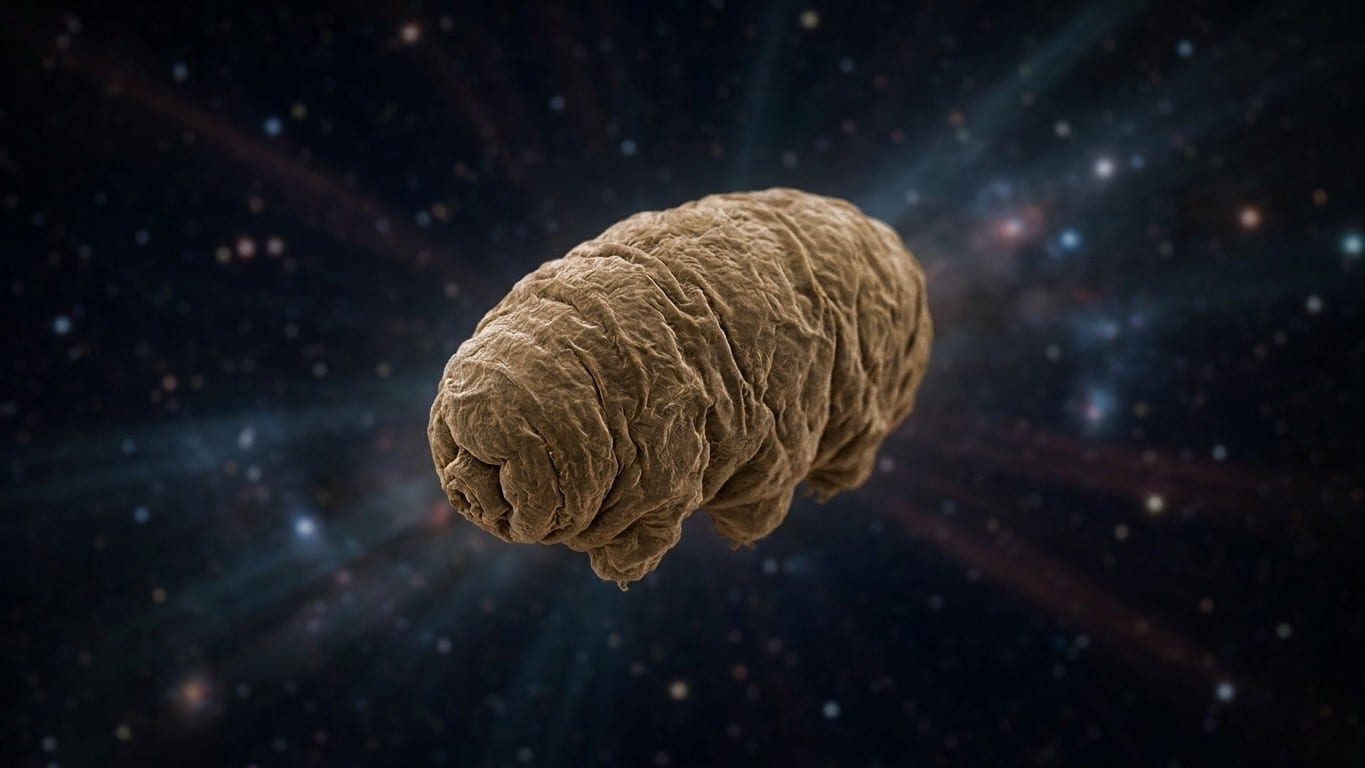
September 14, 2007. A Russian Soyuz-U rocket launched into orbit a spherical capsule carrying 43 scientific experiments. Among them, the most discreet was also the boldest: animals placed naked on an exterior platform at an altitude of 270 kilometers, exposed to the vacuum and to solar ultraviolet rays with no protection whatsoever. Ten days later, the capsule touched down on the Kazakh steppes. And the animals, for the most part, were alive.
These creatures were tardigrades. Microscopic invertebrates, no larger than two millimeters, nicknamed “water bears” because of their slow, eight-legged gait. These tiny eight-legged invertebrates are renowned for their exceptional resilience. But surviving the vacuum of space, exposed directly, without any capsule around them? No one dared to bet on it. It was known that bacteria could do it, but it seemed impossible for animals to endure the two great dangers of space: the vacuum, which boils their internal water, and the ultraviolet radiation that destroys chromosomes.
Key takeaways
- Microscopic animals survived the impossible: space vacuum and extreme radiation
- Their secret? A strategic death before launch that renders them virtually indestructible
- This discovery opens unexpected doors for future manned missions to Mars
The TARDIS Experiment: Ten Days of Discovery in Orbit
The Swedish biologist Ingemar Jönsson, from Kristianstad University, designed the TARDIS (Tardigrades in Space) experiment, which was mounted on a platform named Biopan-6, built by the ESA and positioned outside the Foton-M3 capsule at an altitude of 270 kilometers. The protocol was rigorous, almost surgical in its logic. Tardigrades from four different species, in an anhydrobiotic state, were arranged in four series of boxes open to space for ten days. One group was shielded from all radiation, two others received either UV-A or UV-B, and the last had no protection. The control group: no filter, unfiltered sun, total vacuum. At this altitude, ultraviolet radiation reaches 7,000 kilojoules per square meter, a thousand times higher than at sea level.
The results, published in September 2008 in the journal Current Biology, stunned the scientific community. More than two-thirds (68%) of the samples survived this extreme orbital journey. It was the first time an animal had been exposed simultaneously to the vacuum of space, cosmic radiation, and direct solar ultraviolet light, and returned alive. Even better: some females produced viable offspring after their return to Earth. Returning alive from exposure to the vacuum of space, then reproducing. That kind of performance upends certain biological certainties.
The Secret: Dying Before Departure
The key to this extraordinary survival lies in a paradox. Before entering space, the tardigrades were already in a state of near-death. That is their genius. Anhydrobiosis, triggered by the absence of water, is their most formidable survival form: the tardigrade loses up to 95–99% of its body water and retracts into a desiccated form called a “tun.” A microscopic barrel, inert, metabolically silent. In this form, their vital activity drops to 0.01% of normal.
It’s not simply passive dehydration. This phenomenon is made possible by the production of tardigrade-specific proteins (the CAHS proteins). These form a protective gel-like matrix (vitrification) around the cells, stabilizing their structures and preventing damage. For radiation, another mechanism comes into play. The Dsup (Damage suppression protein) binds to the cell’s chromatin and shields DNA from hydroxyl radicals produced by X-rays. The TARSE project notably revealed that spaceflight induces antioxidant responses in tardigrades, increasing the production of glutathione to neutralize harmful oxidizing molecules. A molecular arsenal that was not developed for space, but for surviving droughts in the mosses and lichens where these animals live on Earth.
In short: the tardigrades did not adapt to the cosmos. They adapted to their mossy prairies, and it turns out that this may be enough to endure in orbit.
What This Means for Science
The TARDIS experiment did not stay isolated. In 2011, the Endeavour mission gave rise to the TARDIKISS project, which broadened knowledge about DNA repair mechanisms under the constraints of spaceflight. The central question now facing researchers is transferability: can these mechanisms be transposed to other biological systems? In a 2016 article in Nature Communications, Takekazu Kunieda, a molecular biologist at the University of Tokyo, explained that a protein known as Dsup prevented the animal’s DNA from breaking under radiation. The discovery opens the way to new solutions to improve the longevity of human cells and protect patients from radiation, such as those used in radiotherapies.
In theoretical terms, the 2007 discovery also reopened the panspermia debate—the hypothesis that life could travel between planets. Researchers at the University of Kent calculated that tardigrades can survive impacts up to 0.9 km/s, with direct implications for panspermia models. The survival potential of tardigrades in terrestrial ejecta impacting the Moon is unlikely for typical lunar impact speeds, but about 40% of these ejecta hit at vertical speeds low enough to allow survival. Panspermia involving animals remains unlikely, but the domain of the possible has narrowed.
The resilience of tardigrades interests researchers, especially for developing technologies to protect astronauts on space missions. It is known that they can survive X-ray doses a thousand times higher than lethal to humans. A figure to ponder when considering that exposure to cosmic radiation remains one of the major obstacles to crewed missions to Mars. The tardigrade’s biology, that obscure dweller of garden mosses, could well become one of the guides for human space exploration.
Sources: spacedaily.com | researchgate.net
