
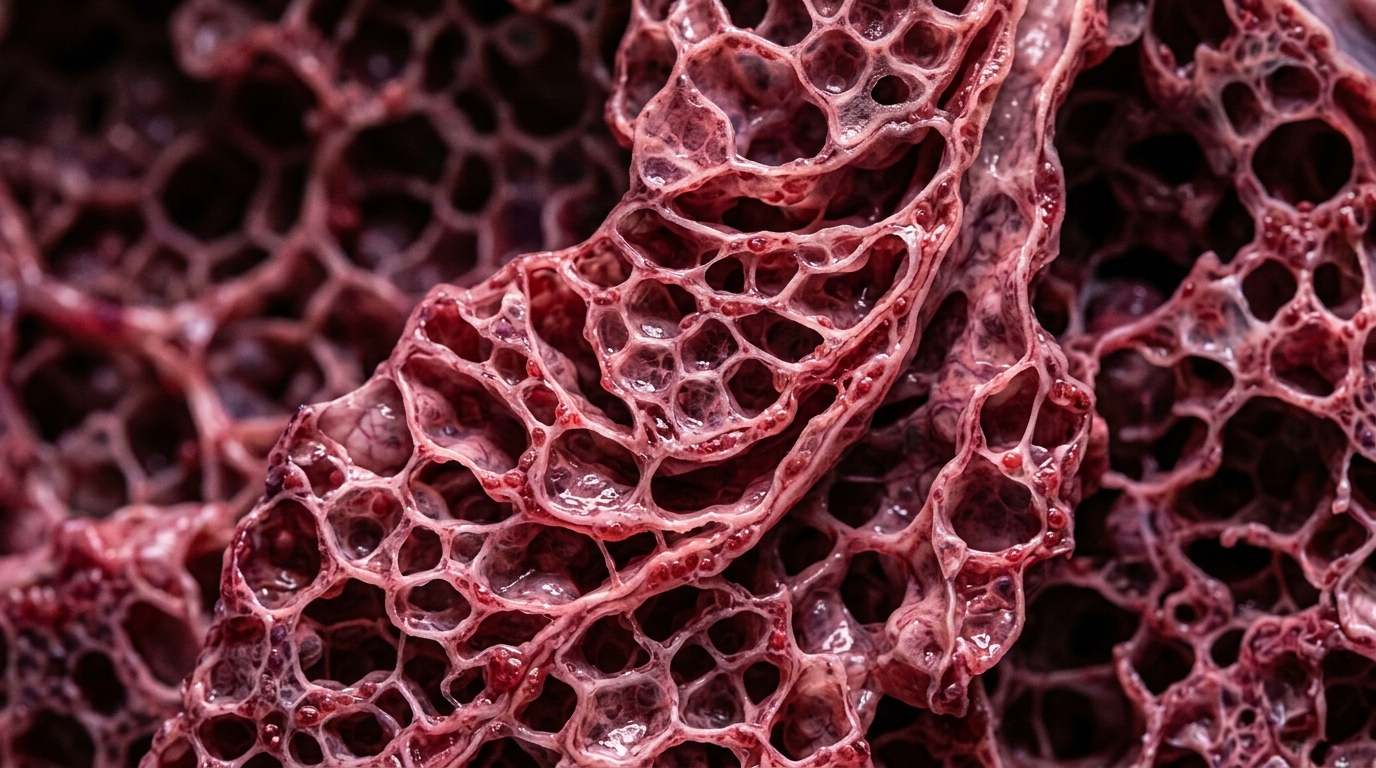
And what if we told you that you’re currently carrying the equivalent of an entire badminton court tucked somewhere between your shoulders? It sounds absurd, almost hard to believe, as the idea defies our most basic intuition. How could an organ confined to a rib cage stretch out a surface the size of a sports field? The answer isn’t found in the size of your lungs, nor in the famed elasticity often, wrongly, credited to this biological marvel. The real secret lies elsewhere, in a craft of astonishing delicacy, shaped by evolution to solve a vital problem: how to bring air into contact with the blood as efficiently as possible, in a space as compact as the chest.
- Lungs contain 300 to 480 million alveoli, and their multiplication creates a gas-exchange surface exceeding 70 square meters
- The alveolo-capillary membrane, barely one micrometer thick, enables near-instantaneous transfer of gases between air and blood
- The surfactant, produced by type 2 pneumocytes, prevents alveolar collapse while occupying only about 35 milliliters in volume
- A badminton court folded inside your thorax
- 300 to 480 million alveoli: the invisible architecture that changes everything
- Not size or elasticity: the real secret of this anatomical folding
- Why this 70-square-meter surface redefines how we breathe
A Badminton Court Folded Inside Your Chest
An official badminton court measures a little over 81 square meters. That is roughly the surface your lungs spread out when laid flat, according to reference estimates from the Universalis Encyclopaedia, which mentions a gas-exchange surface exceeding 70 square meters in an adult. A staggering figure when you compare it to the actual volume these organs occupy in the thorax — barely the size of two large grapefruits assembled together. This apparent mismatch isn’t an anomaly; it is, on the contrary, a feat of biological engineering refined by nature over millions of years.
This apparent paradox becomes clear with a simple logic once understood: the larger the contact surface between air and blood, the more efficient the gas exchanges — oxygen uptake and carbon dioxide release. The human body thus had to find a way to maximize this surface without ballooning the lungs’ volume. The chosen solution approaches architectural genius, as if one managed to fold a vast drapery to fit it inside a small box, without ever creasing or damaging it.
300 to 480 Million Alveoli: The Invisible Architecture That Changes Everything
The key to this puzzle lies in the alveolar sacs, tiny air pockets clustered at the ends of the bronchial branches. Their exact count varies by source and by individual: Universalis cites about 300 million alveoli, while a detailed anatomical study referenced by Kenhub estimates an average of 480 million, with a range from 274 to 790 million depending on the person. This individual variability is fascinating in itself: it means each of us literally possesses a unique pulmonary architecture.
These alveoli are not arranged at random. They organize into functional units called acinus, each acinus containing on average about 1,200 alveoli in humans. It’s a bit like a tree whose leaves, tiny individually, together form a canopy capable of capturing a colossal amount of light. Here, it isn’t sunlight that’s captured, but oxygen molecules, with astonishing efficiency thanks to this enormous multiplication of tiny surface areas.
A theoretical calculation, often cited by sources such as Wikipedia, helps illustrate this phenomenon: starting from 300 million alveoli per lung, i.e. about 600 million in total, and assuming a unit surface area of only 0.125 square millimeters per alveolus, yields a theoretical total surface near 75 square meters. This is how invisible structures, unseen to the naked eye, ultimately recreate, when laid end to end, the equivalent of a full sports field.
Neither Size nor Elasticity: The Real Secret of This Anatomical Folding
One might suppose that the lungs’ ability to expand — their famous elasticity — explains this feat. It isn’t the case. Pulmonary elasticity certainly allows the lungs to swell and deflate with each breath, but it also contributes to maintaining the enormous exchange surface. The true secret lies in extreme miniaturization and multiplication of the exchange units, namely the alveoli themselves.
Each alveolus is separated from the blood in the pulmonary capillaries by an incredibly thin membrane, on the order of a micrometer, i.e., one-thousandth of a millimeter. This barrier, the alveolo-capillary membrane, is so thin that it permits near-instant gas transfer between the inhaled air and the blood. Remarkably, the amount of blood present simultaneously in all these capillaries does not exceed 75 to 100 milliliters, barely half a glass. A tiny volume to irrigate an area so vast.
Another often overlooked detail: the alveoli do not operate in complete isolation. They communicate with each other through tiny openings called Köhn pores, about 3 micrometers in diameter. These microscopic passages help balance pressures within the lung tissue, somewhat like discreet valves that prevent some regions from collapsing while others overextend.
There is also a discreet but essential actor: surfactant, the surface-tension–reducing liquid produced by specialized cells known as type 2 pneumocytes. Without it, the alveoli, due to their minuscule size, would tend to cave in on themselves like a poorly inflated balloon. And the most astonishing part is that this thin liquid layer, which coats the entire 70 square meters of alveolar surface, accounts for only a tiny volume of about 35 milliliters, barely two tablespoons.
Why This 70-Square-Meter Surface Redefines Our Breathing
This outsized architecture isn’t a mere whim of nature; it’s a vital necessity. The human body constantly consumes oxygen to fuel every cell, every organ, every muscle—even at rest. Without this gigantic surface for exchange, it would be simply impossible to absorb enough oxygen to sustain our vital functions, let alone meet increased demands during intense physical exertion.
Understanding this mechanism genuinely reshapes how we view a gesture we repeat thousands of times a day without thinking. Breathing isn’t a trivial act; it results from a cellular architecture of astonishing complexity, capable of fitting an entire sports field into the constrained space of our thorax. This reality invites a kind of vertigo, the realization that our own bodies hide engineering marvels we hardly suspect.
Ultimately, what makes this folding possible isn’t lung size or elasticity, but the near-infinite multiplication of microscopic structures, paired with stabilization mechanisms of surgical precision. The roughly 300 to 480 million alveoli provide an estimated 70 square meters of gas-exchange surface in an adult, a figure that, once known, continues to fascinate.
Next time you take a deep breath, you might think differently about what’s really happening inside your chest. An entire badminton court, folded with incredible precision, working tirelessly to keep you alive. One question remains, however: how many other unsuspected wonders does our own body hide just beneath the surface?
